

Reviewed · WALKING TOURS
Trier: City Walk with Audio Guide in 7 Languages on your Phone
Roman Trier really sticks in your head. This phone-guided audio walk turns key landmarks into short stories, legends, and fun facts, so you can wander with confidence. I like that you can pause, start, and stop whenever you want, which makes a “history walk” feel relaxed instead of rushed. One thing to consider, though: you need your own smartphone, plus GPS and an internet connection, and the narration accuracy can vary by language.
What I love most is how the walk is built for independent travel. You cover about 5.5 km and get 27 stories that explain what you are seeing as you go, from Roman walls to a cathedral tied to major pilgrimage. I also like the practical pacing, you can take breaks, grab a drink, or even keep going the next day. The main drawback is technology stress, bring a charger plan, because low battery or weak GPS can mess with the flow.
If you want Trier in bite-sized scenes, this is a smart, budget-friendly way to do it. Just be ready to walk, plug in your headphones, and follow the route on your screen.
In This Review
- Key highlights that make this walk work
- Price and what you actually get for about $9
- How the audio walk runs on your phone (and where people get stuck)
- Walking route basics: 5.5 km, 27 stories, and plenty of pauses
- Stop 1 focus: Porta Nigra, Roman power you can still touch
- Hauptmarkt: the square that pulls you back for one more look
- Trier Cathedral: the oldest in Germany, with a pilgrimage pulse
- Karl Marx House: ideas on the street where he grew up
- Basilica of Constantine (Aula Palatina): Roman grandeur in a church today
- Who this audio walk suits best (and who may want something else)
- Tech tips that keep the experience smooth
- A note on language and narration quality
- Should you book this Trier city walk?
- FAQ
- Do I need my own smartphone and headphones?
- How long is the Trier city walk?
- What do I need for GPS and audio to work?
- How much walking is involved?
- Is the audio available in multiple languages?
- Is it private, and can I cancel for a full refund?
Key highlights that make this walk work

- 27 story stops that explain what you see, not just a list of facts
- Self-guided control so you can pause, restart, or finish later that day
- Roman to medieval highlights including Porta Nigra, Trier Cathedral, and the Aula Palatina
- GPS navigation with phone-based audio in 7 languages
- Flexible time window because you can finish by the end of the next day
- Good “start anytime” freedom since you are not tied to a group schedule
Price and what you actually get for about $9
At about $9.03 per person, this is the kind of activity that feels like a bargain because it costs less than most guided tours, and you keep the freedom of DIY travel. You are paying for an app, GPS tracking, and audio narration in 7 languages, not for entry tickets to paid attractions.
Most of Trier’s major landmarks are viewable from the outside or in areas where you can simply look, read, and absorb. If you decide to go inside places with admission fees, those are not included, so expect separate costs if you want museum time beyond what you can do for free.
The real value is in the format. Instead of “museum logic,” you get a walk that fits into a morning, afternoon, or slow day with coffee breaks.
More German cities at walking speed:
- Trier: Guided City Walk with Wine Tasting
★ 4.8 · 979 reviews - Trier: Guided Old Town Highlights and History Walking Tour
★ 4.7 · 687 reviews - Trier: City Walking Tour
★ 4.6 · 118 reviews
How the audio walk runs on your phone (and where people get stuck)
This is a private self-guided walk, meaning only your group uses the route. You activate it using instructions sent by email, and the audio follows your location through GPS guidance.
Two practical requirements matter a lot:
- You need a smartphone and headphones of your own.
- You need internet connection and GPS working on your phone.
Plan for battery like it is part of the itinerary. The walk is only 2 to 3 hours in typical use, but you also have until the end of the next day to finish, so it is easy to accidentally stretch your listening time. I suggest charging your phone fully or packing a power bank, especially if you are also using maps or looking up details.
One more thing: if you book with more than one phone in your group, you may want to keep them close together for the audio to stay reliable. If you want someone to go off solo a few minutes, you might find the system prefers the phones to stay together.
Walking route basics: 5.5 km, 27 stories, and plenty of pauses
Think of this as a guided stroll with story chapters. The route covers about 5.5 km, and the app tells 27 stories tied to the sights you pass.
You are not forced into a strict walking cadence. You can typically pause and resume whenever you want, which is perfect when a cathedral draws your attention longer than expected, or when you stop for a snack.
You also have an extended finishing window. Even though the average duration is 2 to 3 hours, you can keep going until the end of the next day. That means bad weather does not instantly ruin the plan, and it is also handy if you want to tack on a museum visit afterward.
Stop 1 focus: Porta Nigra, Roman power you can still touch

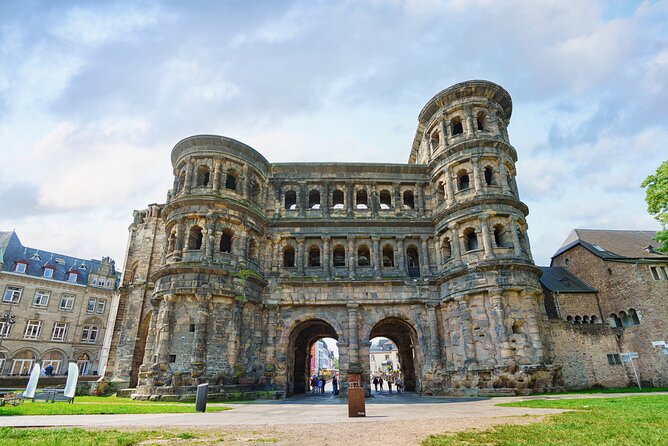
The walk’s Roman cornerstone is Porta Nigra, a well-preserved city gate from the 2nd century AD. It was originally a defensive structure made from massive stone blocks, and today it is one of Trier’s signature sights and a UNESCO World Heritage site.
This is the perfect opening stop because it frames Trier’s identity fast. Instead of starting with a “church first” approach, you begin with Roman infrastructure that still looks sturdy, heavy, and real.
What I like about having audio here is simple: you do not just see the stones, you learn what the gate was built to do. And since Porta Nigra is so iconic, the story gives you something to look for in the next scenes.
Practical tip: Porta Nigra is easiest to appreciate when you walk around it slowly, not when you just snap a photo and keep moving.
Hauptmarkt: the square that pulls you back for one more look
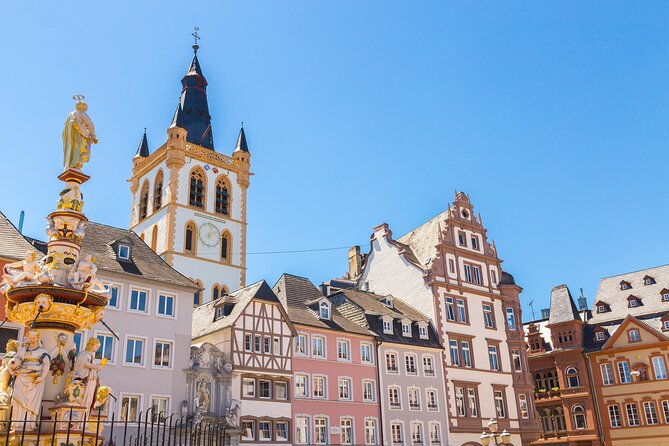
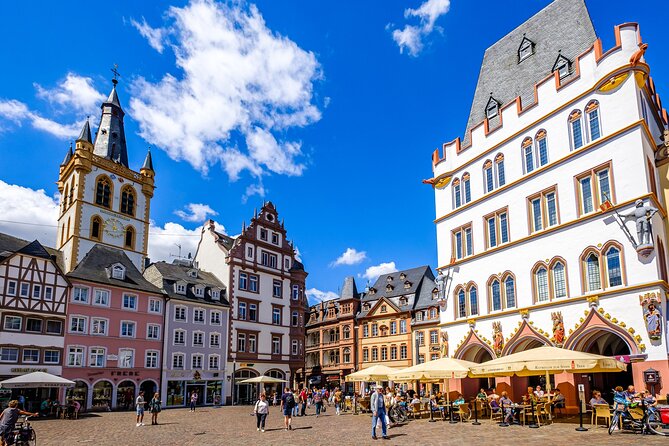
Next up is the Hauptmarkt, Trier’s central square and one of Germany’s oldest market places. The surrounding buildings include colorful half-timbered houses, and two standouts mentioned in the narration are St. Gangolf Church and the Roman Fountain.
This stop works because squares are where cities reveal daily life. Even if you came for ancient walls, Hauptmarkt reminds you that Trier is still a working town, not an outdoor museum.
The narration also helps you spot details on your own. Rather than feeling lost in architecture, you get a mental checklist: the church, the fountain, and the historic shape of the square.
If you like to snack and people-watch, this is a smart place for a break during your 2 to 3 hour window.
Also holding a platform in Trier




Trier Cathedral: the oldest in Germany, with a pilgrimage pulse
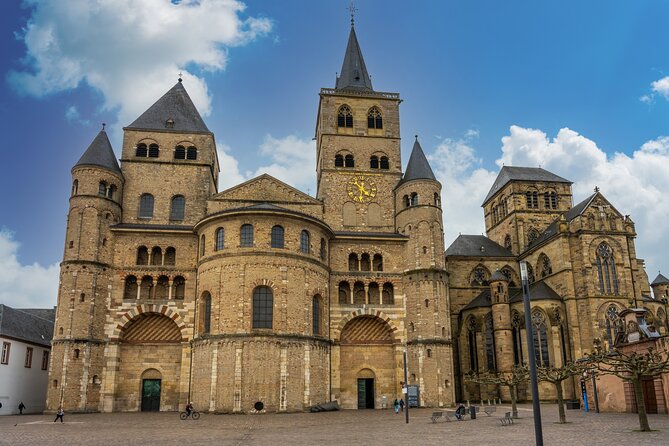
The audio walk highlights the Cathedral of Saint Peter, known as Trier Cathedral, as the oldest cathedral in Germany. Construction began in the 4th century under Emperor Constantine, and over time it expanded and changed styles, so you get a layered feel instead of one uniform look.
The cathedral is also a UNESCO World Heritage site, and the stories go further by mentioning its significant relic tradition, including the Holy Robe, believed to be the tunic worn by Jesus Christ. That detail matters because it helps explain why Trier Cathedral is not only architecturally impressive, it also has real pilgrimage weight.
What to expect on the ground: this is the stop where you naturally slow down. Even if you do not go inside, the exterior and its setting feel serious and historic. With audio guiding you, you get context fast enough to make your visit feel intentional, not like you are just passing by something famous.
Karl Marx House: ideas on the street where he grew up
If your itinerary includes one “19th-century Europe” anchor, the app’s stop at the Karl Marx House does that job. It is described as the philosopher and revolutionary socialist’s birthplace and childhood home, now turned into a museum devoted to his life and work.
The narration points to what the museum emphasizes, including original documents, photographs, and exhibits that explain Marx’s contributions and the historical context of his time.
Even if you do not head into the museum, this stop gives Trier a different kind of depth. You get a city that has Roman emperors, yes, but also world-changing thinkers from much later centuries.
Practical note: museum hours are not part of the audio story, so if you want ticketed time, you will need to plan your timing around what is open.
Basilica of Constantine (Aula Palatina): Roman grandeur in a church today
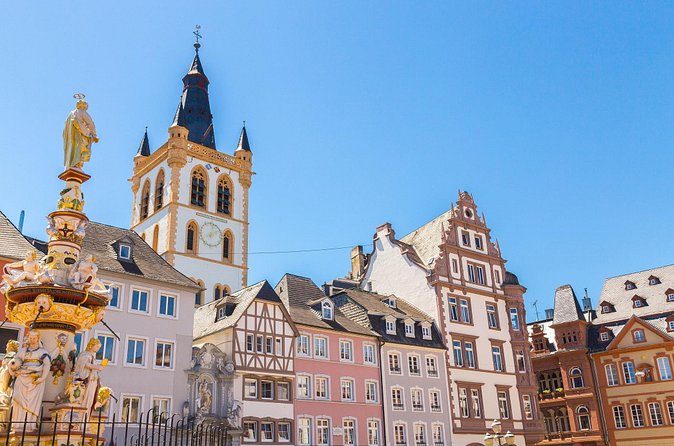
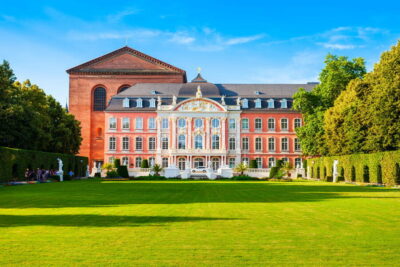
Another major highlight is the Basilica of Constantine, also called the Aula Palatina. The walk places it in Trier and describes it as a Roman palace basilica built in the early 4th century during the reign of Constantine the Great.
The app frames it as an emperor’s audience hall inside a larger palace complex. Architecturally, it is noted for its impressive rectangular hall and a high, flat wooden ceiling. Today, it is used as a Protestant church, and it is said to remain one of the best-preserved examples of Roman architecture in the region.
This stop is the one that tends to surprise people. It is Roman structure, but it is also still in active use. The narration helps you “read” the building, not just stand and look.
If you like to compare past and present, you will probably spend extra time here, since the shift from palace hall to church is the kind of continuity that makes old places feel human.
Who this audio walk suits best (and who may want something else)
This is a great match for independent travelers who like to set their own pace. If you do not want to join a fixed group schedule, and you enjoy learning through short, story-driven segments, you will likely find this format satisfying.
It also works well if you are tight on budget. For the price, you get a guided narrative experience without paying for a human guide.
It may be less ideal if you:
- Hate phone-based navigation or struggle with GPS on your device.
- Want guaranteed, perfect translations every time, because language quality can be uneven by narration file.
- Prefer to walk far apart from your travel partner while sharing the same tour setup, since the system may expect phones to stay together for reliable audio progression.
Tech tips that keep the experience smooth
Here are the fixes I would treat as non-negotiable before you start.
First, bring headphones and test them early. If sound is choppy, that becomes the whole mood of the walk.
Second, plan battery. If multiple phones are involved, pick the device that has the most battery as the likely “anchor” for the route, because if the main device runs out, you can end up losing audio progression accuracy for the others.
Third, stay near the waypoints. GPS narration depends on your proximity, so if you drift a block away to take photos, you might notice the story does not switch as expected.
Finally, be aware that the narration can feel computer-translated in some lines. If something sounds off, you can always cross-check by looking at the actual landmark name and context around you.
A note on language and narration quality
The tour offers audio in 7 languages and English is available. That’s a big plus if you are not fluent in German, because it turns signage and architecture into something you can understand right away.
Still, audio quality is not always consistent. On some recordings, translations may sound awkward or inaccurate in specific references. If you care deeply about exact wording, consider switching to a different language option in the app, if available, or be prepared to rely on what you see around you.
This is less about the landmark facts and more about how the narration frames them.
Should you book this Trier city walk?
Book it if you want a budget-friendly way to connect Trier’s top sights with short stories, and you like the freedom to walk slowly, take breaks, and keep the plan flexible across weather or schedule changes. The 27 stories and the 5.5 km route size are ideal for first-time Trier visitors who want meaning without a rigid tour structure.
Skip it or consider a different option if you hate relying on your phone, you do not want to manage internet and GPS, or you want a traditional guided experience with a human who can adapt on the spot.
If you are comfortable with tech and want Trier to feel personal and doable, this one is a strong choice. Charge your phone, pack headphones, and give yourself time to linger at Porta Nigra and Trier Cathedral, because those two stops set the tone for the whole city.
FAQ
Do I need my own smartphone and headphones?
Yes. The tour includes the app with audio and GPS guidance, but you must bring a smartphone and headphones.
How long is the Trier city walk?
The average duration is about 2 to 3 hours. You also have until the end of the next day to finish the route.
What do I need for GPS and audio to work?
You need an internet connection and GPS function on your phone, and the tour requires you to use the phone-based audio guide.
How much walking is involved?
You’ll walk about 5.5 km total, with 27 stories told along the route.
Is the audio available in multiple languages?
Yes. The audio guide is available in 7 languages on your phone, and English is offered.
Is it private, and can I cancel for a full refund?
It is private for your group only. Free cancellation is available up to 24 hours in advance for a full refund.
More Self-Guided Tours in Trier
- Trier Self Guided Sherlock Holmes Murder Mystery Game
★ 4.0 · 9 reviews - Dortmund: BVB Self-Guided Stadium Walk
★ 4.5 · 3,195 reviews - Hamburg: Scavenger Hunt Self-Guided Tour for Children
★ 4.5 · 319 reviews - Spicy’s Gewürzmuseum Entry Ticket and Audio Guide
★ 4.3 · 203 reviews
Fresh on the arrivals board for Trier




Walking Tours, compared.

Berlin City walk Government District and Places of Democracy
Read our review →



Berlin’s Best: 2 Hour Walking Tour Third Reich and the Cold War
Read our review →
Browse the lists this tour appears in