
Reviewed · THIRD REICH & WORLD WAR II TOURS
Nuremberg WWII Tour, Courtroom 600 and 3rd Reich Sites
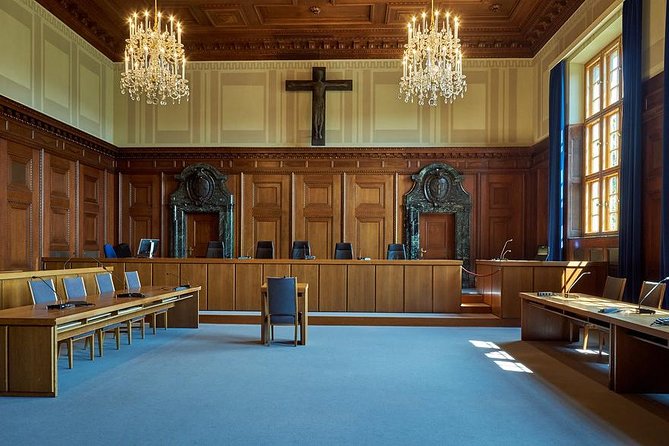
Nuremberg hits hard, even before you enter the courtroom. This half-to-full day tour is built for people who want the Nazi Party rally grounds and Nuremberg Trials stories connected, with a guide in a small private vehicle who can answer questions as you go. I like that it saves you from map-chasing and parking puzzles, and I like the focus on why these sites mattered. One thing to consider: Courtroom 600 access has extra variables, including Palace of Justice closure on Tuesdays and a separate entrance fee, so you should plan your expectations around timing.
If you care about how the Third Reich worked and how international law responded afterward, this tour is the kind of route that makes the history feel less like dates in a book and more like a chain of decisions. You’ll spend meaningful time outdoors at places like Zeppelinfeld and the Hall of Honour, then finish with the Nuremberg Palace of Justice area tied to the Major War Criminals Trial. A possible drawback is that English narration quality can vary by guide and accent, so if you’re a tough listener, ask questions early and don’t be shy about requesting slower pacing.
In This Review
- Key highlights worth planning around
- A private Nuremberg WWII tour with room for questions
- Hall of Honour: Speer’s scale, Brugmann’s execution, and why it mattered
- Kongresshalle Nürnberg: the documentation center angle you shouldn’t skip
- Zeppelinfeld: grandstand geometry, 1909 Zeppelin landings, and 1945 symbolism
- Courtroom 600 at the Palace of Justice: the most powerful stop, with timing caveats
- What makes the guide-led format worth paying for
- Price and ticket costs: what the €7.50 and extra admission change
- Logistics that can make or break a smooth day
- Who should book this Nuremberg WWII tour
- Should you book? My practical take
- FAQ
- How long is the tour?
- What’s included in the price?
- What extra ticket costs should I expect?
- Is Courtroom 600 always available?
- Where does pickup happen?
- How big is the group?
- What language is the tour offered in?
- Is there a mobile ticket?
- Can I cancel for a full refund?
Key highlights worth planning around
- Private vehicle, max 8 people means you can ask real questions without feeling like you’re yelling over a busload.
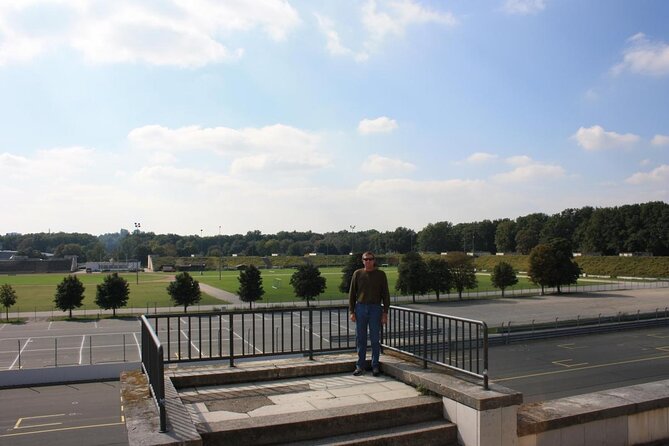
- Nazi rally grounds loop gives you the physical “stage set” behind the propaganda, from Speer-designed spaces to Speer-inspired grandstands.
- Zeppelinfeld details include the 360-metre grandstand width and the symbolic moment in 1945 when the swastika was removed.
- Courtroom 600 context first, then courtroom helps you understand what you’re looking at, instead of getting history dumped on you at the end.
- Tickets split out clearly, with the Palace of Justice entrance (including Courtroom 600) not included, plus the Kongresshalle portion also not included.
- Guides like Rob and Seba are singled out for fast, story-driven explanations and strong fact grounding.
A private Nuremberg WWII tour with room for questions
Nuremberg is one of those rare German cities where modern streets sit right beside Nazi-era architecture and then, shortly after, the machinery of accountability. What makes this tour work is the order and the pacing: you start at the monumental spaces tied to the NSDAP rallies, then you move toward the documentation and the trial setting. It’s not just sightseeing. It’s a guided reading of place.
The format matters. With a small group of up to eight and private transport, you get a guide who can react to what you’re curious about. That sounds simple, but it changes everything. Standard city tours often keep you on rails. Here, you can ask follow-ups, and the guide can connect a detail you saw outside to what happened later in the trial process.
There’s also a very practical benefit: you’re not doing map math between large open-air sites and museum buildings. Nuremberg’s rally grounds complex covers serious distance, and the “time sink” on self-guided days is getting around efficiently and then trying to make sense of what you’re seeing. This tour hands you that structure.
Further Third Reich and wartime history tours:
- Nuremberg: Walking Tour of Former Nazi Party Rally Grounds
★ 4.7 · 1,665 reviews - Nuremberg: Historischer Kunstbunker WWII Art Bunker Tour
★ 4.8 · 921 reviews - Nuremberg Old Town and Nazi Party Rally Grounds Walking Tour in English
★ 4.5 · 504 reviews
Hall of Honour: Speer’s scale, Brugmann’s execution, and why it mattered
Your first stop is the Hall of Honour, part of the Nazi Party Rally Grounds area in the southeast of Nuremberg. This is the kind of site where you feel the design before you understand the intent. You get about an hour here, and it’s a big open space tied to rally ceremony and political theater.
What I like about starting here is that you learn how the regime tried to manufacture awe. The basic concept is attributed to Albert Speer, with Walter Brugmann handling the detailed work and implementation. The complex is massive, covering over 16.5 km², so even if you only visit a portion, you’re seeing how the Nazis planned for large crowds and carefully controlled sightlines.
This is also a stop that’s free of ticket cost. That makes it a good “invest first” location because you get time to absorb it without adding money. One consideration: because it’s mostly outdoors, you’ll want to dress for Nuremberg weather. On rainy days, you’ll still be able to walk and see the main points, but you might move a bit faster for comfort and photo opportunities.
Kongresshalle Nürnberg: the documentation center angle you shouldn’t skip
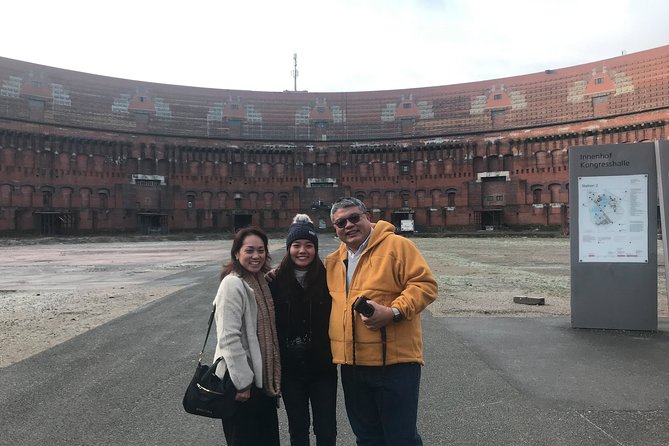
Next is the Kongresshalle Nürnberg, tied to the Nazi party rally infrastructure between 1933 and 1938. On paper, it can sound like another building stop. In practice, this one is valuable because it shifts you from “ceremony and design” toward “how it was produced,” documented, and preserved.
This visit is about 40 minutes, and it’s the one place where the admission ticket is not included. So budget for it separately. The good news is that the site remains carry that immediate sense of organized propaganda. You can stand in what’s left and understand how the regime wanted crowds to feel they were part of something inevitable and massive.
I also like that this stop gives you context before Courtroom 600. You start to see how the Nazis built legitimacy through spectacle and structure. Then later, you’re guided toward the trial setting where legitimacy is examined in a totally different way.
Zeppelinfeld: grandstand geometry, 1909 Zeppelin landings, and 1945 symbolism
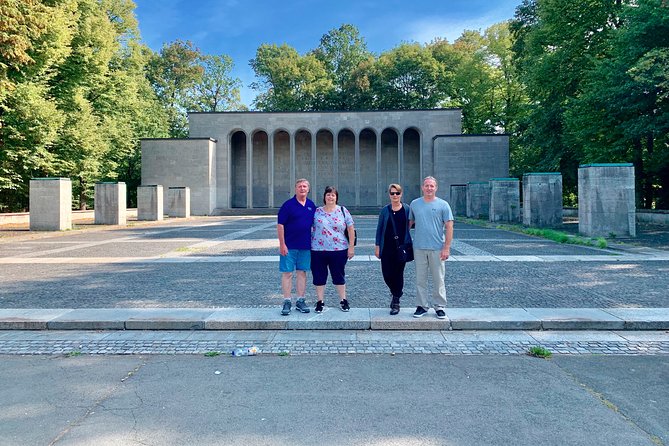
Then you head to Zeppelinfeld, east of the Great Road. Expect about 30 minutes here, and it’s another free stop. This is one of the most “photographable” sites in the route because the grandstand design creates strong lines, and it’s easier to imagine the crowds and stage management.
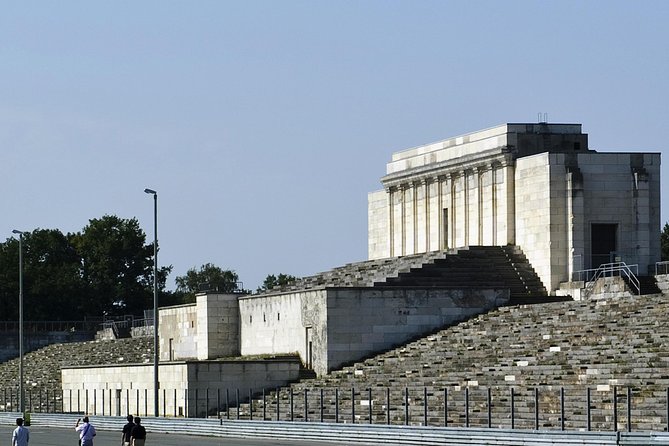
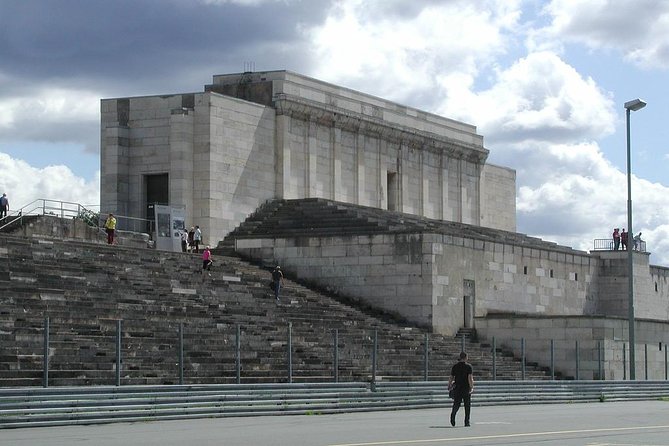
A few details make Zeppelinfeld more than just an outdoor ruin. The grandstand, called the Zeppelinhaupttribüne, stretches 360 metres wide. There’s also a smaller stand. The design is described as one of Speer’s early Nazi-party works and is based on the Pergamon Altar, tying Nazi monumental ambition to older classical references.
The architecture even has a credit for the inspiration behind the square piers, inspired by work by Paul Philippe Cret, a Franco-American architect. That kind of specificity helps your brain lock onto details instead of feeling lost in generic “Nazi site” impressions.
And then there’s the symbol and the year. Zeppelinfeld is famous for the moment in 1945 when the swastika was blown off the top of the grandstand after Germany’s fall in World War II. Standing there, you can see why this was built for spectacle, and why its symbols were later treated as evidence of crimes, not decoration.
Finally, the name itself carries a surprising layer. Zeppelinfeld (also known as Zeppelinwiese) refers to the fact that in August 1909, Ferdinand Graf von Zeppelin landed with an airship (LZ6) in this location. That’s a reminder that the ground had meaning before it became part of the Nazi rally machine.
Courtroom 600 at the Palace of Justice: the most powerful stop, with timing caveats
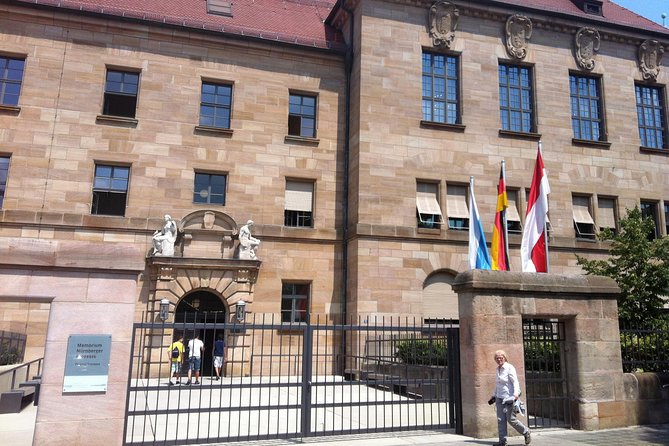
The tour’s final act is the Nuremberg Palace of Justice, tied to the Major War Criminals Trial held at the International Military Tribunal from November 20, 1945 to October 1, 1946. This is where Courtroom 600 became internationally known.
In the schedule, you should plan for about 30 minutes at the Palace of Justice area tied to Courtroom 600, and the guide typically shapes the visit so the courtroom matters, not just the building exterior. The Palace of Justice ticket is not included, and the entrance fee listed is €7.50 per person. Also, the Palace of Justice is closed on Tuesdays. That’s a hard stop you should check if your travel plans land on a Tuesday.
One more timing reality: the courtroom portion can feel tight. Some departures report around 35 to 40 minutes in the Courtroom 600 area, but there’s also been at least one situation where the courtroom exhibit availability affected what people could see and how long they got. So I’d treat this stop as “plan for the experience, not for a perfect amount of time.” If you’re the type who wants to read every panel slowly, you might need extra time on your own after the tour, or you might simply accept that this visit is a guided orientation to courtroom history rather than a full museum session.
If it helps your planning, your guide ends with guidance for getting back to your hotel area. Since the courtroom stop is the final point, you won’t be split off into endless free time while you’re trying to navigate public transit afterward.
Also holding a platform in Nuremberg
What makes the guide-led format worth paying for
Let’s talk money, since this is not a cheap add-on. At $160.90 per person for roughly 4 hours, the value only works if you actually want what a small private tour buys you: control, context, and conversation.
Here’s what you’re getting that you can’t easily replicate with just buying tickets:
- Private transport just for your group. This matters around the rally grounds where distances are large and the “walk and figure it out” plan costs time.
- A guide who knows how to connect the dots as you move. Instead of reading every sign alone, you get a guided narrative that connects the design of propaganda spaces to what the trials tried to judge.
- A chance to ask questions in real time, which is exactly what you want in a topic like this. When a detail feels unsettling or confusing, you don’t want to wait until later.
The guide factor comes through in the names that repeatedly show up: Rob and Seba are mentioned as guides who make the story work through energy and strong explanations. A small number of people found the pace fast or the accent hard to follow, including one mention of difficulty understanding due to accent. That’s not a dealbreaker, but it’s why I’d recommend you speak up right away if you’re struggling. Ask them to slow down or repeat a key point.
Also, there’s an important emotional angle. Places tied to Nazi propaganda and wartime crimes are heavy. You want a guide who can keep it factual and respectful. The best departures are the ones where the commentary stays grounded, doesn’t sugarcoat, and still helps you make sense of how international law and trials fit into the post-war world.
Price and ticket costs: what the €7.50 and extra admission change
The $160.90 price covers the tour guide and private transport, plus a mobile ticket for the tour itself. What’s not included are the site admissions where the listed fees apply: the Palace of Justice entrance at €7.50 per person and the Kongresshalle documentation center admission.
That split is actually useful. It means you can plan your total cost without surprises, as long as you budget the extra admissions in your head. If you’re traveling as a couple, a small group, or with family members who care deeply about the Courtroom 600 part, those extra ticket costs are easier to justify because that stop is the emotional and historical centerpiece.
Value depends on your priorities. If you just want a quick overview and you’re happy with a self-guided route, you may find cheaper options. If you want the story structured and explained, with real-time answers and a compact route that hits the major Third Reich sites in a sensible order, paying for the guided format starts to make sense quickly.
Logistics that can make or break a smooth day
This tour offers pickup in the Nuremberg Old Town and from the River Cruise Port. If your hotel is outside the Old Town, you’ll need to go to the pickup point at Novotel Hotel Centre Ville, Bahnhofstrasse 12.
That matters more than people think. When you’re dealing with tight time windows and multiple stops, being late to pickup can compress everything. I’d plan to arrive at the pickup location early, especially if you’re on a cruise or using a ship’s shuttle system that can be unpredictable.
Dress matters too. Even though the most “indoor” stop is the Palace of Justice area, much of the route is outdoors, including Hall of Honour and Zeppelinfeld. Pack a warm layer and a rain jacket. You’ll thank yourself when you’re waiting in open-air spaces or taking photos.
And one last practical tip: with a tour that focuses on complex and painful subject matter, it’s okay to bring a notebook or phone for key dates. You might want to jot down questions as they come, because you’ll get the best answers while you’re still looking at the relevant place.
Who should book this Nuremberg WWII tour
Book this if you:
- Want the Nazi Party rally sites and the Nuremberg Trials connected by a guide’s narrative.
- Like small-group tours where you can ask questions rather than just follow a headset script.
- Care about international law and how the post-war world framed accountability.
Consider another option if you:
- Only want a light overview and are happy doing museum and outdoor sites on your own pace.
- Need a very slow, panel-by-panel reading time in the Courtroom 600 area, because the schedule is built for a shorter guided stop.
If you’re a history buff, an architecture nerd, or someone trying to understand how propaganda spaces worked and how trials responded, this is a strong fit.
Should you book? My practical take
Yes, I’d book it if you want a structured route through Nuremberg’s most important WWII and Third Reich landmarks, with private transport and a guide who can explain what you’re seeing. The strongest part is the way the tour connects the physical propaganda world to the courtroom world, so your learning has a spine, not just scattered facts.
The only real caution is time and access at the Palace of Justice. With Tuesday closure and extra entrance cost, double-check your day and budget for the €7.50 entry. If you do that, you’ll get a meaningful, thought-provoking half-day in one efficient shot, without spending your precious Nuremberg time trying to figure out where to go next.
FAQ
How long is the tour?
It runs about 4 hours.
What’s included in the price?
The tour includes private transport and a tour guide.
What extra ticket costs should I expect?
The Nuremberg Palace of Justice entrance fee is €7.50 per person, and the Kongresshalle admission ticket is not included.
Is Courtroom 600 always available?
The Palace of Justice is closed on Tuesdays, so Courtroom 600 would not be available on those days.
Where does pickup happen?
Pickup is offered in the Nuremberg Old Town and at the River Cruise Port. If your hotel is outside the Old Town, you go to Novotel Hotel Centre Ville, Bahnhofstrasse 12.
How big is the group?
The tour has a maximum of 8 travelers.
What language is the tour offered in?
The tour is offered in English.
Is there a mobile ticket?
Yes, a mobile ticket is included.
Can I cancel for a full refund?
Yes, you can cancel up to 24 hours in advance for a full refund.
Fresh on the arrivals board for Nuremberg
Third Reich & World War II Tours, compared.

Berlin’s Best: 2 Hour Walking Tour Third Reich and the Cold War
Read our review →
Third Reich Berlin: Hitler and WWII Walking Tour
Read our review →
Walking Tour of Former Nazi Party Rally Grounds
Read our review →
Browse the lists this tour appears in