
Reviewed · THIRD REICH & WORLD WAR II TOURS
Nuremberg Oldtown and Third Reich Private Tour
Medieval Nuremberg, then the darker shadow of the 1930s. This private tour stitches together the city’s best landmarks with the Third Reich sites, and you move at your private pace with a local guide.
I love the way the tour builds in real time for questions and stops you can linger in, including church interiors like St. Sebaldus. Most stops are free, but the Nazi-era sections are heavy, so plan to take breaks and bring the right headspace.
In This Review
- Key Highlights You Will Actually Care About
- Starting at Schöner Brunnen, and Why Orientation Matters
- Altstadt Highlights: Castle Views, Churches to Linger In
- Kaiserburg Nuremberg: The City’s Triple Castle Complex
- Hauptmarkt: The Beautiful Fountain, Church of Our Lady, and Männleinslaufen
- Albrecht-Dürer House: Medieval Home to Renaissance Workbench
- Weissgerbergasse: Craftsmen’s Lane and the Shadow of WWII
- Hangman’s Bridge and the Henkerhaus Museum
- City Walls of Nuremberg: Defense, Scale, and Walkable Sections
- St. Sebaldus Church: Gothic Detail and the Veit Stoss Altar
- From Old Town to the Third Reich: Nazi Party Rally Grounds
- Nuremberg Trials Site: Memorium Nuremberg Trials and the Museum Ticket Choice
- Price, Time, and What You’re Really Paying For
- Who This Tour Fits Best
- Should You Book This Nuremberg Old Town and Third Reich Tour?
- FAQ
- How long is the Nuremberg Old Town and Third Reich private tour?
- Is the tour offered in English?
- Where does the tour start?
- Is pickup available?
- Are there entrance fees for the stops?
- Is the tour walking-heavy?
- Can I cancel and get a full refund?
Key Highlights You Will Actually Care About
- Andreas leads with real Q and A time, and he adjusts as your group asks more.
- You hit the core Old Town sights in one organized walk, from Kaiserburg views to Hauptmarkt details.
- You connect medieval Nuremberg to the 1930s propaganda sites, instead of treating them like random history stops.
- Many entrances are free, so your main add-on is the Nuremberg Trials museum.
- The guide points out how sites were used and rebuilt, helping you see continuity and change in one day.
Starting at Schöner Brunnen, and Why Orientation Matters
You meet at Schöner Brunnen in Hauptmarkt, the natural heart of Nuremberg’s Old Town. Even if it’s your first time in the city, this start makes sense because you’re immediately positioned for the castle, churches, and the big squares nearby.
What I like is that this is a private setup, so you are not stuck with a rigid group script. You can ask questions early, and you can also ask for a slower pace when the streets turn into a maze of half-timbered lanes and small corners that beg for context.
Also, you can pick up the tour approach quickly. You learn what to look for, why it mattered, and how Nuremberg’s medieval layout connects to later events. That kind of orientation saves you from wandering afterward with a phone map and half-understood landmarks.
Further Third Reich and wartime history tours:
- Nuremberg: Walking Tour of Former Nazi Party Rally Grounds
★ 4.7 · 1,665 reviews - Nuremberg: Historischer Kunstbunker WWII Art Bunker Tour
★ 4.8 · 921 reviews - Nuremberg Old Town and Nazi Party Rally Grounds Walking Tour in English
★ 4.5 · 504 reviews
Altstadt Highlights: Castle Views, Churches to Linger In
Your first stretch is the Altstadt, Nuremberg’s Old Town. This is where the city feels most medieval, with stone facades, church spires, and winding alleys that make you slow down without trying.
One practical win: the tour is flexible about short pauses, and I’ve seen how that flexibility pays off. If you want a moment inside a church, you get it. If you want to ask something, you get time. That matters in a city like Nuremberg, because the “why” behind the sights is often the best part.
You also get major landmarks in a logical order. Instead of hearing ten names and forgetting them, you see them in place: the old street patterns, the religious sites, and the civic squares. The guide helps you connect the dots so the Old Town feels like a single story, not a collection of postcards.
Tip for your comfort: wear shoes you trust for steady walking. The route is designed for touring on foot, and the tour pace expects you to be reasonably mobile.
Kaiserburg Nuremberg: The City’s Triple Castle Complex
Next comes Kaiserburg Nurnberg, Nuremberg Castle, and it’s a defining moment. This castle is described as a triple castle, made up of the Imperial Castle, the Burgraves’ Castle, and the buildings of the Imperial City.
Why this stop works on a private tour is simple: you see the layers without having to figure out where each part begins. You’re not just looking at walls from a distance. You’re getting the big picture so the castle stops being one landmark and starts being a whole system.
It’s also a great viewpoint stop. You’ll get a sense of how Nuremberg was organized and defended, and the guide’s explanations help you notice what you might otherwise miss, like how different buildings relate to the city below.
Hauptmarkt: The Beautiful Fountain, Church of Our Lady, and Männleinslaufen
At Hauptmarkt, you’re in the center of the Old Town action. This square is where major civic life happened, and it still feels like a focal point when you stand there with the guide’s map of the area in mind.
The tour calls out the highlights in a smart way: the Beautiful Fountain, the Church of Our Lady, and the standout clockwork show called Männleinslaufen. If clocks and symbolic displays are your thing, this is the moment you’ll appreciate most because it’s not just a building. It’s a time-based tradition in a real public space.
The best part is that the guide ties these sights to what people used to do here. That turns Hauptmarkt from a pretty square into a place that makes sense in daily life.
Albrecht-Dürer House: Medieval Home to Renaissance Workbench
Then it’s off to the Albrecht Dürer House, a medieval residence built around 1420. What makes the stop valuable is the timeline built into the story: the house got its current look through renovations led by Bernhard Walther after 1500, and it served as Dürer’s home and workplace from 1509 until his death in 1528.
If you care about art history, you’ll appreciate how grounded this is. You are not learning Dürer as an abstract genius. You’re seeing where he worked and how that life fit into the city.
Even if you are not an art obsessive, this is a strong stop because it shows how Nuremberg produced talent, not just buildings. It also helps explain why Nuremberg is considered important beyond being a pretty medieval center.
Also holding a platform in Nuremberg
Weissgerbergasse: Craftsmen’s Lane and the Shadow of WWII
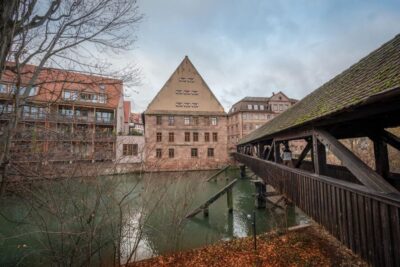
Weissgerbergasse is one of those lanes that feels designed for slow strolling. It’s known as Nuremberg’s most beautiful craftsmen’s lane, and the tour uses it to explain what happened during and after World War II.
This stop matters because it doesn’t let the city be only medieval or only historical. It forces you to face the fact of destruction, then reconstruction, then living with what was lost. You’re looking at craftsmanship shaped by both time and trauma.
If you like walking through a place and understanding why it looks the way it does, you’ll probably enjoy this part a lot. It’s a reminder that history has edits, not just footnotes.
Hangman’s Bridge and the Henkerhaus Museum
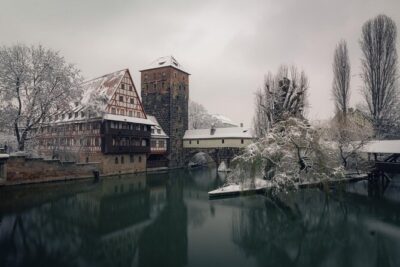
The tour moves to the Hangman’s Bridge area and the Henkerhaus, the Executioner’s House on the Pegnitz River. This building served as both the home and workplace of the city’s executioner in the Middle Ages.
What makes this stop unusual is that it’s not only about crime as spectacle. The museum focuses on life, justice, and the social isolation executioners faced. That angle helps you understand medieval morality as a lived system, not just a list of punishments.
The setting along the river adds atmosphere too. It’s the kind of stop where you naturally look around more than you would in a more formal museum space.
If you’re traveling with kids, this can be a surprisingly good education stop, as long as your family is comfortable with the topic. It’s framed as history and justice, not entertainment.
City Walls of Nuremberg: Defense, Scale, and Walkable Sections
Next up is the city walls. These are among the best-preserved medieval fortifications in Europe, built between the 12th and 16th centuries. The tour gives you the key scale too, noting they once stretched over 5 kilometers and included towers, gates, and a moat.
What I love here is that you get to see defense as architecture and planning. It’s not theory. You’re standing near the remains and learning what the walls actually did for the city.
Because large sections can still be walked today, this stop can give you views without needing a big climb or modern tourist infrastructure. You can get your bearings and feel the shape of the Old Town as a contained space built for protection.
St. Sebaldus Church: Gothic Detail and the Veit Stoss Altar
At St. Sebaldus Church, the atmosphere shifts. This is one of Nuremberg’s oldest and most important medieval churches, dedicated to the patron saint St. Sebald.
The tour highlights Gothic architecture and richly decorated interiors, and it calls out a major artwork: the impressive altar by Veit Stoss. Even if you only spend a short time inside, this stop gives you something immediate, like carvings you can actually see and interpret with the guide’s help.
This is also the kind of stop where the private nature of the tour makes a difference. If you want to take extra time, you can. If you prefer quiet reflection, this is a good place to do it.
A practical note: churches often reward slower looking. Bring patience, and don’t rush your photos.
From Old Town to the Third Reich: Nazi Party Rally Grounds
Then you move from the medieval city to something far darker, the Documentation Center Nazi Party Rally Grounds. This former site is the vast area of the Reichsparteitagsgelände, where Nazi Party rallies were held in the 1930s.
Here’s what the tour does well for your understanding: it doesn’t treat the site as a spooky backdrop. It explains the monumental architecture built to show Nazi power and propaganda, and then points you toward what exists today, parts serving as a documentation center and museum.
That makes the visit educational in a careful way. You see how architecture, mass gatherings, and messaging can work together, and you understand why totalitarianism is not only a political system but also a designed experience.
This part can feel heavy and draining. If you get overwhelmed, tell the guide. A good private tour should let you slow down, even for a few minutes.
Nuremberg Trials Site: Memorium Nuremberg Trials and the Museum Ticket Choice
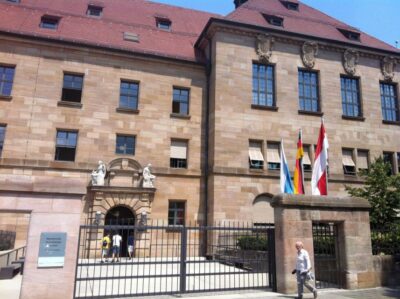
The tour can end at the Memorium Nuremberg Trials area, tied to the Nuremberg Trials held between 1945 and 1946. The tour context is direct: it was a series of military tribunals prosecuting prominent Nazi leaders for war crimes, held in the Palace of Justice.
This stop is valuable because it connects the horrors of the Holocaust and the war to the legal aftermath. It also helps you understand why these trials mattered for international law and justice.
There is one practical detail you should know in advance: the stop includes time on site, and entry to the museum is not included, though the guide can help with tickets if you want to go inside. If you skip the museum, you can still get the orientation and context from the guide and finish with a clear idea of what happened next.
If you do add the museum, plan for extra time and keep your pace gentle. This is not a “quick photo and go” area.
Price, Time, and What You’re Really Paying For
The tour costs $66.23 per person, and it runs about 2 to 5 hours. That range matters because you are not just buying a route, you’re buying a flexible guide and time at each stop.
When the itinerary includes many free admissions, you get a lot more value than tours that nickel and dime every doorway. Your main added cost risk is the optional trials museum ticket, since that is noted as not included.
This is also a strong value if you care about depth. The tour is private, so you’re not competing for the guide’s attention. In reviews from this experience, the guide is repeatedly praised for being flexible, answering questions, and adapting to what the group wants, including families with kids.
One more value angle: a guide who helps you understand what you’re seeing means you spend less time later trying to reconstruct the story on your own. You get a coherent flow from medieval roots to Third Reich propaganda sites, which is exactly what makes the tour different from a standard Old Town walk.
If you are short on time, this tour is also an efficient way to see major Nuremberg without turning it into a frantic hop between disconnected sights.
Who This Tour Fits Best
I’d recommend this private tour if you want two things at the same time: the beauty of Nuremberg’s Old Town and a clear, guided look at the Third Reich sites tied to that place. If your trip goal is understanding, not just ticking boxes, you’ll feel the difference.
It also fits families, since the guide’s style can work for younger visitors who still want to learn. For kids, the trick is pacing, and the private format helps with that.
Choose a different plan if you want only light sightseeing or if the Nazi-era content would be too much for your comfort level. This tour covers that reality, and it deserves your attention.
Should You Book This Nuremberg Old Town and Third Reich Tour?
Book it if you want a guided route that actually connects the pieces, medieval Nuremberg to the propaganda architecture, then on to the trials. You’ll walk through major sights like the castle complex and Hauptmarkt, and you’ll also understand why the darker sites are essential to the story.
Skip or consider an alternative if you prefer a gentler, purely cheerful Old Town day. This is history with heavy subject matter, and even the best guide cannot change that fact. If you do book, bring the right mindset, wear comfortable shoes, and take short pauses when you need them.
If you like asking questions, you’ll probably enjoy this the most. A private tour only works when the guide lets you steer, and this one is built that way.
FAQ
How long is the Nuremberg Old Town and Third Reich private tour?
It lasts about 2 to 5 hours, depending on how your visit flows and whether you add museum time at the end.
Is the tour offered in English?
Yes, the tour is offered in English.
Where does the tour start?
The tour starts at Schöner Brunnen, Hauptmarkt, 90403 Nürnberg, Germany.
Is pickup available?
Yes. Pickup is offered at your hotel, the train station, or wherever is easiest for you within the city.
Are there entrance fees for the stops?
Most stops are listed as free. The Memorium Nuremberg Trials museum ticket is not included, and you can get help with tickets if you want to enter the museum.
Is the tour walking-heavy?
It requires a moderate physical fitness level, so you should be comfortable with a paced walking tour through the city.
Can I cancel and get a full refund?
Yes. You can cancel up to 24 hours in advance for a full refund. If you cancel less than 24 hours before the start time, the amount paid is not refunded.
Fresh on the arrivals board for Nuremberg

Third Reich & World War II Tours, compared.
Berlin’s Best: 2 Hour Walking Tour Third Reich and the Cold War
Read our review →
Third Reich Berlin: Hitler and WWII Walking Tour
Read our review →
Walking Tour of Former Nazi Party Rally Grounds
Read our review →
Browse the lists this tour appears in