
Reviewed · WALKING TOURS
Rostock: Private Guided Walking Tour
Rostock rewards curious walkers. This private 2-hour stroll pairs big visual sights, like the Gothic Town Hall with its seven towers, with the kind of city explanations that help everything click, from Hanseatic trade power to post-war rebuilding. You also get specific payoffs, like the story behind the Seagulls’ Fountain and the way the old town layout still tells you where people once gathered and worked.
One possible consideration: it is an on-foot overview with no entrance fees included. If you want lots of time inside churches or museums, you may feel a bit rushed in a two-hour format.
In This Review
- Key things I’d circle before you go
- New Market Square: Town Hall with Seven Towers and the Seagulls’ Fountain
- St. Mary’s Church and the 15th-Century Astronomical Clock
- St Petri Church Tower: Fishermen’s Landmark, WWII Damage, and Rebuilding
- Rostock’s Name Origins and the Hanseatic League Angle That Makes Everything Make Sense
- Old Fortifications and the Dutch Renaissance Stone Gate Motto
- University Since 1419 and the Fountain of Happiness
- The 2-hour Private Format That Keeps You Moving Without Feeling Rushed
- Price, value, and how to decide if $280 is fair for your group
- Who this Rostock walking tour suits best
- Should you book this Rostock private guided walking tour?
- FAQ
- Where does the tour meet?
- How long is the private guided walking tour?
- How much does it cost?
- Is the tour private?
- What languages are available?
- Are entrance fees included?
- Can the tour be customized?
- Is free cancellation available?
- Can I reserve without paying right away?
Key things I’d circle before you go
- Start at New Market Square so you’re in the heart of Rostock right away
- Seagulls’ Fountain details with Neptune figures that tie directly to the sea economy
- St. Mary’s 15th-century astronomical clock and why it matters
- WWII survival and reconstruction told through real landmarks you can still see
- Old fortifications and Stone Gate motto for a real sense of city boundaries
- Rostock University from 1419 plus the Fountain of Happiness
New Market Square: Town Hall with Seven Towers and the Seagulls’ Fountain
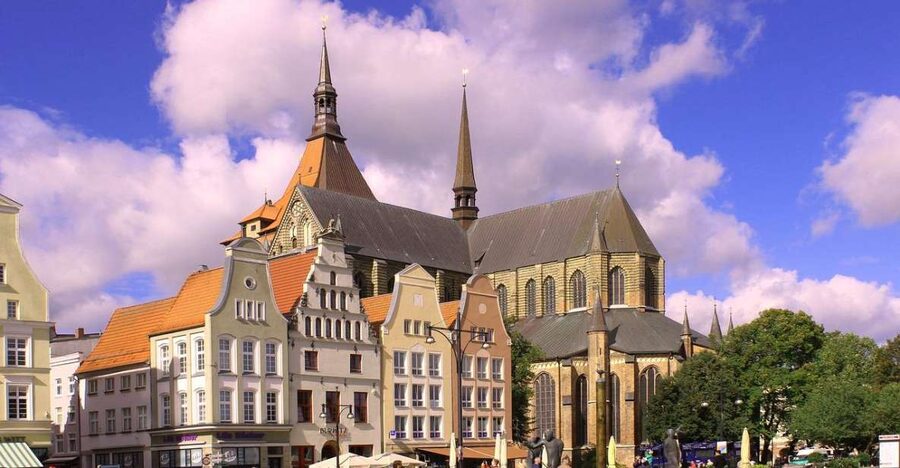
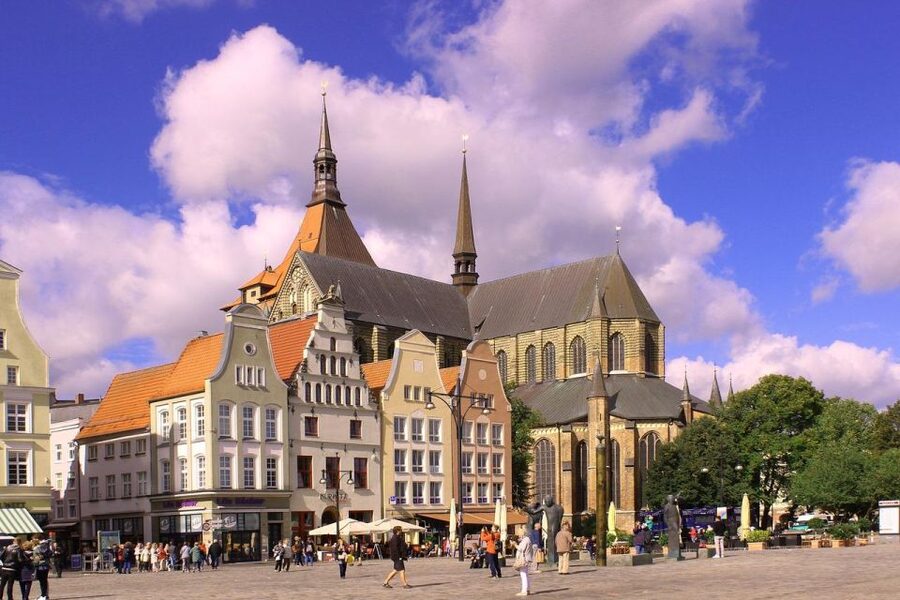
Your tour kicks off at the Seagulls’ Fountain in Neuer Markt. That is a smart start because this square works like a stage. You can orient fast. You also get right into the mix of architectural styles that make Rostock feel layered, not copy-paste.
From there, the focus turns to the Town Hall, with its striking seven towers. You will learn what those towers and Gothic-Baroque features were built to communicate, not just how they look. Think civic pride and public power. In places like this, the building is more than decoration. It is a message in stone about who ran the town and what the town wanted the world to know.
Then you shift to the Seagulls’ Fountain story. The figures connect to Neptune, the sea god, and his sons. That may sound myth-y, but it ties neatly to how Rostock lived: it was a Baltic port city, shaped by the water and the trade that moved through it.
If you like tours that help you read a city as you walk, this opening does that. You’ll spend less time staring at random buildings and more time understanding why those exact details were chosen.
More German cities at walking speed:
- Rostock: City Walking Tour
★ 4.9 · 198 reviews - Warnemünde: Guided Walking Tour
★ 4.3 · 102 reviews - Surprise Walk of Rostock with a Local
★ 5.0 · 7 reviews
St. Mary’s Church and the 15th-Century Astronomical Clock
Next up is St. Mary’s Church. What makes this stop especially meaningful is that it survived the worst of the WWII air raids, unlike many other major structures. That survival detail changes how you see the church. It is not just a pretty Gothic landmark. It is a living witness.
Your guide also points you to the church’s famous astronomical clock, built in the 15th century. Even if you do not care about mechanics, astronomical clocks are city storytelling machines. They show how people once tracked time, seasons, and the larger idea that the sky and everyday life were connected. You’ll also get why this kind of clock could become a point of pride and identity for a town.
Practical tip for your walk: take a minute to pause and look from slightly different angles around the church area. In older squares and church fronts, sightlines matter. You’ll spot how the street layout funnels your attention toward the clock and key church features.
This is the kind of stop where a guide makes the difference. Left on your own, you might admire the building and move on. With a guide, you learn what the clock represented to people back when it was new.
St Petri Church Tower: Fishermen’s Landmark, WWII Damage, and Rebuilding
After St. Mary’s, you move to St Petri, famous in part for its connection to fishermen in the region. That link matters. Rostock’s economy and daily life were shaped by the sea, and churches like this reflect who the city served and who held influence.
Here is the WWII thread again, because St Petri’s tower was destroyed and later rebuilt. The rebuilt piece is important for the emotional truth of the story. You see how a city can lose something and then decide what it will restore, and what it will rebuild with. That is resilience in real form, not a slogan.
If you’re the type who likes history but hates long lectures, this works well. Instead of a slide show, you get the timeline anchored to the structure itself. You walk past evidence. You hear it explained. Then you move on.
One small consideration: since this is a walking tour, you’ll get viewing time rather than long interior time. Plan your expectations accordingly, especially if you want to go deeper into church interiors later.
Rostock’s Name Origins and the Hanseatic League Angle That Makes Everything Make Sense
Two hours can feel short, but this tour uses time efficiently by threading together three big ideas: identity, trade power, and endurance.
First, you learn about the origins of Rostock’s name and why that matters historically. Names often carry older meanings from the founding era, and they can explain how outsiders and locals thought about the place. Even if you only remember one fact, this section helps you stop seeing Rostock as just a pretty Baltic stop.
Then comes the Hanseatic League connection. Rostock played an influential role in this trade network, and your guide ties that to what you see around you. Streets, squares, and civic buildings start to feel purposeful rather than random. You’ll understand why the city grew, why it attracted commerce, and how that created wealth and power.
This also connects to the port reality you’ll hear about. Rostock is described as a major Baltic hub and the largest on the Baltic coast, with links connecting Germany to major Scandinavian destinations and worldwide cruises. Even if you are not taking a ship, that info helps you picture why the city was worth building up in the first place.
If you’re a history fan, you’ll like how the trade story stops being an abstract concept. It becomes a reason for the architecture and the city layout you are walking through.
Old Fortifications and the Dutch Renaissance Stone Gate Motto
One of my favorite parts of walking tours is when the city’s edge shows up. Here, you get parts of the old fortifications, including ramparts, guard houses built into the walls, and even a section of wooden wall walk. Those details are gold because they show defense as a system, not just a leftover wall.
You also see the Dutch Renaissance city Stone Gate. This is where you get a motto carved into the walls: Sit intra te concordia et publica Felicitas. The message translates as harmony and prosperity within the city walls. Even if you do not read Latin every day, the meaning lands quickly because it matches what you are seeing.
A city gate is not just a doorway. It is a statement about rules, order, and what the town promises itself and its visitors. Getting that interpretation makes the structure more interesting on the second look.
Practical note: wall areas and ramparts can mean uneven paths. Wear shoes that are comfortable for walking. It is a guided stroll, but you still want proper traction.
This fortifications section also ties back to WWII resilience. When you understand how the city was designed to protect itself long ago, the post-war rebuilding story hits harder. It becomes part of a longer pattern of survival.
Also holding a platform in Rostock



University Since 1419 and the Fountain of Happiness
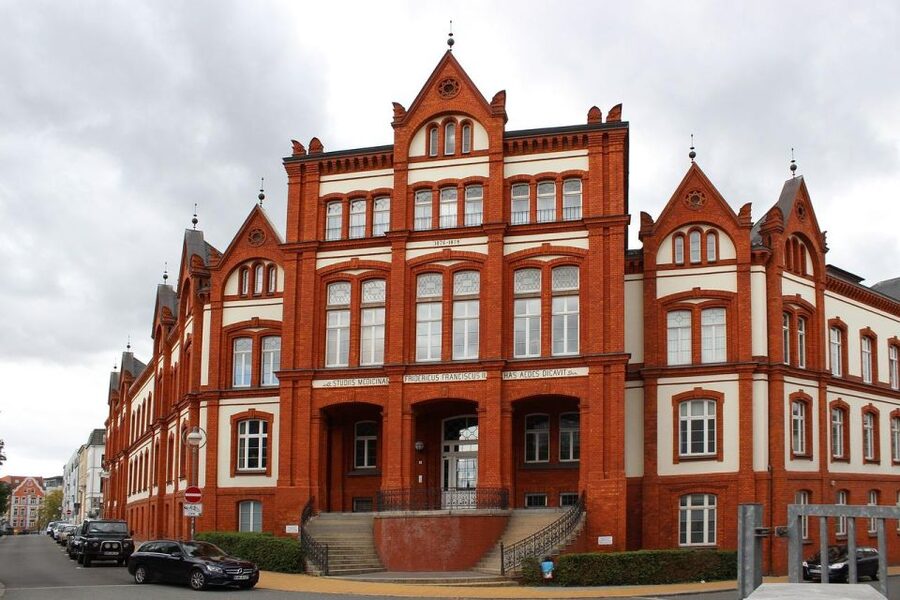
Rostock’s university stop is a perfect change of pace. You are not only looking at church towers and civic buildings now. You’re looking at education as a pillar of the city.
You’ll learn that the University of Rostock dates back to 1419, and that it’s recognized as one of the oldest universities in the world, including being the oldest in the Baltic region. That age turns it from a campus into a living historical institution. The guide also connects it to the broader sense that Rostock has always been more than a port.
Then there is the Fountain of Happiness. It’s a playful counterpoint to the heavier wartime and trade themes. You might not think of a fountain as a serious historical clue, but it often reflects local identity and public life. Happiness as a civic theme is a reminder that cities are built not only to survive, but also to function as human communities.
If you like tours that give you both the big dramas and the everyday tone, this section does the job. It balances scale, meaning, and atmosphere.
The 2-hour Private Format That Keeps You Moving Without Feeling Rushed
This is a private group tour, which changes the feel right away. Instead of trying to manage a crowd, you get a guide who can adjust pacing for your questions. The tour lasts 2 hours, so it is built for people who want the highlights without losing half a day.
The guide is local and stays with your group only. That means you can ask practical questions as you walk, like how one building relates to another or what a particular detail meant. You also have the option for customization on the spot. That is useful because Rostock’s history has multiple angles, and not everyone wants the same emphasis.
Languages are English and German with a live guide. If you are traveling with someone who prefers German, this helps. If you’re on an English-first itinerary, you still get clear explanations rather than guessing from signage.
One more small advantage: entrance fees are not included. That keeps the tour straightforward in cost planning, but it also means you should expect viewing and explanation more than ticketed interior time.
Price, value, and how to decide if $280 is fair for your group
The price is $280 per group up to 15 for a 2-hour guided walking tour. So the real question is not the total number. It’s the cost per person once you split the group.
For a couple, it can feel like a premium, because you are paying for a guide’s time. For a family or a small group, it gets more reasonable fast. If you can fill even a handful of spots, you’re paying for the flexibility of a private guide, not for an inflated per-person ticket.
Also think about what you’re buying. You are getting interpretation of several high-impact sights in one tight loop: Town Hall and its towers, St. Mary’s 15th-century astronomical clock, the WWII survival and reconstruction story, fortifications and ramparts, Stone Gate motto, plus the university connection from 1419. That is a lot of context for a short walk.
If you only plan to do one guided history walk in northern Germany, this may be the efficient choice. If you prefer slow, museum-heavy touring, you might want to pair this with self-guided time later.
Who this Rostock walking tour suits best
This tour is a strong fit if you want:
- A fast orientation to Rostock’s highlights without planning your own route
- History explained through buildings, not just dates
- A mix of maritime identity, civic architecture, and WWII rebuilding
- A private guide who can tailor attention as you go
It might be less ideal if:
- You need long ticketed visits inside churches or other interiors
- You dislike walking for two hours, even at a calm pace
- You want a deep, museum-level treatment of each stop
In general, it works best for first-timers who want substance, and repeat visitors who want a clearer story tying the landmarks together.
Should you book this Rostock private guided walking tour?
I’d book it if you like your city history practical. Rostock is not just about seeing famous buildings, it’s about understanding how the sea, trade, and survival shaped what remains. The combination of the Gothic Town Hall, St. Mary’s astronomical clock, and the WWII resilience thread gives you a narrative you can carry even after you finish the walk.
I would hold off if you want lots of entry time and quiet lingering inside specific sites. This tour is built for walking, explanation, and key exterior views, with entrance fees not included.
One last nudge: if you care about getting the human angle, look for a guide who can connect the dots on the spot. In at least one case, the guide Jana was praised for being great at guiding people through the city with insider tips. That kind of guide energy makes the difference in how much you take away.
FAQ
Where does the tour meet?
The meeting point is by the Seagulls’ Fountain in the New Market Square, Neuer Markt, 18055 Rostock.
How long is the private guided walking tour?
The duration is 2 hours.
How much does it cost?
It costs $280 per group, for up to 15 people.
Is the tour private?
Yes. It is a private group tour, with a local professional guide who stays with your group only.
What languages are available?
The live tour guide is available in English and German.
Are entrance fees included?
No. Entrance fees are not included.
Can the tour be customized?
Yes. There is possible customizing on the spot with your local guide.
Is free cancellation available?
Yes, free cancellation is available up to 24 hours in advance for a full refund.
Can I reserve without paying right away?
Yes. The option Reserve now & pay later is available, meaning you can book and pay nothing today.
Fresh on the arrivals board for Rostock


Walking Tours, compared.
Berlin City walk Government District and Places of Democracy
Read our review →
Berlin’s Best: 2 Hour Walking Tour Third Reich and the Cold War
Read our review →
Browse the lists this tour appears in