
Reviewed · THIRD REICH & WORLD WAR II TOURS
Clash of Titans: Battle for Seelow Heights WW2 tour
If you think WW2 is only big cities, think again. This is a Berlin-area battlefield day that gets specific fast. You’ll stand where the 1945 advance hesitated, then hear why those few meters of terrain mattered so much.
I like the small group size, because you get real back-and-forth with the guide and time to ask questions. I also like the mix of museum and on-site remains, including a bunker and trench network you can still walk through. One heads-up: this is a long day that includes walking off the main paths, so sturdy footwear is a must.
In This Review
- Key things you will care about
- Why Seelow Heights still hits different than typical WW2 tours
- The small-group format, and why it matters for a 7-hour day
- Entering the Seelower Höhen museum: maps, a 3D bunker model, and 40 minutes of grounding
- Reitwein forest walking: Zhukov’s command point and the surviving trench lines
- Dolgelin railway area and the German defense: the problem called the shooting gallery
- Lietzen field cemetery and the quiet reality of updated graves
- Jahnsfelde sports field: the red cross attack and the last stand at the heights
- What the guide does with numbers, maps, and timeline staging
- Practical tips: what to wear, how to plan lunch, and how to pace yourself
- Value for money: $167.74 and what you truly get for it
- Who should book this Seelow Heights tour, and who might not love it
- Should you book the Clash of Titans Seelow Heights WW2 tour?
- FAQ
- How long is the Clash of Titans: Battle for Seelow Heights WW2 tour?
- What group size should I expect?
- Is the tour offered in English?
- Where do I meet for the tour?
- What is included in the price?
- Is lunch included?
- What should I wear for the tour?
- What if the weather is poor or I need to cancel?
Key things you will care about
- Seelow Heights-focused sites that follow the flow of the fight, not random WWII stops
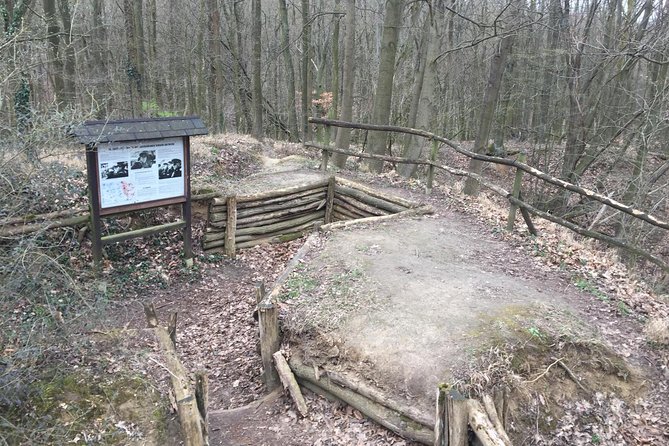
- A museum intro with a 3D model explaining the Soviet bunker and trench network
- Reitwein forest walking to the command bunker and observation point used in the battle
- German defensive positions at key field sites, explained as a tight, brutal problem to solve
- A cemetery stop where graves keep getting updated as new remains are found
- Max 7 people for more guide time and fewer rushed explanations
Why Seelow Heights still hits different than typical WW2 tours
Seelow Heights is one of those places where history stops being abstract. You’re in the open air, looking across the kind of terrain that soldiers had to cross under fire in 1945. The guide turns that geography into a story with timing, forces, and very real constraints.
What makes this tour especially compelling is that it doesn’t float in generalities. You start with a museum briefing, then you move to surviving earthworks and command points, so the battle stops feeling like a textbook page. Even if your WW2 knowledge is limited, the day is built to help you get your bearings fast.
And the tone helps. Guides named Steve or Matt (depending on the departure) are described as passionate and prepared, and they use maps and clear timelines to keep the story understandable. It’s serious subject matter, but the delivery stays human.
Further Third Reich and wartime history tours:
- Berlin: Third Reich & Cold War Guided Walking Tour
★ 4.9 · 8,378 reviews - Berlin’s Best: 2 Hour Walking Tour Third Reich and the Cold War
★ 5.0 · 5,486 reviews - Third Reich Berlin: Hitler and WWII Walking Tour
★ 5.0 · 3,301 reviews
The small-group format, and why it matters for a 7-hour day
This tour caps at 7 travelers, which changes everything on a battlefield day. When the group is small, you spend less time waiting and more time listening while your guide points things out in context. You also get better pacing, especially if anyone needs extra time at a stop.
Transport is handled with an air-conditioned vehicle, and you do not have to figure out how to connect scattered sites yourself. That matters around Berlin, where even “close by” can still mean more driving than you expect. Here, you get the transfers, then you get the walking where it counts.
Expect a start at 9:15am, and plan on about 7 hours total. That’s a full day, but it’s not a grind of nonstop standing. The stops are short, focused, and spaced so you’re not stuck in one place too long.
Entering the Seelower Höhen museum: maps, a 3D bunker model, and 40 minutes of grounding
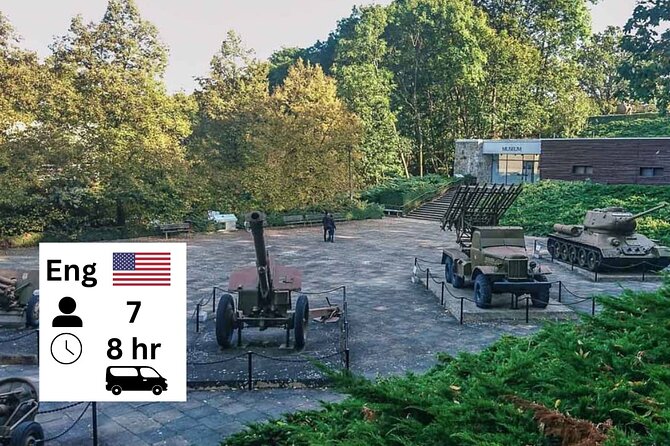
Your first major moment is the Gedenkstaette Seelower Hoehen, with museum time included and about 40 minutes on the clock. This stop sets the framework. You get a guided overview of the Berlin-Seelow offensive operation and then time to explore on your own after the briefing.
The standout here is that the guide connects the explanation to an actual visualization: a 3D model of the Soviet 1st Belorussian Front bunker and trench network, the kind of system that shaped how the assault was staged and controlled. Seeing that layout early makes the later trench remnants feel less random and more legible.
Practical note: museums move at human speed, not battlefield speed. If you like taking in details slowly, this is the best place to do it. If you prefer a tighter walkthrough, you can still get a lot out of it because the guide gives you a “what to look for” path.
Reitwein forest walking: Zhukov’s command point and the surviving trench lines
After the museum, you head to the Reitwein area, with a short break in the town of Reitwein first. The goal at this stage is simple: transition from the museum to the physical ground, while the guide anchors you in what this area was used for.
Then comes the part that makes people recommend this tour so strongly: the walk from town through the forest to the bunker and trench network remnants. This is where the day becomes less about names and more about lines on the ground.
You’ll focus on key remains tied to Marshal Zhukov, including his command bunker and a nearby observation point where he directed the battle. When you can physically locate those points and look outward from them, you get a clearer sense of command and control, and how brutal timing had to be at scale.
Also, you get a sense of why soldiers described certain crossings as nightmarish. Even without getting overly technical, the guide ties the “why” to what you’re seeing: cover, angles, visibility, and the difficulty of moving under pressure.
Dolgelin railway area and the German defense: the problem called the shooting gallery
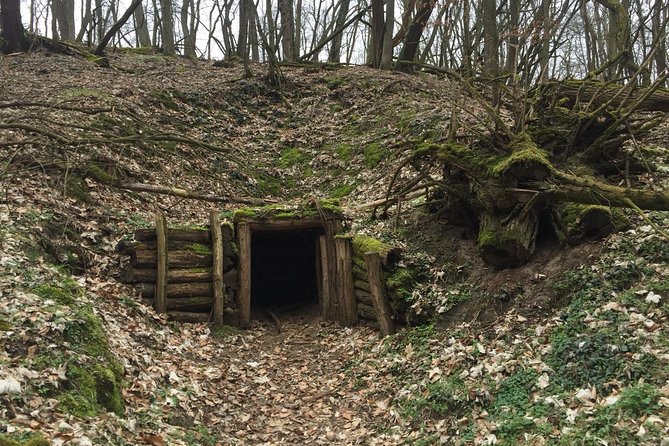
Next you move toward Dolgelin Railway station area, with a shorter time block (about 20 minutes) but a very specific focus. The tour takes you through the trench area a bit, then up to the point where the German defense is explained in terms of what the attackers faced.
This stop centers on German defensive positions, and the guide explains the situation as an awful crossing zone, often described as a shooting gallery. That phrase lands differently once you’re on the ground and can picture how limited movement would be, how exposed advancing troops would feel, and how quickly the defenders could respond from prepared earthworks.
If you like military history, this is where the story gains teeth. If you’re not a military-history person, it still works, because the guide translates tactics into geography and then into human experience: what it meant to move forward when the terrain was hostile.
One caution: this is a battlefield day in real weather and real ground. You can get muddy paths and uneven surfaces depending on conditions, so treat this as an active tour, not a sightseeing stroll.
Also holding a platform in Berlin



Lietzen field cemetery and the quiet reality of updated graves
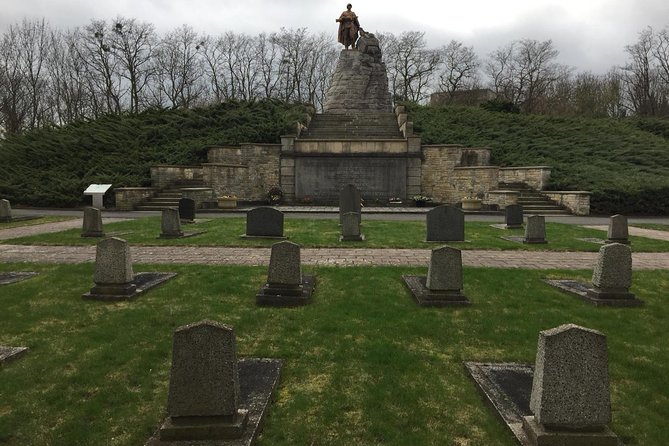
As you loop back toward Berlin along the general route of the Soviet advance, there’s a brief stop at Lietzen with a visit to a German field cemetery. This is about 30 minutes, and it has a particular emotional weight.
The cemetery is described as having been significantly extended since German unification, with newly found remains added continuously. That detail matters because it breaks the myth that “history is finished.” It’s still being uncovered, still being counted, still requiring care.
If you’re sensitive to cemeteries, give yourself permission to go slowly here. The site isn’t about spectacle. It’s about remembrance and the ongoing work of identifying what can be found.
You may also hear local context woven in at this stop, including references to historic buildings in town, such as a very old barn and a manor linked to the Knights Templar tradition dating back centuries. It’s a reminder that these places have lived many lives, not just one war.
Jahnsfelde sports field: the red cross attack and the last stand at the heights
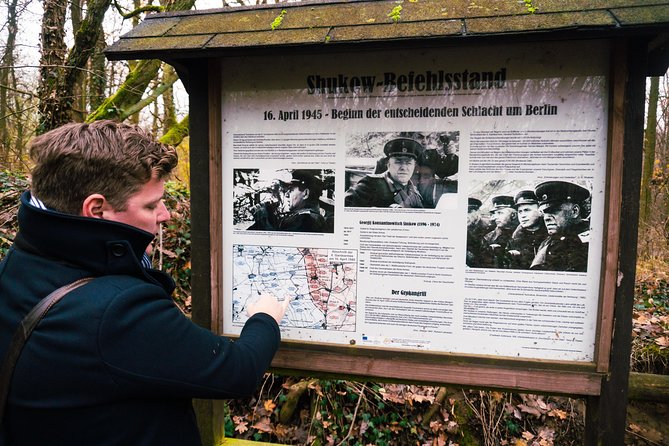
The final battlefield stop is in Jahnsfelde, at Schlosskirche Jahnsfelde. This is about 20 minutes, but it packs some of the hardest material on the day.
Here the tour points out a sports-field area tied to wartime events, including the site of a German field hospital that was attacked by Soviet aircraft targeting red cross markings. The point is not just to list facts. It’s to show how war logic crushed normal symbols, and how desperation shaped last decisions.
The guide also covers the last stand of the 3rd Battalion of the Artillery Regiment 18, describing how the battalion set up defensive positions during a withdrawal when advancing Soviet armor cut across their path. You’ll learn the rough scale of the cost, including figures on casualties and lost equipment, which makes the phrase last stand feel less like a headline and more like a room with no exits.
When you stand in the open and hear the story tied to that specific spot, it becomes clear why Seelow Heights is remembered as a turning point with a very high human price.
What the guide does with numbers, maps, and timeline staging
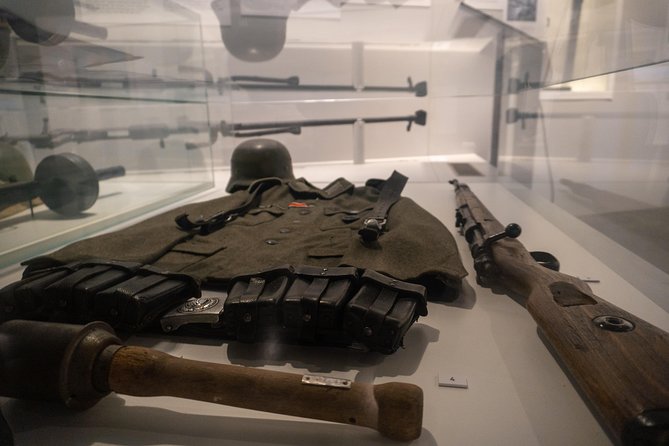
This tour is strongest when you understand how the guide uses tools. You’ll see maps and timelines used at stops so the battle stages feel ordered, not chaotic.
One thing you get here is scale, including the size of the Soviet forces and the inclusion of the Polish 1st Army within the broader assault. You’ll also hear the nature of the artillery and armored push, plus the supporting air component that shaped how fast ground could be reached and how hard defenders were pressured.
The most useful part is how the guide translates that scale into choices people had to make in minutes and hours. Where do you put a command bunker? Where do you position trenches? What happens when attackers can find routes of approach but still get shredded crossing exposed lines?
That’s why the museum intro matters. It gives you a mental model, and the on-site remains let you check that model against reality.
Practical tips: what to wear, how to plan lunch, and how to pace yourself
Wear sturdy footwear. The day includes walking through forests and around trench remnants, and you do not want slick soles or fragile shoes for uneven ground. If you’ve got hiking boots, this is one of those times to use them.
Bring your patience for a full-day rhythm. The tour is about 7 hours, and it moves quickly between sites, even though each stop is timed. The upside of the small group is that the guide can pay attention to pacing, including slower walkers.
Lunch is not included. That’s a real factor with this price tag and timing. The good news is you’ll be near towns during the day, and the guide can help you find a workable food break. If you’re the kind of person who gets cranky when hunger hits, plan for a meal break as part of your day map.
Also remember you get a small bottle of water included. It’s not a substitute for more drinking, so if you run hot, bring a little extra.
Value for money: $167.74 and what you truly get for it
At $167.74 per person, this isn’t a budget “sit on a bus and listen” experience. What you are paying for is the combination of:
- Air-conditioned vehicle transfers across scattered battlefield sites
- Museum admission included at the key Seelow Heights museum stop
- Small group size that keeps explanations interactive
- On-site walking to surviving bunkers, trenches, and specific command points
- WiFi and a bottle of water included
Lunch not being included is the main trade-off. But for many people, that’s a fair exchange for getting museum entry plus the logistics handled, especially when you’d otherwise spend time figuring out how to connect remote sites on your own.
Another value point is the learning density. This is not a general WW2 overview. It’s focused on a single battle area and a specific operational storyline, with stops selected to match that storyline.
Who should book this Seelow Heights tour, and who might not love it
Book this if you want a WWII experience that’s grounded in place. You’ll enjoy it if you like maps, timelines, and physical remains that make the battle feel understandable rather than just tragic.
It’s also a strong fit for families or mixed groups if everyone is curious about history. Guides named Steve and Matt are described as engaging, and one detail that comes through in the feedback is that the guide includes kids and answers questions without making it feel “teacher-ish.”
You might want to skip it if you dislike walking on uneven ground or you want a super relaxed, minimal effort sightseeing day. This is a battlefield tour, meaning active terrain and short time at each stop.
Should you book the Clash of Titans Seelow Heights WW2 tour?
I’d book it if you’re in Berlin and want something more precise than the usual big-tour list. The best reason is also the simplest: you get a museum foundation, then you get to walk to real remnants tied to command decisions during the Seelow assault. That mix makes the story stick.
If you’re on the fence, here’s how I’d decide fast:
- If you like WWII history with specific locations, book it.
- If you need a rest-heavy day, plan your expectations or choose a lighter tour.
- If you can handle walking through forests and trenches on uneven ground, you’ll get a lot more out of it.
FAQ
How long is the Clash of Titans: Battle for Seelow Heights WW2 tour?
It runs for about 7 hours.
What group size should I expect?
This tour has a maximum of 7 travelers.
Is the tour offered in English?
Yes, it is offered in English.
Where do I meet for the tour?
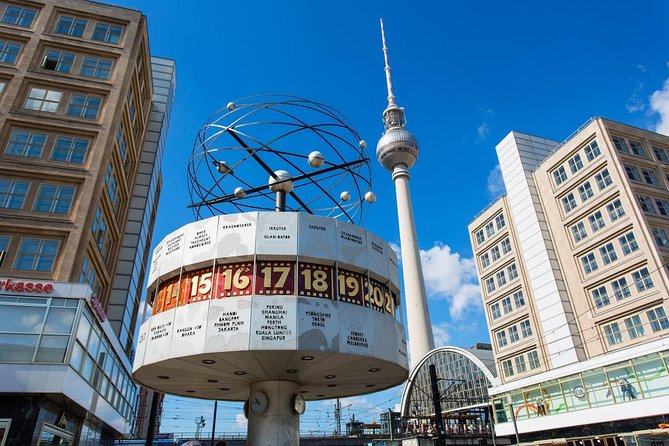
You meet at Alexanderplatz, Dircksenstraße 2, 10179 Berlin, Germany, starting at 9:15am.
What is included in the price?
The price includes an air-conditioned vehicle, museum entrance, WiFi, and a small bottle of water.
Is lunch included?
No, lunch is not included.
What should I wear for the tour?
Wear sturdy footwear, since you walk on-site in areas that are not fully on paved paths.
What if the weather is poor or I need to cancel?
The tour requires good weather. If it is canceled due to poor weather, you’ll be offered a different date or a full refund. If you want to cancel, it has free cancellation up to 24 hours before the experience start time for a full refund.
Fresh on the arrivals board for Berlin





Third Reich & World War II Tours, compared.



Berlin’s Best: 2 Hour Walking Tour Third Reich and the Cold War
Read our review →
Third Reich Berlin: Hitler and WWII Walking Tour
Read our review →
Walking Tour of Former Nazi Party Rally Grounds
Read our review →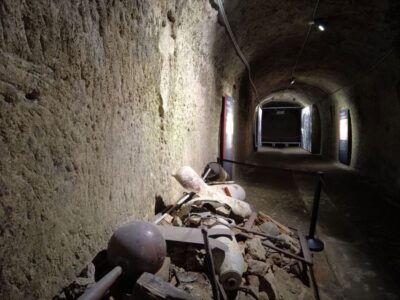
Browse the lists this tour appears in