Reviewed · PRIVATE
Berlin Private Custom 5-Hour Tour by Car
Five hours is the perfect squeeze for Berlin.
This private Berlin car tour is built for maximum sight density without the stress of transit lines, and your driver can pause whenever you want for photos and quick exploring. What makes it especially useful is that it blends the big icons, the Cold War scars, and the neighborhood feel you normally miss when you rush only the center.
I like the hotel pickup and drop-off, because it turns the day into one continuous timeline instead of a series of meet-up sprints. I also like the way the best guides bring meaning to places you recognize instantly, so Brandenburg Gate and the Reichstag area feel more like a story than postcard stops.
The main drawback to plan for is simple: it is a lot of stops in 5 hours, so you will get views and context rather than long museum time, and food and drinks are not included.
In This Review
- Key highlights at a glance
- Why a private 5-hour car route makes Berlin easier
- Price and what drives value at $504.59 per person
- Hotel pickup, English-speaking guides, and the real benefit of flexible stops
- Stop-by-stop: the Berlin core that ties East and West together
- Brandenburg Gate to Reichstag, Holocaust Memorial, and the government zone
- Potsdamer Platz, Topography of Terror, and the Wall corridor
- Checkpoint Charlie and Gendarmenmarkt, Unter den Linden, Museum Island, Alexanderplatz
- Tiergarten drive and the Victory Column, built then moved
- Memorial Church, Kurfürstendamm, and Charlottenburg Palace: West Berlin feel
- Kaiser-Friedrich-Gedächtniskirche (Memorial Church)
- Kurfürstendamm, the old boulevard heart
- Charlottenburg Palace: survival of a long reign
- Cold War photo stops: Checkpoint Charlie and the Berlin Wall legacy
- Hackescher Markt and Jewish Berlin: history in street-level places
- East Side Gallery: turning the Wall into open-air art
- Kreuzberg and Oberbaumbrücke: the immigration story you can feel
- What this tour is best for, and what it may not be
- Should you book this private 5-hour Berlin car tour?
- FAQ
- How long is the Berlin private custom tour by car?
- Is hotel pickup and drop-off included?
- What language is the tour offered in?
- Is food included during the tour?
- Do I need tickets to see the sights on the route?
- What is the cancellation policy?
Key highlights at a glance
- Private, flexible pacing so you can linger for photos and keep moving when you want to
- Hotel pickup and drop-off anywhere in Berlin, with English available
- A tight East and West route covering everything from Brandenburg Gate to Kreuzberg
- Meaningful stops like the Holocaust Memorial area and Cold War landmarks, with time for explanation
- Low ticket friction since the listed stops are marked as admission free
Why a private 5-hour car route makes Berlin easier
Berlin is big, and it is not the kind of city where you want to waste time guessing bus routes. A private 5-hour format solves that problem by doing the boring part for you: transport plus smart stop planning. You sit, you look, you step out when it matters, and you keep your momentum.
This is also a format that works well for first-timers. Instead of spreading your day across distant neighborhoods, you get a focused sweep that connects the dots between eras: imperial Berlin, the Nazi period and its aftermath, the Berlin Wall, and the city’s later reinvention. The pacing is ideal if you want your next day plans to make sense.
One more practical point: the tour runs in all weather. Berlin weather loves surprise, so being in an air-conditioned minivan with a plan for photo stops helps a lot.
Also holding a platform in Berlin
- Berlin: Reichstag, Dome and Government District Guided Tour
★ 4.7 · 18,288 reviews - Berlin: 1-Hour City Tour by Boat with Guaranteed Seating
★ 4.3 · 16,993 reviews - Berlin: TV Tower Standard Entrance Ticket
★ 4.4 · 15,883 reviews
Price and what drives value at $504.59 per person
$504.59 per person sounds steep if you compare it to group tours. But you are paying for privacy, door-to-door pickup, and a guide who can reshape the day around your interests. With a normal hop-on hop-off bus, you still have to fight walking distances and you do not get context that links sites together.
Think of this as “buying time and clarity.” If you are juggling a short visit, traveling with someone who does not want long transfers, or you just want a confident route through Berlin’s most sensitive and important areas, the value adds up fast.
Also, the tour is marked as private, so you avoid the usual problem of being stuck behind slow walkers or separated from the group you wanted to follow. You can also request drop-off and pickup from your hotel or another location in Berlin, which is genuinely useful when you want to build in a later restaurant plan.
Hotel pickup, English-speaking guides, and the real benefit of flexible stops
The biggest day-to-day win here is pickup. You can be picked up anywhere in Berlin, typically your hotel or residency. That means you start your tour without coordinating transit, waiting at a meeting point, or cutting it close to check-in times.
Departure time is flexible based on your schedule, which matters in a city where weather and museum hours can make rigid plans frustrating. And because the tour is private, your driver can stop at any time for photos and short exploration. That is what turns a “drive-by” tour into an actually usable experience.
On the guide side, the English option and the best-rated guides stand out in the way they explain what you are seeing. Names that come up in past tours include Jan, Thomas, Sven, and Winfried (with Jürgen also mentioned in one pairing). One reviewer praised how the guide balanced facts with reflection, while another highlighted recommendations for food and what to do next. Even if your guide’s style differs, the pattern is clear: you are not just collecting photos, you are getting interpretive context.
Stop-by-stop: the Berlin core that ties East and West together
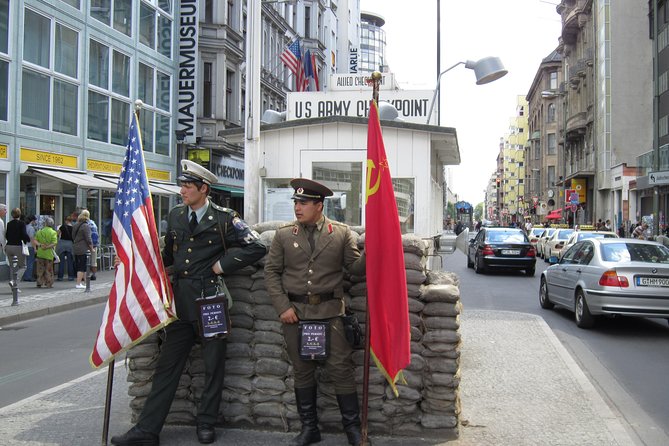
Your main start is centered on the classic Berlin highlights, designed to cover a lot of ground efficiently. In the allotted time, you are looking at major landmarks across the city center, with your guide weaving in what changed over time and why those changes mattered.
Brandenburg Gate to Reichstag, Holocaust Memorial, and the government zone
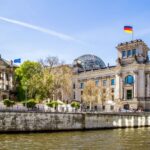
This part of the day is the anchor. You will see Brandenburg Gate and the Reichstag and Government Section area. The value is not only that you recognize these places, but that a good guide connects the symbolism shift over decades, from peace to militarized power and then to unity after the Wall’s fall.
You will also pass the Holocaust Memorial area. What I like about this type of stop is that the guide can point out how design forces you to feel the disorientation and scale of persecution, rather than treating it like a static monument. If your guide is Jan, the way he explains design and memory has been especially praised, including how architecture can push you to experience disorientation rather than just read facts.
Onward connections from Berlin:

Potsdamer Platz, Topography of Terror, and the Wall corridor
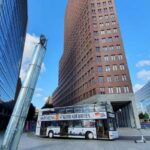
From there, the route runs through Potsdamer Platz and toward the Topography of Terror area. Then you reach the Berlin Wall segment in the center zones, plus Checkpoint Charlie.
The practical advantage of hitting these close together is mental continuity. Instead of separating the Cold War sites into different days, you get a guided chain: propaganda era decisions, wartime aftermath, division, and then reunification. It makes the city feel less like separate attractions and more like one ongoing story.
Checkpoint Charlie and Gendarmenmarkt, Unter den Linden, Museum Island, Alexanderplatz
Checkpoint Charlie is included as a highlight, with time for photos. It matters because this was one of the most visible symbols of division, and your guide can frame why it became an international icon.
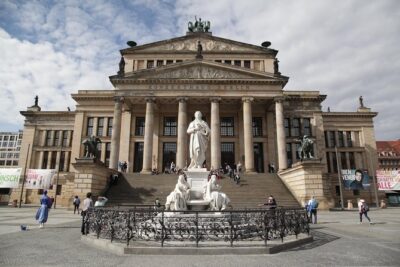
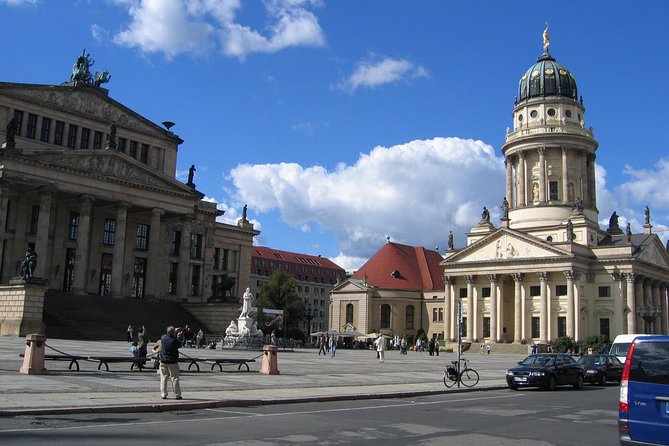
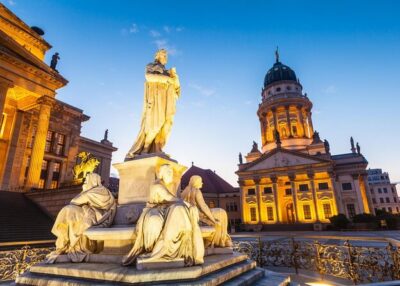
You will also see Gendarmenmarkt, Unter den Linden, Museum Island, and Alexanderplatz. These are not just “pretty center stops.” They show you the shift between grand boulevards, civic architecture, and postwar urban life. Museum Island is especially useful if you want to understand why Berlin is known for culture and collections, even when the city’s political story is heavier.
Tiergarten drive and the Victory Column, built then moved
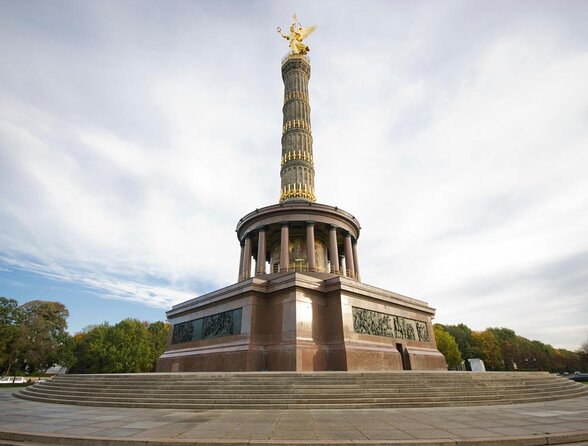
Between the core center stops, you are also driven through Tiergarten. You will see the Victory Column built in the 1870s in front of the Reichstag, then moved by Albert Speer in the 1930s to its current position. That detail is a big clue to how Berlin’s leaders used monuments to rewrite meaning in public space.
If you pay attention here, you start to see why the city feels layered. It is not only what happened, but what was rearranged in physical space to support power, ideology, and narrative.
Memorial Church, Kurfürstendamm, and Charlottenburg Palace: West Berlin feel
After the center circuit, the tour shifts to West Berlin landmarks that add variety without becoming a totally different trip.
Kaiser-Friedrich-Gedächtniskirche (Memorial Church)
You stop at the Memorial Church, a war ruin that serves as a reminder of what destruction means. The short timing means you will not get a long lecture, but you will get enough explanation to understand why it was left as a ruin rather than erased.
This is a thoughtful pause in the schedule. It breaks up the heavier political sites and gives you a different kind of memory: not just names and dates, but scars.
Kurfürstendamm, the old boulevard heart
Kurfürstendamm is where you feel the earlier West Berlin identity. You get a quick look at the boulevard as the heart of former West Berlin, with shops, restaurants, theaters, and cafés along the way.
Because the stop is brief, the guide’s job becomes crucial. You should come away understanding why this area became a cultural and commercial center, not only as an address for luxury, but as a symbol of a Western lifestyle during division.
Charlottenburg Palace: survival of a long reign
Then you visit Charlottenburg Palace. Of the many historic palaces built by the Hohenzollerns during their 500-year reign, this is the only one that survived in Berlin.
This stop is also about scale and endurance. A palace is not just a pretty building. It reflects who ruled, what they valued, and what survived the 20th century’s disruptions.
Cold War photo stops: Checkpoint Charlie and the Berlin Wall legacy
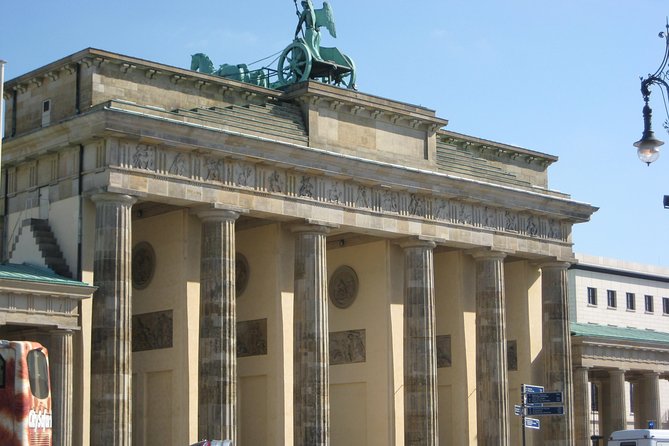
Checkpoint Charlie is included, and it is one of those places where a short stop can still be powerful if your guide explains the context clearly. Expect time for pictures, plus the historical framing that makes you understand why tanks and standoffs turned into global news.
You will also see Berlin Wall legacy elements during the main center sweep, which helps you compare how “division” was presented in different locations. In Berlin, the Wall is not a single moment. It is different remnants, different memorial choices, and different ways the city has kept the story visible.
Hackescher Markt and Jewish Berlin: history in street-level places
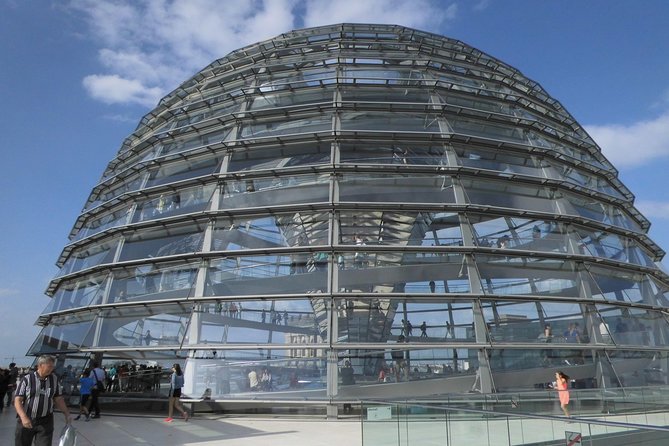
Hackescher Markt is a key stop for understanding Berlin’s Jewish neighborhoods in the 19th century, when immigrants from Eastern Europe helped form new communities. You will see the New Synagogue, the Old Jewish Cemetery, and the Hackesche Höfe.
This part works well because it is not only about grand monuments. It is about how a city’s identity forms through streets, courtyards, and everyday places where communities built life.
One thing I like about including this area on a first visit is balance. If your day only focuses on political division, you miss how real people lived, rebuilt, and created cultural space even under pressure. A strong guide will often tie the visible architecture to the human story behind it.
East Side Gallery: turning the Wall into open-air art
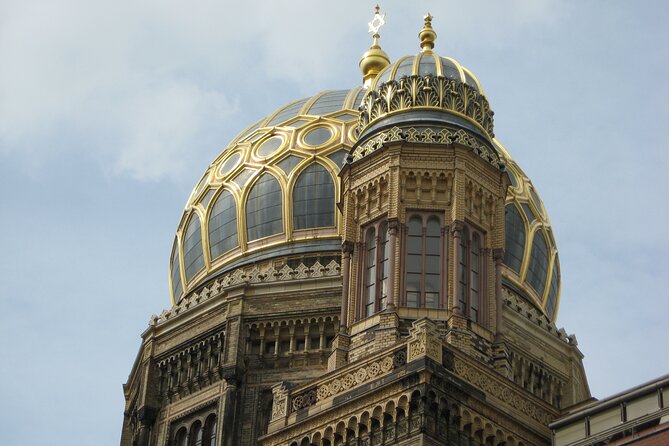
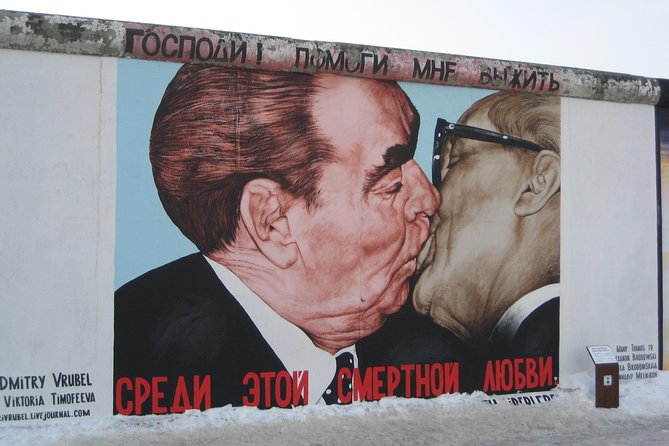
The East Side Gallery is one of the most famous wall stretches in the city, a 1.5 km run used by more than 100 artists as a canvas for their works.
A 15-minute stop might sound short, but the point here is to give you orientation. You get a sense of how Berlin reclaimed something brutal and made it visual, public, and creative. If your guide connects the art to the broader narrative of reunification and memory choices, the stop lands much harder than a quick photo.
Also, because Berlin is visually intense, having a guide’s explanation at the start helps you slow down during your own walk-by looking. You start noticing patterns, themes, and how different messages compete and overlap.
Kreuzberg and Oberbaumbrücke: the immigration story you can feel
To end the day with a real neighborhood feel, you cross the Oberbaumbrücke into Kreuzberg. Kreuzberg became a place where many Turkish immigrants settled in the 20th century.
Today, it is a multi-ethnic neighborhood with lots of bars, restaurants, cafés, and night clubs. You only get about 15 minutes here, so you are not doing a full neighborhood tour. But you should leave with a clearer sense of how Berlin kept changing after reunification, and how different communities shaped everyday culture.
This stop is also a gentle reset from the heavier memory work. It reminds you that Berlin is not stuck in the past. It keeps building in the present, often in the same spaces where history still echoes.
What this tour is best for, and what it may not be
This tour is a great fit if you want:
- A high-coverage Berlin introduction in one day
- Flexible photo stops without worrying about transit
- A guide who brings context to sensitive places, not just a script of facts
- Door-to-door convenience that saves your energy
It may be less ideal if you want:
- Long museum time at a single location
- A slow, deep walking experience where you get to study exhibits on your own
- A meal planned in the itinerary, since food and drinks are not included
One more practical thought: bring layers and plan for the fact that stops are short. You will want to move quickly from car to viewpoint, and having the right jacket matters when Berlin turns windy.
Should you book this private 5-hour Berlin car tour?
If you have a short Berlin schedule and you want your sightseeing to feel organized and meaningful, I think this is a strong book. The combination of private transportation, hotel pickup, and a route that connects the city center to West Berlin landmarks, Cold War sites, and neighborhoods like Kreuzberg makes it easy to get your bearings fast.
I would especially recommend it if you value strong guiding. Past tours highlight guides like Jan, Thomas, Sven, and Winfried for context, balance, and humor. If you want your day to produce more than photos, this format is built for that.
If you have the time for multiple days of slow museum visits, you might still book it, but use it as your orientation day, not your replacement for deeper exploring.
FAQ
How long is the Berlin private custom tour by car?
It runs for about 5 hours.
Is hotel pickup and drop-off included?
Yes. Pickup and drop-off from your Berlin hotel or another location you request are included.
What language is the tour offered in?
The tour is offered in English.
Is food included during the tour?
No. Food and drinks are not included.
Do I need tickets to see the sights on the route?
The listed stops are marked as admission ticket free, so you should not be hit with entrance fees for the scheduled items.
What is the cancellation policy?
You can cancel up to 24 hours in advance for a full refund. Cancellations within 24 hours of the start time are not refunded.
Fresh on the arrivals board for Berlin


Private, compared.
Berlin Private Complete History All Day Walking Tour
Read our review →
Munich Private Tour with a Local – Highlights & Hidden Gems
Read our review →
Private Walking Tour Berlin Third Reich Hitler and World War II
Read our review →
Your private 3-hour Hamburg driving tour with a former policeman
Read our review →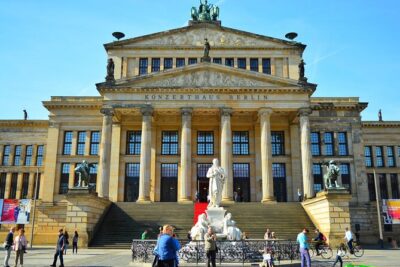
Private Berlin: Iconic Sights and Hidden Gems Walking Tour
Read our review →
1.5-Hour Private Tour through Historical Old Town
Read our review →