
Reviewed · GUIDED WALKS IN BERLIN
Private Berlin: Iconic Sights and Hidden Gems Walking Tour
Berlin’s story hits hardest on foot.
This private walking tour connects the reunification symbols to the places where Berliners suffered, fought, and rebuilt. I love that you get hotel pickup and drop-off, so you waste less time hunting for a meeting point. I also like the way the guide can tailor the route to you, with people in the past calling out guides like Ariel and Tina for making the history clear, human, and easy to follow. The main drawback to flag is that this route covers heavy WWII and Nazi-era topics, so expect an emotional pace, not a casual stroll.
You’ll choose a 3-hour or 4-hour option, and that choice matters. The shorter tour is a strong orientation to key sites across central Berlin, while the longer one gives you more time for questions and context. I like that this isn’t a canned script, it’s built around your interests, and that shows in how often guides are praised for adapting to the group.
One more consideration: at the stops, the time is tight. Even with a private guide, some sites are only a quick visit, so if you want a long, slow read or extra photo time at one specific place, you’ll need to plan that with your guide.
In This Review
- Key highlights that make this tour worth your time
- Meeting in your hotel, then walking with a private guide
- Choosing 3 hours vs 4 hours: how much depth you really get
- Brandenburg Gate and Pariser Platz: reunification in one iconic frame
- Bernauer Strasse and the Berlin Wall Memorial: the emotional core
- Checkpoint Charlie: the Cold War border, plus the human stakes
- Gendarmenmarkt: switching gears to classic Berlin elegance
- Führerbunker to Reichstag: power symbols, then transparency claims
- The Führerbunker: where the last days happened
- The Reichstag: then the glass dome viewpoint
- East Side Gallery to Museum Island: art and memory on the Spree
- Berliner Dom, Bebelplatz, and Hackescher Höfe: faith, censorship, and courtyards
- Berliner Dom: the cathedral with big dome views
- Bebelplatz: the Empty Library memorial and what was lost
- Die Hackeschen Höfe: courtyards and a more playful Berlin ending
- Price and logistics: does $192.97 per person make sense?
- Who this private Berlin walk fits best
- My take: should you book this tour?
- FAQ
- How long is the private tour?
- Is the tour offered in English?
- Does the price include hotel pickup and drop-off?
- What is included in the tour price?
- Are there admission fees for the stops?
- Can I cancel for a full refund?
Key highlights that make this tour worth your time
- Hotel transfers simplify the start and finish, especially if it is your first day or you are jet-lagged.
- Private guiding means real Q and A, not just listening while everyone else talks over you.
- Cold War to reunification, in walking order, so you can see the logic of the city’s division and change.
- Iconic and lesser-known stops in the same route, from Brandenburg Gate to Bernauer Strasse.
- A guide can adjust for your pace, including walkers who need a more flexible rhythm.
Meeting in your hotel, then walking with a private guide
Berlin is spread out, and the big sites are not all next door. This tour solves that problem with a meet-and-greet in your central Berlin hotel lobby. You pick a departure time, you pick the 3-hour or 4-hour option, and your guide leads from there on foot, with hotel drop-off at the end.
That structure is practical. You spend less energy figuring out transit lines or guessing where a group is gathering, which matters when you are still learning the city. It also keeps the day feeling coherent, you go from stop to stop with a guide explaining why each location matters, rather than turning your day into an untimed scavenger hunt.
It is also the right size for people who want control. Since it is a private tour, you can ask questions freely, slow down, speed up, or steer the focus. In the feedback I saw, guides like Ronja and Klaus were specifically called out for pacing and for answering questions clearly in English.
More Guided Walks in Berlin
- Discover Berlin Half-Day Walking Tour
★ 5.0 · 9,624 reviews - Berlin City walk Government District and Places of Democracy
★ 4.7 · 8,467 reviews - Berlin: Third Reich & Cold War Guided Walking Tour
★ 4.9 · 8,378 reviews
Choosing 3 hours vs 4 hours: how much depth you really get
The tour gives you two formats: around 3 hours or around 4 hours. The shorter option is a focused sweep through the city’s headline sites, plus enough background to understand what you are looking at. The longer option is better if you know you will want to talk, stop for details, or connect the WWII era to the Cold War era without feeling rushed.
Here is how to decide based on your travel style. If Berlin is only a quick stop for you and you want the main points fast, go 3 hours. If it is your first visit and you want a clearer map of how the city changed over time, go 4 hours. In both cases, the guide is customizing your walk, so you are not stuck with a rigid route that ignores your interests.
Also remember: the tour runs on foot. Even when the planned stop times are short, the day adds up. If you have limited mobility or you know you tire out quickly, tell the guide at booking so they can adjust the pace and the order.
Brandenburg Gate and Pariser Platz: reunification in one iconic frame
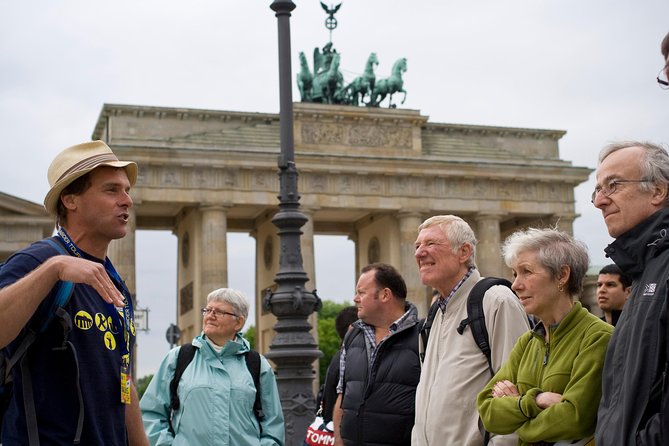
Your walk starts at Brandenburg Gate, at Pariser Platz. It is one of Berlin’s most photographed monuments for a reason. The neoclassical arch with the Quadriga at the top carries a long set of meanings, from Germany’s power symbols to the Cold War divide, and then to reunification.
What I like about starting here is the immediate clarity. You can stand in the open space, look at the arch, and your guide can explain how this one structure became a shorthand for division and then later for peace and unity. The square around it is active, with cafés and shops nearby, so if you want a break or a quick snack after the walk, you are not far from it.
Drawback? Because it is famous, it can also be busy. Your guide can help you time photos and point out the angles that make it feel less like a parade route and more like a meaningful stop.
Bernauer Strasse and the Berlin Wall Memorial: the emotional core
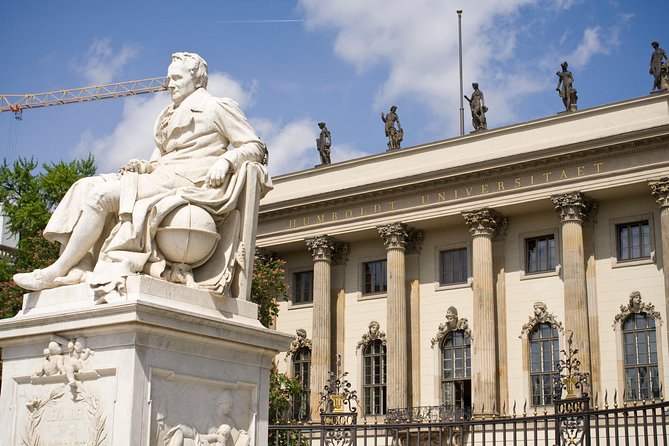
From Brandenburg Gate you move to the Memorial of the Berlin Wall along Bernauer Strasse. This is where the tour gets serious in a good way. The memorial includes a preserved section of wall and a visitor area with context. You will also hear about the real impact the wall had on everyday people, including what it meant to try to escape.
This stop is longer than the quick exterior moments because it needs a little more time to land. You are looking at not just a monument, but a story about control, desperation, and survival. The memorial’s exhibits and personal accounts turn the abstract idea of a divided city into something you can understand with your own senses.
Practical tip: this is not a place to rush. Even if your schedule is tight, give yourself a few extra minutes here, because it changes how the later Cold War stops feel.
Checkpoint Charlie: the Cold War border, plus the human stakes
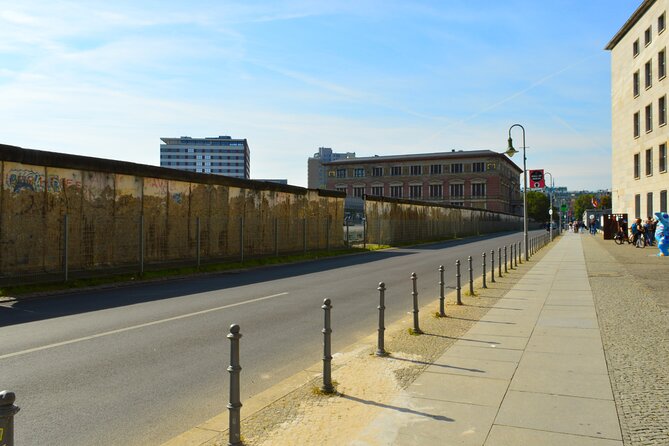
Next is Checkpoint Charlie on Friedrichstrasse, one of the best-known crossing points between East and West Berlin. Your guide will explain how it functioned and why it became a symbol of Cold War tension. Even today, the site is tied to escape stories, along with the political climate that made ordinary movement feel dangerous.
There is an iconic booth setup here, and it is designed to help you visualize the border in a way that is easy to remember. The museum-style displays provide the history, not just the photo op. That balance is key. You can see why people stop to take pictures, but you also leave with context instead of just a souvenir moment.
One consideration: because this place is famous, you may notice tourist crowds at certain times. In a private tour, you can still manage it better by asking your guide for the best order to approach the site and where to focus your attention.
More German cities at walking speed:


Gendarmenmarkt: switching gears to classic Berlin elegance
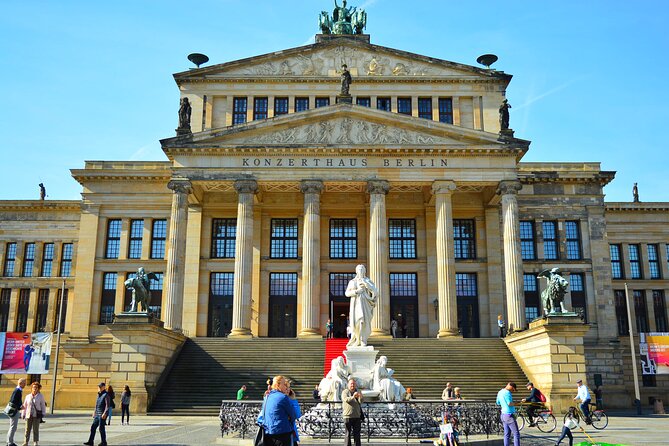
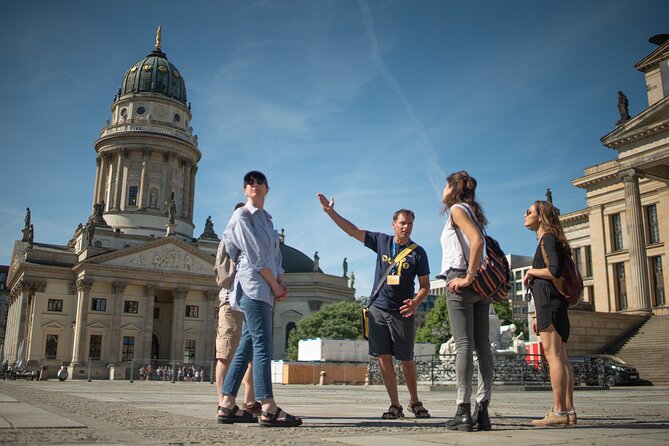
After the heavier border history, the tour moves to Gendarmenmarkt. This square is surrounded by striking architecture, including the French and German cathedrals on either side and the concert hall in the center. It feels different from the Cold War stops, and that contrast is useful.
Your guide can help you see how Berlin is not only scars and divisions, it is also culture, civic pride, and design. The square has cafés and cobblestone streets, so it works as a breather. If the tour is running on a day with events or markets, you might notice extra energy in the square.
If you want maximum focus on history, this stop may feel lighter. But in my view, that is the point. It keeps the day from turning into a nonstop lecture and helps your brain reset before the route turns darker again.
Führerbunker to Reichstag: power symbols, then transparency claims
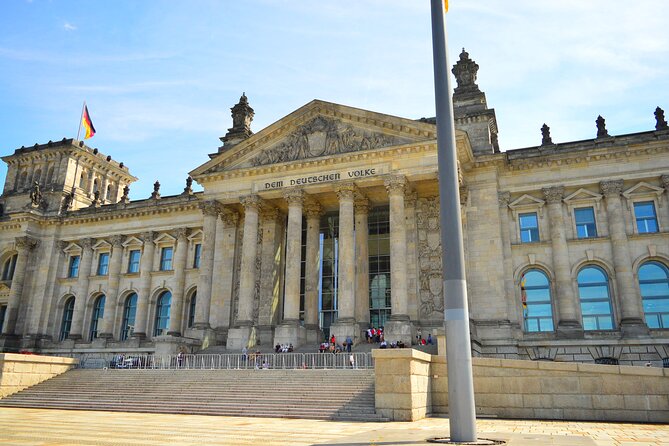
Two of the most dramatic stops come back-to-back: the Führerbunker site and the Reichstag building.
The Führerbunker: where the last days happened
The Führerbunker is beneath the gardens of the Reich Chancellery area. It is a place tied to Hitler’s final days in 1944, when the Allies closed in on Berlin. The tour description is clear: the site is largely unmarked, with only a small plaque, so this is not a grand memorial you can linger in like a museum hall.
That makes the guide role more important here. You need someone to connect what you are seeing (or not seeing) to the larger story of the Third Reich’s collapse and what Berlin endured during the end of the war.
Emotional note: it is brief, but it can be intense. If you want to adjust the emotional load, ask your guide for a moment of context before you step into the site area.
The Reichstag: then the glass dome viewpoint
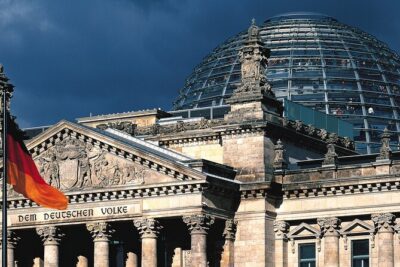
Then you head to the Reichstag building, Germany’s historic parliament. Your guide will connect the building to the German Empire era, the fire of 1933, and the eventual rebuilding into the seat of the Bundestag in 1999.
The highlight people remember is the glass dome designed by Norman Foster. It is a powerful symbol because it changes how you experience power. From the dome, you can look out over Berlin, and you also get a sense of transparency in government by seeing the parliament space below.
This stop is one of the best “shift your perspective” moments in the tour. After memorial walls and border crossings, the Reichstag offers a different story: how Berlin tried to reinvent itself politically and symbolically.
East Side Gallery to Museum Island: art and memory on the Spree
The tour then moves along the Wall’s legacy through the East Side Gallery, an open-air stretch of remaining Berlin Wall covered with murals. The wall art adds a different emotional texture. Instead of reading only about division, you see how artists turned the Wall into public storytelling after 1989.
Your guide can point out major murals and explain what makes them memorable, including the well-known Fraternal Kiss mural. You will walk along the stretch, about 1.3 kilometers worth of wall art. Expect time here to be more about observation and meaning than about museum-style exhibits.
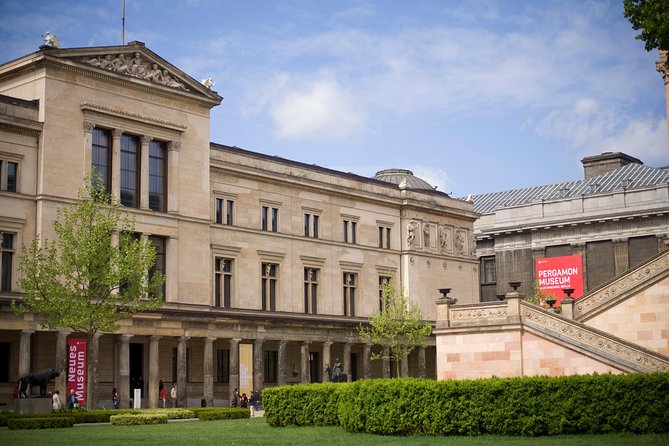
Then you shift to Museum Island. Even in a short window, it is a great photo and orientation stop. You get views of grand museum façades, plus the Spree River and the green around the island. If you have art or archaeology in your future plans, this stop helps you place Museum Island on your mental map.
Potential drawback: Museum Island is an area where you could easily spend hours. This tour keeps it brief, so if you want to step inside any museum, you will need a separate plan.
Berliner Dom, Bebelplatz, and Hackescher Höfe: faith, censorship, and courtyards
The final stretch layers three stops that each feel like Berlin in a different mood.
Berliner Dom: the cathedral with big dome views
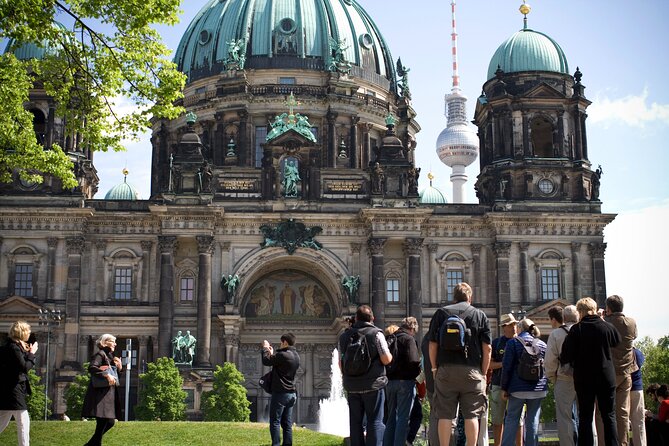
At Berliner Dom (Berlin Cathedral), you get a classic skyline anchor with a large dome and a Baroque style. Your guide can explain what you are seeing on the exterior and why it is such a landmark. The stop description also highlights the option to climb for panoramic views, so you can finish the tour with a sense of Berlin’s scale.
Even if you do not climb, the cathedral still works as a “look up and orient” moment.
Bebelplatz: the Empty Library memorial and what was lost
Next is Bebelplatz, tied to the Nazi book burnings on May 10, 1933. The stop centers on censorship and the destructive idea that culture can be erased on command. In the middle of the square is the Empty Library memorial by Micha Ullman, an underground space of empty bookshelves visible through a glass panel.
This is one of the most thought-provoking stops on the walk because it connects ideology to tangible harm. You stand in a beautiful civic space, and your guide brings you back to what happened there and why intellectual freedom matters.
Die Hackeschen Höfe: courtyards and a more playful Berlin ending
Finally you end at Die Hackeschen Höfe, a complex of interconnected courtyards near Hackescher Markt. The architecture is art nouveau style, with tiled details and wrought iron, built in the early 1900s. Today, the courtyards function like a creative hub with shops, galleries, dining, and performance spaces.
This ending works well because it gives you a lighter tone after the darker themes. It is a good place to wander a bit on your own afterward if you still have energy, especially for a slow walk back toward your hotel.
Price and logistics: does $192.97 per person make sense?
At $192.97 per person, this is not a bargain-basement tour. It is a private experience, and you are paying for two things: (1) a guide who can tailor the route and handle questions, and (2) hotel pickup and drop-off that removes friction from your day.
So, how do you judge value? It is best value when you are getting maximum benefit from a tight walking window. If it is your first day in Berlin, the tour acts like a guided “map with meaning,” linking Brandenburg Gate, the Berlin Wall memorial area, and Cold War crossings in one coherent thread. That saves you time later when you would otherwise be re-learning the city from scratch.
It is also strong value for small groups because private guiding typically costs more per person than group tours, but your group gets the flexibility. If your group has mixed interests, the customization feature is your friend.
Where it might not feel worth it is if you already know Berlin well and only want a quick highlight loop. Also, if you want extensive museum time or long stops at memorials, you may wish you had booked more hours or added independent time.
One practical note: this is an experience that people plan ahead for. It is commonly booked about 50 days in advance, so if you have specific departure times in mind, secure it early.
Who this private Berlin walk fits best
This tour is ideal if you want a first-time Berlin orientation that does not sugarcoat the city’s past. It is also good if you like structure, you want a logical route on foot, and you want to ask questions in plain English.
It is especially suitable for:
- First-time visitors who want East and West Berlin context without doing separate research
- Small groups and couples who want control over pace and interests
- People who appreciate history that connects places to real stories, including WWII and Cold War topics
It might be less suitable if:
- You want a relaxed, entertainment-only day
- You hate walking and long city blocks, even though the tour is paced for a private group
- You plan to spend extra time in museums or inside major buildings beyond what the route allows
My take: should you book this tour?
If you are choosing one guided experience to get your bearings in Berlin, this is a strong pick. The mix of Brandenburg Gate, Berlin Wall Memorial, Checkpoint Charlie, and East Side Gallery gives you a clear line from division to reunification, and the Reichstag and Führerbunker stops add the political and WWII weight you would otherwise miss.
Book it if you want history explained in a way that feels grounded, with a guide like Ariel or Tina being called out for clarity and energy. Skip it or modify the plan if you are sensitive to heavy WWII and Nazi-era sites, or if you know you want longer museum time than a walking route can provide.
FAQ
How long is the private tour?
You can choose a 3-hour or 4-hour private walking tour. The itinerary is designed for those timeframes, with stops scheduled accordingly.
Is the tour offered in English?
Yes, the tour is offered in English.
Does the price include hotel pickup and drop-off?
Yes. Hotel pickup and drop-off are included, and the meeting is done in the central hotel lobby.
What is included in the tour price?
The tour includes a professional guide, a private walking tour (3 or 4 hours depending on your option), and hotel pickup and drop-off. Food and drinks are not included.
Are there admission fees for the stops?
The tour’s provided stop details list admission ticket free for each site on the route.
Can I cancel for a full refund?
You can cancel up to 24 hours in advance for a full refund. If you cancel less than 24 hours before the start time, the amount you paid will not be refunded.
Fresh on the arrivals board for Berlin


Guided Walks in Berlin, compared.
Berlin City walk Government District and Places of Democracy
Read our review →
Berlin’s Best: 2 Hour Walking Tour Third Reich and the Cold War
Read our review →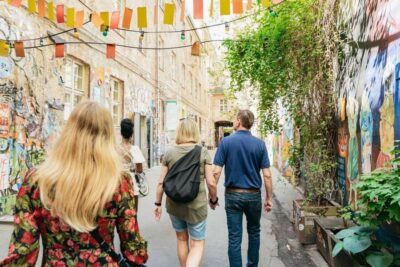
Third Reich Berlin: Hitler and WWII Walking Tour
Read our review →
Browse the lists this tour appears in