Reviewed · WALKING TOURS
Weimar Private Walking Tour With A Professional Guide
Weimar’s classicists walk right up to you. This private walking tour strings together the big names of Weimar, from Goethe and Schiller to the birth of Germany’s first democracy, using a route where key sights are close together. I love how the tour mixes culture and politics without turning into a lecture, and you get the kind of flow that fits a tight schedule.
Two things I especially like: the one-on-one feel with a local guide, and the way the stops connect ideas across centuries. You’ll hear about Lucas Cranach near Market Square, then jump to the House of the Weimar Republic and Democracy Square, and it all clicks. The only drawback to consider is that it is a 2-hour walk with multiple stops, so if you like long pauses and slow museum time, you may want to plan extra time afterward.
In This Review
- Key highlights worth centering your trip on
- Why this Weimar tour fits perfectly into 2 hours
- Starting at Markt 20, then letting the city do the directing
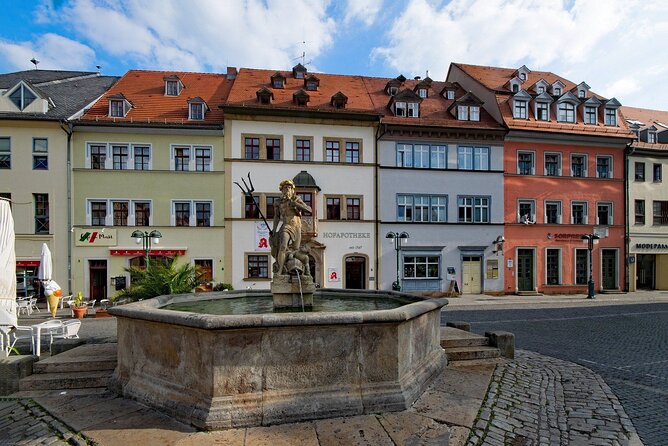
- Market Square: Cranach, classicists, and feudal-era bones
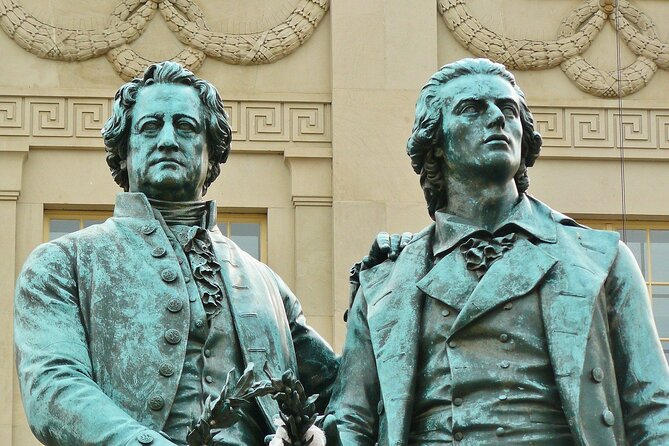
- Theaterplatz and the Goethe-Schiller memorial in front of the theater
- The House of the Weimar Republic and Democracy Square
- St. Peter and Paul Church: Luther, Herder, and Anna Amalia
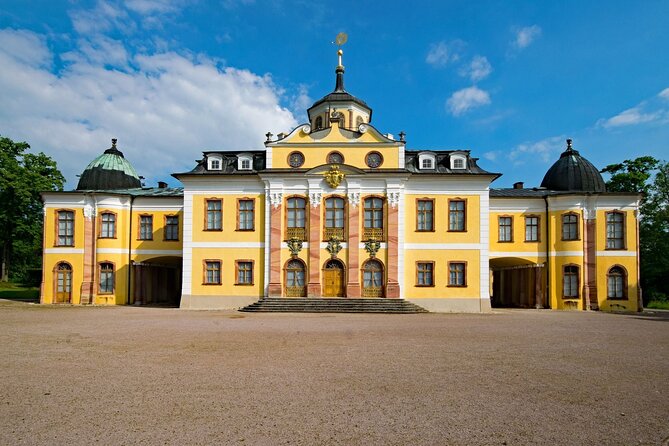
- Weimar Palace and the royal buildings around the squares
- Anna Amalia’s Library and Park an der Ilm: ideas in stone and trees
- Goethe’s House on Frauenplan: where the writing happened
- Liszt Haus and Friedrich Schiller’s House: the arts spiral keeps going
- Price, group size, and whether a private guide is worth it
- Who should book this private walking tour in Weimar
- Should you book it
- FAQ
- How long is the Weimar private walking tour?
- Is the tour private or shared?
- What language is the tour offered in?
- Does the tour require transportation?
- Where do we meet, and where does it end?
- Can I cancel for a full refund?
Key highlights worth centering your trip on
- A private guide who answers on the spot: reviews call out guides like Alexander and Tori for going beyond the usual facts and handling unexpected questions.
- A compact route through pedestrian Weimar: the city center is walkable, so you spend more time seeing and less time figuring out how to get around.
- Goethe and Schiller everywhere you look: memorials and two major residences bring the classicists down to street level.
- Democracy history in real places: the Weimar Republic story is anchored at the House of the Weimar Republic and reinforced around Democracy Square.
- Architecture that hints at power: royal-era buildings, palace spaces, and church layers help explain why Weimar looks the way it does.
- Easy pace, no transit required: the activity level is easy and transportation is not needed.
Why this Weimar tour fits perfectly into 2 hours
This is the kind of tour that helps you get your bearings fast. Weimar is made for walking, and the route is built around that fact. In about 2 hours, you cover a tight loop of landmarks, so you are not wasting your day bouncing between far-flung neighborhoods.
The guide time matters here. With a private group, you can ask the practical questions that make history feel personal, like how Weimar’s literary fame connects to its political experiments. And because the guide is with only your group, the conversation can move at your pace, not a crowd’s pace.
The other reason this works is balance. You get the “literature crowd” sights, like Goethe’s House and Schiller’s House, but you also get the “what happened here” story at the Weimar Republic sites. That mix is exactly what makes a short walking tour more memorable than just ticking off famous names.
More German cities at walking speed:
- 2 hour Private Walking Tour: The Berlin Wall & the Cold War
★ 5.0 · 33 reviews - Eisenach Private Walking Tour With A Professional Guide
★ 5.0 · 7 reviews - Discover Berlin Half-Day Walking Tour
★ 5.0 · 9,624 reviews
Starting at Markt 20, then letting the city do the directing
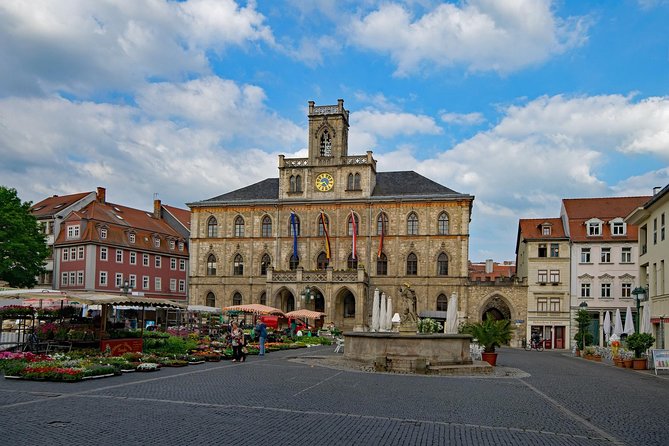
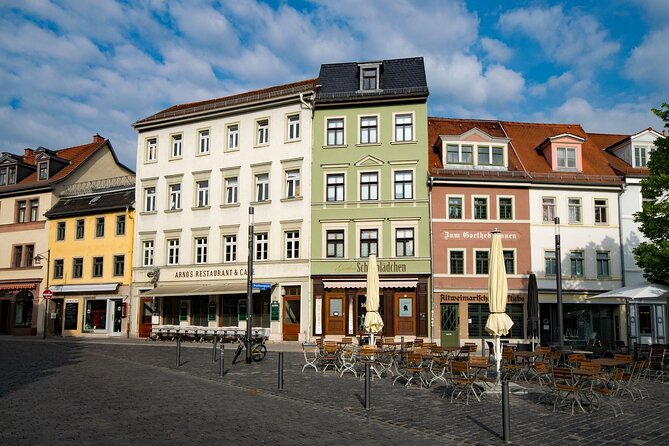
You begin at Markt 20, 99423 Weimar, where Market Square is the classic starting point in the city center. This is useful because it is a natural hub, and the tour starts by grounding you in what locals would recognize instantly: the square as a meeting place and a stage for important lives.
From there, you walk through central Weimar on foot, with stops that are close enough that you stay in “walk and learn” mode. You do not need to plan transit during the tour, which makes the experience feel smooth. It also means you can pay attention to what is around you at street level, not just when you pause at a headline attraction.
I also like that the tour ends back in Weimar’s center area for convenience. After a short guided walk, you are in the right place to keep exploring independently, whether you want another stroll in the park areas or to head into a museum on your own time.
Market Square: Cranach, classicists, and feudal-era bones
Market Square is where the tour starts shaping the big story. You learn that Lucas Cranach, the Renaissance painter, lived in nearby buildings, and that the square has long been a gathering point for famous people.
But the real draw for most visitors is how the square sets up Weimar’s classicist reputation. The city’s buildings and layout reflect earlier feudal days, so the architecture feels like it is carrying a memory. Even if you are not a history nerd, you can sense it: Weimar’s center looks designed for influence, display, and conversation.
You also get a practical benefit from starting here. The guide helps you connect the dots between places you will see later, so later stops, like Theaterplatz and the memorials, do not feel random. They feel like the next scene in the same story.
Theaterplatz and the Goethe-Schiller memorial in front of the theater
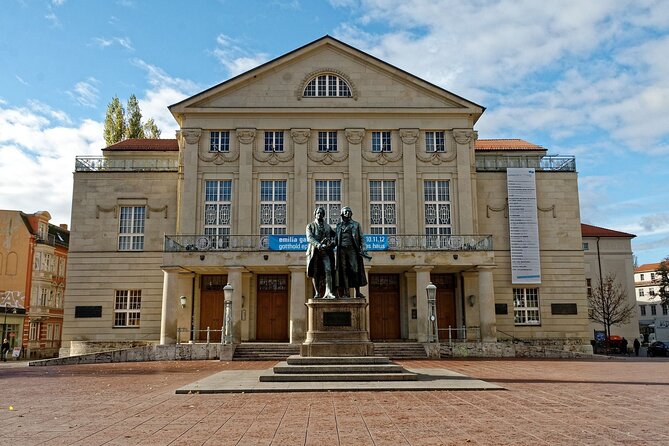
Next comes Theaterplatz, where you meet the Goethe and Schiller memorial in front of the National Theater. This is one of those stops where the names on the plaque start to feel real because the location is so theatrical.
You learn how Weimar classicism is tied to Duchess Anna Amalia, who hosted gatherings that included Goethe and Schiller. That detail matters because it reframes the classicists. They are not just writers producing works in isolation. They are part of a court and a culture that actively shaped who got heard.
The memorial in Theaterplatz becomes a visual anchor. Once you see the pair standing in this setting, you understand why the classicists dominate so many parts of Weimar’s identity. It is also a good moment to ask your guide how Weimar’s literary scene influenced the city’s reputation beyond Germany.
The House of the Weimar Republic and Democracy Square
This is the part that adds weight. On the opposite side of Theaterplatz, you visit the House of the Weimar Republic, described as the place where the National Assembly met in 1919 after World War I. You learn how the Weimar Republic was born here, as a first attempt to build a democracy in post-imperial Germany.
Then the tour’s logic brings you back around to the political geography at Democracy Square, which used to be called Duke’s Square. The square is surrounded by royal buildings, including the red and yellow palaces and the house where Duke Charles Augustus lived. The contrast is striking and very teachable: a public space that once reflected ducal power now frames democratic lessons.
At the House of the Weimar Republic, the story is told inside a renovated building and connected to a Forum for Democracy. Even if you only catch it from the guided perspective, the key takeaway is clear. This is not abstract civics. It is history with a physical address.
Also holding a platform in Germany




St. Peter and Paul Church: Luther, Herder, and Anna Amalia
The tour heads to St. Peter and Paul Church, the most important church in Weimar. This stop works because it is layered, like the city itself. The church is built upon foundations of a 13th-century building, then rebuilt in the 16th century with Gothic style, and later converted to Lutheran belief.
You also get a direct link to a heavyweight figure: Martin Luther preached there. That is the kind of detail that turns a church from a photo stop into a historical landmark.
The guide also points out who lies connected to the church’s story. Theologian Johann Gottfried Herder is buried there, and Duchess Anna Amalia is also buried there. In front of the church, there is the Herder Memorial dedicated in 1850. It is a nice way to connect the church to the surrounding public memory.
If you enjoy understanding how beliefs, politics, and art overlap, this is one of the most satisfying stops on the whole walk.
Weimar Palace and the royal buildings around the squares
After the church, you pass by the Weimar Palace, once the residence of the dukes of Saxe-Weimar and Eisenach. The description of its timeline matters: it began as a medieval castle, is mentioned as early as the 10th century, and then took centuries to become the present-day palace form after fires and remodelling.
Why include a palace when you are taking a culture-and-politics tour? Because the palace explains the setting. Weimar’s classicists did not float in a vacuum. They were supported, shaped, and hosted in spaces powered by ducal authority.
Then the route brings you back through the area surrounding Democracy Square, where the royal-era architecture is part of what you notice while walking. The guide can help you see how “public” spaces were once heavily tied to rulers, and how that changes as the city’s identity shifts toward arts and democracy.
Anna Amalia’s Library and Park an der Ilm: ideas in stone and trees
One of my favorite combinations in this route is Anna Amalia’s Library followed by Park an der Ilm. The library is described as a small palace that supported a treasured library over the centuries, closely linked to Anna Amalia’s support.
The guide points to specific kinds of treasures, including a document that offers an early indication of Wolfgang von Goethe’s presence in the city. It is also where you learn that Goethe ran a library for decades. That detail makes the library feel less like a must-see room and more like an engine for ideas.
Then you step into Park an der Ilm, created in the 18th century and known for valuable trees and architectural features like the ruins of the Tempelherrenhaus. Goethe’s connection continues here too. He played a part in designing the park, and he spent his first years in Weimar in a house near the park that he received as a gift from Charles Augustus.
This pair of stops is a smart way to see how Weimar built culture into both buildings and public outdoor space.
Goethe’s House on Frauenplan: where the writing happened
Next is Goethe’s House on Frauenplan, the poet’s later residence after 1782. The focus here is on how the rooms are presented as they were in the final years of his life. The guide highlights that the study, where he wrote works like Faust, is unchanged.
This stop matters because it turns a famous work into a physical place. You see why people get emotional about these houses. It is not just nostalgia. It is the feeling of standing somewhere that shaped ideas you have already met in books.
The tour also notes that Goethe stayed in Weimar until his death in 1832. So the house becomes a kind of time capsule for the city’s long relationship with him.
If you love literature, you will likely slow down a little here. If you do not, you can still enjoy it as a well-directed introduction to how major thinkers used daily spaces for creative work.
Liszt Haus and Friedrich Schiller’s House: the arts spiral keeps going
To round out the art world, the tour stops at Liszt Haus, where Franz Liszt lived for summers, given by the local Duke. The guide also shares that in his Weimar home, Liszt taught young pianists from all over Europe for free.
That detail adds human scale. It is easy to treat composers like museum objects. Here, you learn about teaching, mentoring, and sharing skill in a real community.
Then you reach Friedrich Schiller’s House. The guide explains how an assembly brought Schiller and Goethe together, and how Goethe invited Schiller to Weimar after being impressed. From there, an intense creative association developed.
This is a satisfying closing chapter because it connects the earlier memorial and Theaterplatz story to the actual places tied to the meeting and collaboration. The art spiral does not just repeat names. It shows how the network formed.
Price, group size, and whether a private guide is worth it
The price is $244.41 per group, up to 15 people, for about 2 hours in English. The value depends on how you travel.
If you are two to four people, the cost might feel like a splurge compared to group tours. But you are buying something specific: a local guide who can personalize your route, and the ability to ask questions without worrying about slowing down a larger group. The tour also allows possible customization on the spot, which is a big deal if you are the type who wants to steer toward democracy history, architecture, or literary details.
If you have a small group of friends or a family unit, this can be a practical way to avoid decision fatigue. Instead of figuring out which five sights are the best use of your limited time, the guide does the sequencing and tells you what to notice at each stop.
Who should book this private walking tour in Weimar
Book this if you want a guided sense of Weimar that goes beyond one theme. I think it is especially good for people who care about how culture and politics overlap.
It also fits a wide age range. The activity level is marked as easy, and you do not need transportation during the walk. Because it is private and in English, it is also a nice option if your group wants a calmer pace than bigger tours.
If you are a Goethe or Schiller fan, you will likely appreciate how the route keeps returning to them in different forms, from memorials to residences. If you are more into the history side, the Weimar Republic stop gives the tour a serious spine.
Should you book it
Yes, if you want a high value, low stress way to see core Weimar landmarks in a short window. The big sell is the pairing of Goethe and Schiller sites with the Weimar Republic and Democracy Square story, all guided by someone who can explain connections, not just recite dates.
Also, the reviews highlight that guides like Alexander and Tori bring strong local knowledge and are comfortable answering questions right where you are standing. That matters because it is the difference between watching a slideshow in the street and actually understanding the city.
If you already plan to spend all day in museums, you might choose a longer self-guided day instead. But if you want a focused orientation plus meaningful stops, this is a solid pick.
FAQ
How long is the Weimar private walking tour?
It lasts about 2 hours.
Is the tour private or shared?
It is a private tour, meaning only your group participates.
What language is the tour offered in?
The tour is offered in English.
Does the tour require transportation?
No. It is a walk tour and no transportation is needed.
Where do we meet, and where does it end?
You meet at Markt 20, 99423 Weimar, Germany, and the tour ends in the 99 Weimar, Germany area.
Can I cancel for a full refund?
Yes. You can cancel for a full refund if you cancel at least 24 hours before the experience’s start time. If you cancel less than 24 hours before, the amount paid is not refunded.
Fresh on the arrivals board for Germany




Walking Tours, compared.
Berlin City walk Government District and Places of Democracy
Read our review →

Berlin’s Best: 2 Hour Walking Tour Third Reich and the Cold War
Read our review →