
Reviewed · GUIDED WALKS IN BERLIN
Private Tour: Jewish Heritage Walking Tour of Berlin
Berlin’s Jewish story hits hard, then heals.
This private 4-hour walk connects everyday life to survival and resistance, with a guide who keeps the threads straight. I love the undivided attention you get on this route, especially when you want context at the tougher stops. One heads-up, there’s a moderate amount of walking and some sections can feel emotionally intense, so plan your pace.
You’ll start in places tied to Jewish daily life and culture, then move toward the sites that mark deportation and mass murder. I also like that the tour blends prewar Germany with what’s visible today, so you don’t just “pass by history,” you understand it. The main tradeoff is time: in a half-day format, you’ll see a lot, but you may need a follow-up visit if you want to linger at every site.
In This Review
- Key things that make this tour worth your time
- Entering Berlin’s Jewish Heritage, with a guide who keeps the story straight
- Value and practical expectations: price, duration, and what to plan for
- Hackesche Höfe: courtyards on Rosenthaler Straße, where community life took shape
- The New Synagogue and Centrum Judaicum: from 1866 to a visible act of remembrance
- Otto Weidt Museum: a workshop story of protection, falsified papers, and courage
- Gleis 17 Memorial: the deportation platform, anchored by names and dates
- Alter Judischer Friedhof: learning Berlin through tombstones and inscriptions
- Rosenstraße Block der Frauen: the protest that forced attention in early 1943
- Holocaust Memorial: what the slabs and the maze are trying to do
- What makes the private guides matter, and why your questions count
- Logistics you can handle easily: meeting up, transit, and keeping the day comfortable
- Should you book this Jewish Heritage Berlin Walking Tour?
Key things that make this tour worth your time
- Private guide, your group only, so you can ask questions without feeling rushed
- Hackesche Höfe courtyards show how Jewish artisans and newcomers shaped Berlin’s city life
- Gleis 17 Memorial focuses on names and dates at the deportation platform site
- Otto Weidt Museum tells a specific, human story of protection and paperwork tricks
- Rosenstraße Block der Frauen highlights protest in early 1943, when many felt trapped
- Holocaust Memorial walk uses scale and disorientation to force reflection
Entering Berlin’s Jewish Heritage, with a guide who keeps the story straight
If you’ve ever tried to study Berlin’s Jewish landmarks on your own, you already know the problem. The city gives you the sites, but it rarely gives you the connections. This private walk is built to do that joining for you, so the route feels logical rather than like a pile of stops.
You’re also not stuck with a “one-size-fits-all” tempo. The tour runs about 4 hours, and because it’s private, your guide can adjust the pace when you’re asking questions or slowing down at memorials.
More Guided Walks in Berlin
- Discover Berlin Half-Day Walking Tour
★ 5.0 · 9,624 reviews - Berlin City walk Government District and Places of Democracy
★ 4.7 · 8,467 reviews - Berlin: Third Reich & Cold War Guided Walking Tour
★ 4.9 · 8,378 reviews
Value and practical expectations: price, duration, and what to plan for
At $191.62 per person for a private, guided half-day, the value comes from two places. First, this is a guided route through multiple major sites, not just a general overview. Second, most of the listed stops are marked with free admission tickets, which helps you avoid sticker shock once you arrive.
The practical bit to plan: your tour price does not include a Berlin Transport AB Zone ticket, listed at 2.70 Euro, and it also doesn’t include food or drinks. Since pickup is offered and the itinerary includes multiple points around central Berlin and beyond, you’ll want to be ready to hop on transit at least once, or to have the option if the day is rainy.
Good shoes matter. The tour involves moderate walking, and it runs in all weather, so dress for wind, cold, or rain.
Hackesche Höfe: courtyards on Rosenthaler Straße, where community life took shape
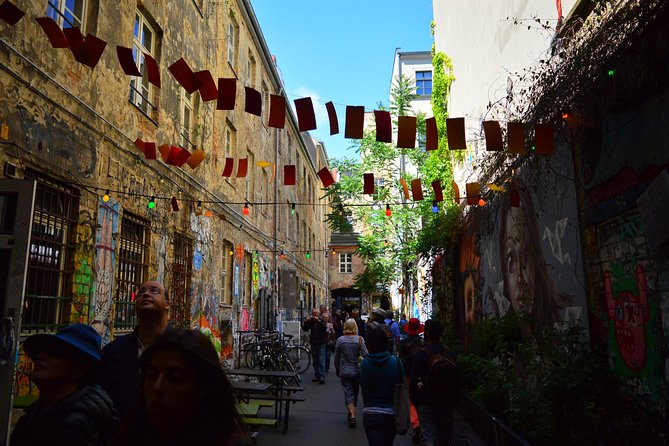
This stop starts with architecture, but it quickly turns into people. The Hackesche Höfe are an interconnected complex of courtyards on Rosenthaler Straße, originally built in the late 19th century. This is the kind of place where you can almost picture daily movement: artisans, merchants, and Jewish immigrants contributing to Berlin’s cultural fabric.
What you’ll get from having a guide here is the “why” behind the courtyards. It’s not just pretty stone and passages. It’s the spatial story of migration and community building, and it sets a baseline for everything that follows.
If you’re the type who likes to read a city as a map of human stories, this is a great first stop. It also works well if you want your first hour to feel less heavy than what’s coming later.
The New Synagogue and Centrum Judaicum: from 1866 to a visible act of remembrance
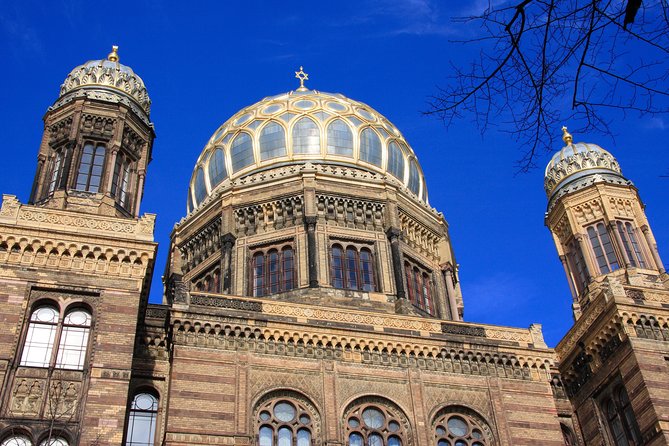
Next comes the Stiftung Neue Synagoge Berlin, also known as Centrum Judaicum, in and around the restored New Synagogue. The building’s original opening in 1866 is part of the emotional math here. You’re not only looking at a monument, you’re looking at a long arc of Jewish life, disruption, and renewal.
Your guide will help you connect the building’s distinctive dome and details with the center’s role as both museum and place of remembrance. You’ll also get a sense of how Berlin uses education and exhibitions to keep Jewish culture and contributions in the public conversation today.
One possible drawback: if your group wants a museum-style deep read with lots of time inside, a short stop may feel fast. Still, for an orientation and exterior emphasis in a 4-hour walk, it hits the right note.
Otto Weidt Museum: a workshop story of protection, falsified papers, and courage
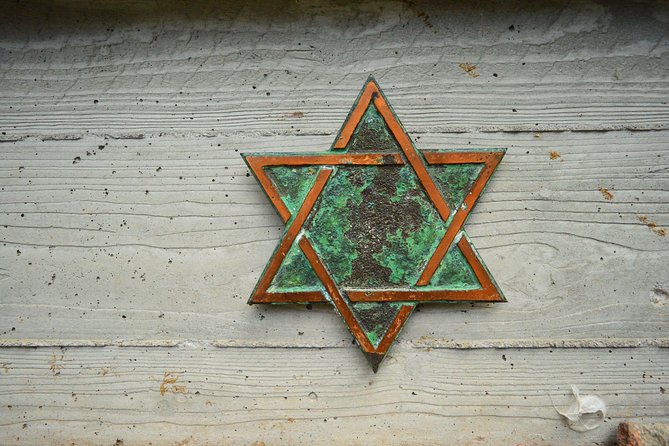
The Museum Blindenwerkstatt Otto Weidt is small, but it lands hard because it’s specific. Otto Weidt was a blind brush maker who employed and protected Jewish workers during the Nazi regime. The tour’s time here is about understanding what protection looked like at ground level, not just the broad historical labels.
In the original workshop space, you’ll hear how Weidt supported workers and what measures were used to keep people safe, including tactics like creating false papers and leaning on his influence to reduce deportation risk. That kind of detail matters because it shifts the story from abstract tragedy to practical, desperate choices.
Many people find this stop especially touching. Even in a fast walk day, it’s one of the places where your guide’s phrasing can change how you experience the room.
More German cities at walking speed:


Gleis 17 Memorial: the deportation platform, anchored by names and dates
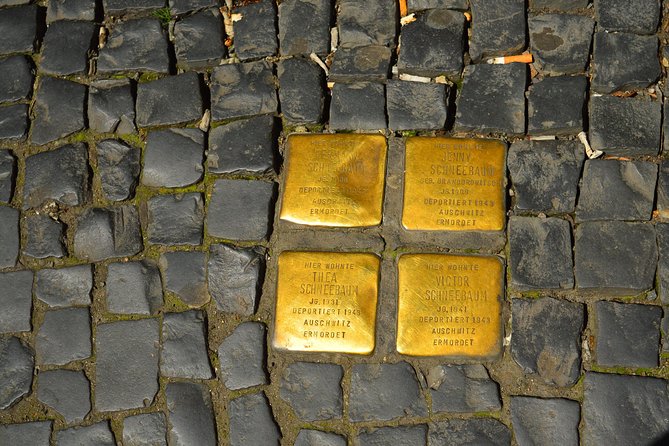
At Gleis 17 Memorial at Grunewald train station, the tone changes. This site marks the painful fact that between 1941 and 1945, thousands of Jews were forcibly transported from this area to concentration camps and extermination sites across Europe.
What’s powerful here is the memorial installation. Metal plaques embedded in the ground display names of deported individuals and the dates of their transports. That format keeps the focus from becoming a vague, sweeping abstraction, and it gives your mind something concrete to hold.
If you’re sensitive to heavy history, plan a slow pace through this part. It’s also a good moment to ask your guide how to think about the site without turning it into a checklist of facts. A strong guide will help you do that.
Alter Judischer Friedhof: learning Berlin through tombstones and inscriptions
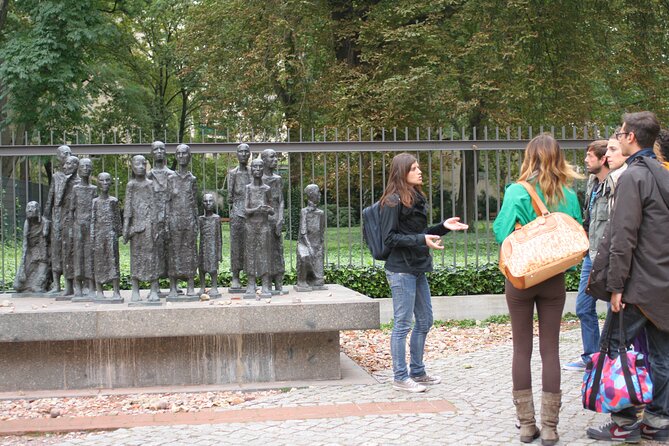
The Alter Judischer Friedhof, the Old Jewish Cemetery, gives you a different kind of learning. You’re walking among intricate tombstones and memorials with artistic styles and epitaphs that reflect the lives and legacies of prominent Jewish figures.
This stop often works as a mental reset after the memorial intensity of earlier parts of the walk. It’s quieter, and it lets you reflect on continuity, generations, and the way communities leave records even when everything else is torn apart.
One consideration: cemeteries have their own pace. If your group is prone to speeding from stop to stop, it helps to set expectations with your guide early, so you get a respectful amount of time to read and absorb.
Rosenstraße Block der Frauen: the protest that forced attention in early 1943
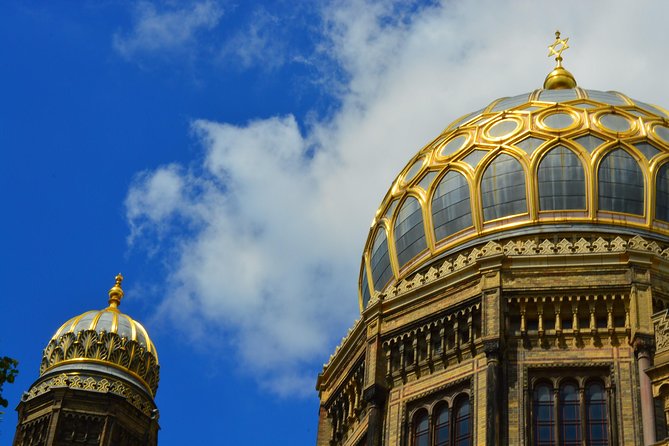
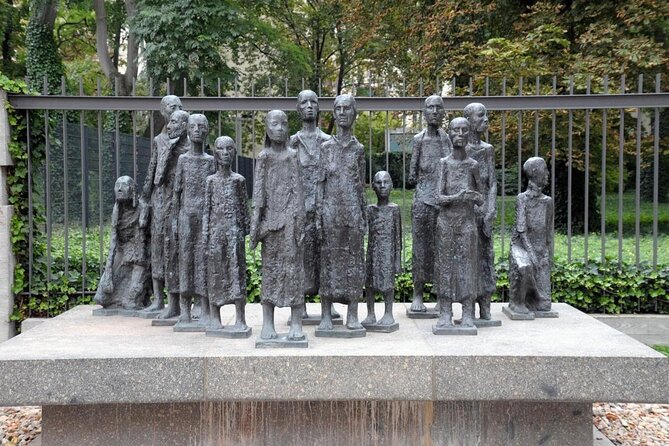
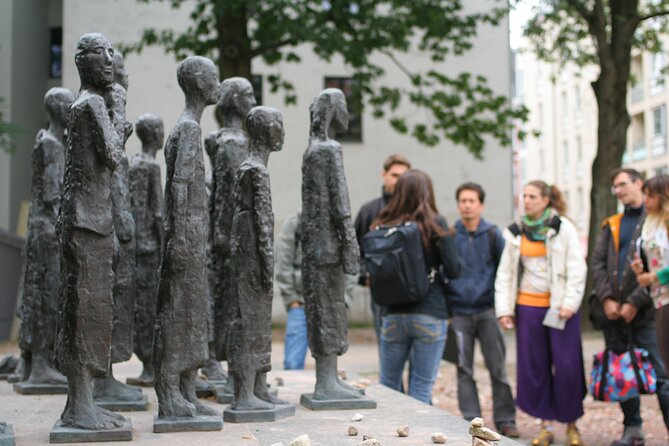
At the Block der Frauen memorial on Rosenstraße, you shift from what was taken to what people resisted. This memorial honors the brave women who protested for the release of their Jewish husbands during the Nazi period in Berlin.
The key detail is timing and duration. The protests happened in early 1943, when many Jewish men were being rounded up for deportation, and the demonstrations lasted for several days. Your guide’s job here is to put you in that moment, including how the women pushed back against police headquarters and risked severe consequences to stand up for family members.
This stop is also useful because it balances the narrative. You still confront horror, but you also see agency, community action, and courage.
Holocaust Memorial: what the slabs and the maze are trying to do
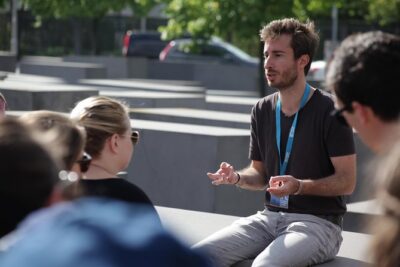
The Memorial to the Murdered Jews of Europe, known as the Holocaust Memorial, is the final stop and one of the most famous sights in Berlin. It’s made of 2,711 concrete slabs in a grid across a field, designed by Peter Eisenman and opened in 2005.
Walking through it creates disorientation on purpose. The changing heights and the maze-like paths make it hard to settle your thoughts quickly. That design is a tool, not a gimmick, and it helps you feel how movement and direction can fail in the face of incomprehensible events.
At the same time, your experience will depend on your personal tolerance for emotional spaces. If you need a slower pace, tell your guide and they can adjust. Some guides handle this part with a careful, respectful tone, and that can make the difference between feeling overwhelmed and feeling grounded enough to reflect.
What makes the private guides matter, and why your questions count
This is one of those tours where the guide is not a minor upgrade, they’re half the experience. In the feedback I’ve seen reflected in how the tour is run, guides such as Mickail, Eran, Ioana, Nikolai, Ariel, Zvika, Asaf, Oren, and Finn are praised for being friendly, flexible, and willing to answer questions honestly.
A few practical strengths show up again and again:
- Many guides are good with difficult historical and current topics, and they don’t dodge follow-up questions
- Your pace can adjust when weather changes, including rain
- Guides often connect Jewish Berlin to what you can notice in modern neighborhoods today
- Family groups often get patience, including explanations that work for younger visitors
There’s also an added value if you want personalization. Some guides will use family ties as a starting point for context, helping you connect larger history to the scale of your own story.
If you’re traveling with kids, this matters. The tour includes heavy themes, but the way a guide frames it can keep it age-appropriate without sanding off the truth.
Logistics you can handle easily: meeting up, transit, and keeping the day comfortable
The tour offers pickup, and it runs near public transportation. That combo is useful in a city where transit is good, but timing can get messy if you’re trying to coordinate multiple sites on your own.
You’ll also get a mobile ticket. Bring your phone with enough battery, and keep your confirmation handy.
What to bring is simple:
- Comfortable walking shoes for moderate walking
- A weather-ready layer, because the tour runs in all conditions
- Something light to drink or snack time-wise, since food and drinks are not included
Finally, if you’re booking, plan ahead. The average booking window is about 70 days in advance, and earlier booking usually gives you more date choices.
Should you book this Jewish Heritage Berlin Walking Tour?
Yes, I’d book it if you want the city’s Jewish landmarks connected into a single, understandable story. The private format is where you get real value, especially if you like to ask questions, need context at memorial sites, or want a guide who can shift the pace to match your group.
I’d think twice only if you know your group cannot handle emotionally intense history at sites like Gleis 17 and the Holocaust Memorial. If that’s you, consider still booking but message your guide ahead of time about your needs, so the pacing and framing can be adjusted.
If you want Berlin without confusion, with a human guide walking you through both life and loss, this tour is a strong choice.
Centuries Per Block
- Berlin: Natural History Museum Entrance Ticket
★ 4.6 · 3,382 reviews - Berlin: 3-Hour World Heritage Cruise to Potsdam
★ 4.5 · 1,569 reviews - Berlin: History of the Third Reich Guided Walking Tour
★ 4.7 · 791 reviews - Berlin: Berlin Charité Guided History Tour
★ 4.4 · 660 reviews
Fresh on the arrivals board for Berlin



Guided Walks in Berlin, compared.
Berlin City walk Government District and Places of Democracy
Read our review →
Berlin’s Best: 2 Hour Walking Tour Third Reich and the Cold War
Read our review →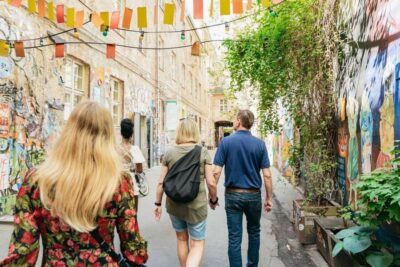
Third Reich Berlin: Hitler and WWII Walking Tour
Read our review →
Browse the lists this tour appears in