
Reviewed · GUIDED WALKS IN BERLIN
Private walking Tour: Berlin Architecture Tour
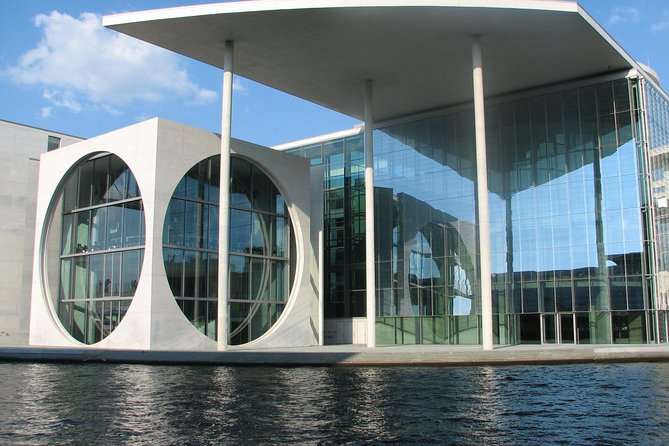
Berlin architecture is politics in disguise. This private, 4-hour tour connects the dots between East and West Berlin through buildings you can actually see, and it keeps the pacing human with a guide who can steer you around your priorities. I like how hotel pickup and drop-off removes friction so you can focus on the skyline and street details.
Two things I really appreciate: the route is built for contrast, so you get both big “wow” landmarks and the in-between neighborhoods that explain how Berlin grew. I also like that the experience is private and customized, so you can ask for specific stops or photo angles instead of rushing with a crowd.
One consideration: this is not a cheap “see it from the bus” tour. At $191.87 per person, it is best when you care enough about design and history to justify a full guide-led morning or afternoon.
In This Review
- Key points to know before you go
- Berlin’s Buildings Tell the Story of Who Held Power
- Hotel Pickup, English Guide, and a Route You Can Adjust
- Stop 1: Museum Island for Neoclassical Grandeur and Restored Charm
- Stop 2: Gendarmenmarkt and the Architectural Trio You Will Actually Notice
- Stop 3 and 4: Berliner Philharmonie and the Reichstag Glass Dome Contrast
- Stop 5: Potsdamer Platz as a Berlin Rebuild Story in Steel and Glass
- Stop 6: Berliner Dom for Scale, Symmetry, and an Interior That Looks Dramatic
- Stops 7 and 8: Kreuzberg and Friedrichshain for the Everyday Texture of East and West
- Stop 9 and 10: Pariser Platz and Hackescher Höfe for Classic Facades and Courtyard Drama
- What Makes This Tour Worth the Money: The Guide Factor
- Timing, Wear Shoes, and How to Plan Your Day Without Stress
- Who This Tour Is For (and Who Might Want Another Option)
- Should You Book This Private Berlin Architecture Tour?
Key points to know before you go
- Private guide, private pace: only your group, with room to tailor stops.
- East-West architecture in one sweep: post-World War II division shows up in the shapes and materials.
- Photo-friendly landmarks: Museum Island, Gendarmenmarkt, the Philharmonie, and the Reichstag route you through best-view areas.
- Two ways to do it: you can walk or choose bike during the tour.
- Classic and modern collide: you’ll see neoclassical, postwar cultural buildings, and sharper contemporary designs in the same day.
- Strong guide reputation: guides named in past tours include Ariel, Sara (an architect), Thomas, Daniel, Heiko, and Tarek Ibrahim, with consistent praise for clarity and flexibility.
Berlin’s Buildings Tell the Story of Who Held Power
Berlin is one of those cities where architecture isn’t decoration, it’s evidence. The tour’s core idea is the divide after World War II, and how the East and West kept rebuilding with different political and cultural priorities. That contrast is the thread that makes everything from domes to modern glass feel connected, not random.
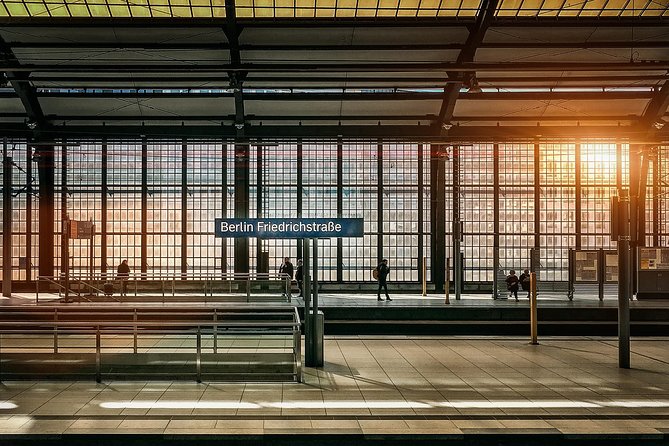
I especially like that this is not just “pretty buildings” spotting. You’re also looking at urban renewal and cultural rebuilding, like what happened around major corridors such as Friedrichstraße, and how major cultural sites were reconstructed or newly planned after losses behind the Berlin Wall.
And yes, the photo ops are real. The route is lined with recognizable ensembles, and the guide helps you position for the right angles, especially at squares and major public buildings.
More Guided Walks in Berlin
- Discover Berlin Half-Day Walking Tour
★ 5.0 · 9,624 reviews - Berlin City walk Government District and Places of Democracy
★ 4.7 · 8,467 reviews - Berlin: Third Reich & Cold War Guided Walking Tour
★ 4.9 · 8,378 reviews
Hotel Pickup, English Guide, and a Route You Can Adjust
Your tour starts with a central hotel meet-and-greet in the lobby. That matters in Berlin, because “meeting in a landmark” can turn into 20 minutes of walking in circles if your directions are slightly off. With pickup, you get right into the architecture.
This is also offered in English, and it’s truly private, so you are not sharing the guide with other groups. You can ask for specific requests for desired attractions, which is where the tour feels more like a curated plan for you, not a fixed checklist.
One more practical detail: you can do it on foot or by bike. If you like seeing more territory without feeling wrecked, the bike option can help. If you want to slow down and linger for photos, walking is the better fit.
Stop 1: Museum Island for Neoclassical Grandeur and Restored Charm
Museum Island is the kind of place where the skyline keeps changing as you turn a corner. The main draw here is variety within a compact area, so you get a quick “architecture lesson” without needing museum tickets as part of the day.
You start at the Altes Museum, a neoclassical showpiece with big columns and a formal portico. It’s built to feel monumental, and the symmetry makes it easy to photograph without complicated planning.
Then you move through the other island icons, including the Pergamon Museum’s monumental classical façade. That size and theatrical styling is part of the point, because it shows how monumental design can project confidence, even when the city’s later history gets much more complicated.
The Bode Museum adds a baroque touch, with an elegant dome and smooth curves. The Neues Museum brings the modern-restored layer into the mix after wartime damage, which makes the whole area feel like a timeline you can walk through.
Even if you do not plan to go inside, you’ll get photo opportunities from multiple corners and perspectives, including panoramic angles toward the Spree.
Stop 2: Gendarmenmarkt and the Architectural Trio You Will Actually Notice
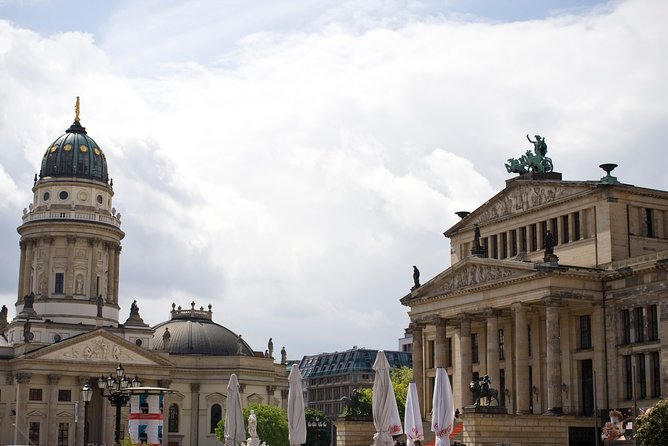
Gendarmenmarkt is one of Berlin’s most beautiful squares for a reason. The layout is clean, the sightlines are strong, and the buildings frame the space like a stage set.
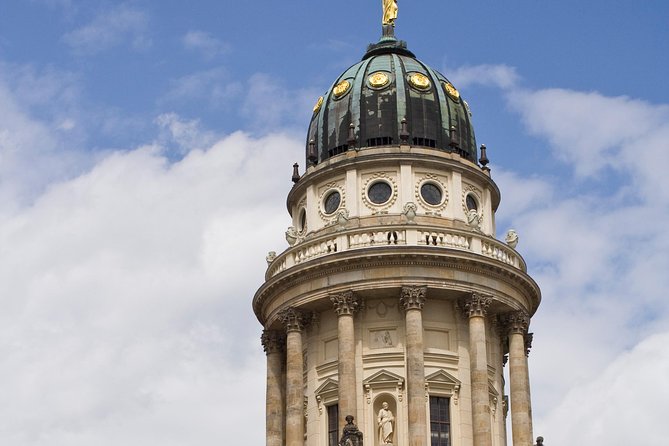
The main attraction is the architectural trio: the Deutscher Dom, the Französischer Dom, and Schinkel’s Konzerthaus. You’ll recognize the drama right away, especially the domed cathedrals that mirror each other on either side of the square. The Konzerthaus adds the concert hall presence in the ensemble, and the overall effect is more coordinated than it sounds on paper.
There’s also a statue of Friedrich Schiller at the center, which gives you an easy reference point for photos. If you like architecture, you’ll also appreciate the square as an outdoor “reading room.” The buildings are close enough that you can look up and still see how the façades relate to street level.
The tour keeps the stop short, so come in ready to look fast, then spend your extra time once the guide points out what to watch for.
Stop 3 and 4: Berliner Philharmonie and the Reichstag Glass Dome Contrast
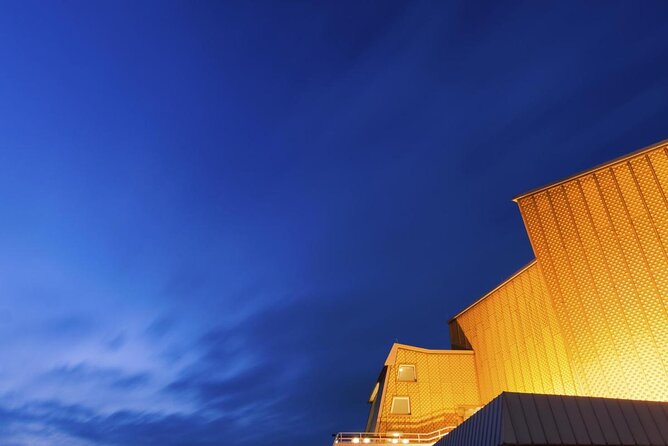
Berlin’s modern culture buildings are not shy about style. The Berliner Philharmonie is famous for its tent-like asymmetrical shape, and it works visually even from a distance. This is modern architecture that doesn’t hide.
Inside matters if you plan it, but on this tour you are mainly getting the architectural exterior experience, plus a quick orientation to why this design is so important. The circular interior is designed for acoustics, which gives the building a purpose beyond looks.
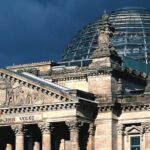
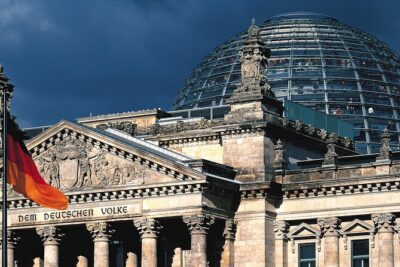
Then you shift to the Reichstag Building, where the story becomes about old power and new ideals in one view. The Reichstag’s original classical façade dates to 1894, and the dramatic change is the glass dome added during the renovation after reunification, designed by Norman Foster.
What I like here is the contrast: the older structure reads as authority and permanence, while the glass dome signals transparency and a different kind of symbolism. The dome also gives spectacular views, so even a short stop can feel worthwhile for skyline photos and that “Berlin today” perspective.
More German cities at walking speed:



Stop 5: Potsdamer Platz as a Berlin Rebuild Story in Steel and Glass
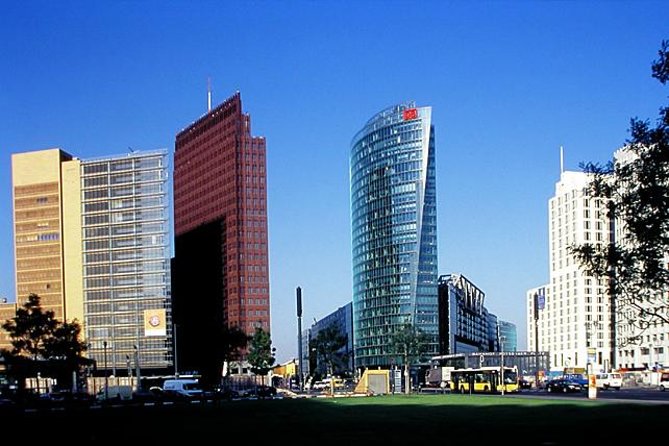
Potsdamer Platz is a physical lesson in how a city heals after ruin. Before World War II, it was a busy center, then it became a Cold War divide, split by the Berlin Wall and left to sit in a complicated in-between.
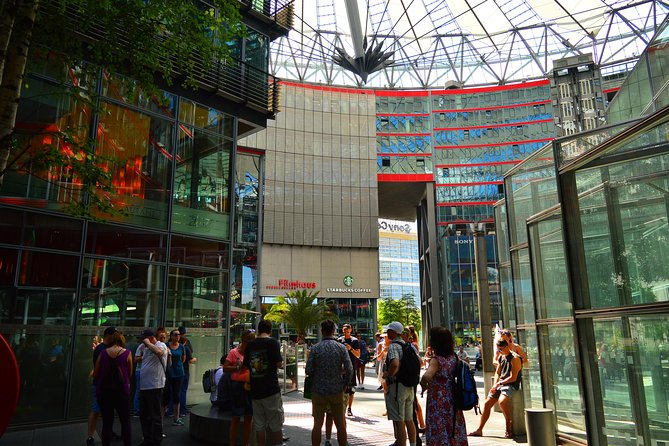
Today, it’s a modern hub with cutting-edge office buildings and public spaces. You’ll pass the Sony Center with its iconic glass roof, and the DB Tower, which dominates the skyline with its sleek glass-clad presence.
The Panoramapunkt is another highlight for views of Berlin’s changing skyline, which is a nice capstone after you’ve spent time understanding the past. This stop works best if you treat it as a “before and after” moment, not just another place to photograph.
Stop 6: Berliner Dom for Scale, Symmetry, and an Interior That Looks Dramatic
The Berliner Dom is one of the clearest iconic landmarks on the route, and the exterior makes its point fast. Completed in 1905, it blends Baroque and Renaissance Revival styles, with a huge central dome that towers over everything nearby.
This dome size is the main visual anchor, and the façade uses symmetry and elaborate detailing to create a sense of ceremony. You’ll also notice the richness in the stonework and sculptural elements on the exterior.
What you get from this stop on an architecture-focused day is contrast with the modern parts you’ve seen. After the Philharmonie’s modern boldness and the Reichstag’s glass symbolism, the Berliner Dom feels like a different style of presence, built to impress through mass and ornament.
The stop is short, but you can still appreciate why this cathedral style has lasted as a city symbol.
Stops 7 and 8: Kreuzberg and Friedrichshain for the Everyday Texture of East and West
Once the route moves into neighborhoods, the architecture shifts from “icons” to lived-in city scenes. This is where the tour explains Berlin’s growth in a more human way, because buildings stop being theory and start being street-level reality.
In Kreuzberg, you get a mix of old and new. The area is known for an eclectic, creative atmosphere, and architecturally you see 19th-century Altbau apartment buildings alongside industrial-style loft conversions and newer developments. Altbau buildings have those recognizable façade rhythms, plus high ceilings and older urban proportions that make the streets feel different from newer districts.
You’ll also reach Oberbaum Bridge, one of the most iconic Kreuzberg photo spots. Its red-brick towers and Gothic-inspired arches make it easy to see why this bridge is a favorite for photographers. Even in a short stop, you can frame the bridge as a visual link between neighborhoods across the Spree.
Then you cross into Friedrichshain, which sits in the former East Berlin. The architectural theme here includes pre-war Altbau apartment buildings too, but the tour’s emphasis is on the socialist-era structures and later developments layered into the same streets.
If you want one East Berlin cultural marker on the walk, the East Side Gallery comes up as an open-air mural stretch along a surviving section of the Wall. Even when you’re not a museum person, this kind of street-scale history hits differently, because it’s right there in the urban fabric.
Stop 9 and 10: Pariser Platz and Hackescher Höfe for Classic Facades and Courtyard Drama
Pariser Platz is a study in architectural coexistence. At its center is the Brandenburg Gate, the neoclassical triumphal arch that has become a Berlin symbol tied to unity and peace. The surrounding buildings add variety, which is the whole point of the square.
You’ll see structures including Hotel Adlon and embassy buildings, plus a modern counterpoint: the DZ Bank building by Frank Gehry, completed in 1999. Gehry’s fluid, sculptural glass and steel façade creates a strong contrast against the classical edges around it. It’s a great moment to ask yourself which style feels more “Berlin to you,” because both are intentional.
Then the tour finishes with Hackescher Markt and Hackescher Höfe, a classic early 20th-century architectural landmark built in 1906 by August Endell. This is where Berlin gets playful in stone, tile, and ironwork.
Hackescher Höfe is a complex of interconnected courtyards, and the Art Nouveau design shows up in details like ceramic tile patterns and decorative metalwork. Each courtyard has its own style, so if you like stepping into spaces where buildings shape the walk experience, you’ll enjoy this. It’s also an easy place to slow down for photos because the textures and corners reward close looking.
What Makes This Tour Worth the Money: The Guide Factor
At $191.87 per person for about 4 hours, the value depends on one big thing: the guide. When the guide is strong, the day turns from sightseeing into understanding. The names mentioned by past participants point to that pattern: guides like Sara, an architect by training, plus Ariel, Thomas, Daniel, Heiko, and Tarek Ibrahim.
What I find consistently useful from guides like this is the ability to explain what architects were trying to do. It’s not just dates and names, it’s how design choices reflect political ideology, cultural priorities, and what a city wanted to signal at that moment in time.
I also like the flexibility element. In practice, that means your pace can shift, your stops can adjust, and the day does not feel like a rigid march. One of the strongest notes about guides on this experience is that they can tailor the tour to your interests, which is exactly what you want on an architecture day.
If you care less about buildings and more about political story, the guide can still steer you through the same landmarks with that focus. If you care more about design details, you can spend extra seconds looking at façades and materials instead of rushing.
Timing, Wear Shoes, and How to Plan Your Day Without Stress
This is a half-day tour in the practical sense, around 4 hours. That’s a sweet spot in Berlin, because you can still do museums, food, or neighborhood wandering afterward without feeling like you booked your entire trip into one activity.
You’ll be outside at multiple major sites, including open squares and large public buildings. You do not need heavy planning, but you should dress for walking and bring a camera, because the stop design is built for photos.
Food and drinks are not included. That means you should plan a lunch or snack before you go, or keep your schedule loose after. If you already have reservations, you can usually work around them with the guide, since tailoring is part of the experience.
If you want the day to feel extra smooth, make sure you have a clear meeting point at your hotel and arrive a few minutes early. Berlin loves good shoes and good timing.
Who This Tour Is For (and Who Might Want Another Option)
This tour is a great fit for you if you like architecture, you like comparing styles, and you enjoy history when it’s tied to actual streets and buildings. It also works well for first-timers because the route naturally gives orientation, especially around Museum Island, the cultural district, and major central landmarks.
It’s also a strong choice for couples and small groups who want a private plan and the ability to pause for photos. If you are bringing an older teen or a design-minded adult, it can make the city feel more understandable fast.
If you only want a casual highlights walk and you do not care about the story behind the buildings, you might find it too focused. This tour rewards attention, not just passing glances.
Should You Book This Private Berlin Architecture Tour?
I’d book it if you want architecture with context, not architecture as wallpaper. The private setup, hotel pickup and drop-off, and the ability to tailor the day make the experience feel efficient and personal, and the route covers both the dramatic icons and the neighborhood textures that explain Berlin’s rebuild.
I would think twice only if your budget is tight or if you prefer free-form exploring with no guide context. For most people who care even a little about how design reflects power, culture, and time, this is the kind of half-day that pays off immediately when you walk away and start noticing buildings on your own.
Fresh on the arrivals board for Berlin
Guided Walks in Berlin, compared.
Berlin City walk Government District and Places of Democracy
Read our review →
Berlin’s Best: 2 Hour Walking Tour Third Reich and the Cold War
Read our review →
Third Reich Berlin: Hitler and WWII Walking Tour
Read our review →
Browse the lists this tour appears in