
Reviewed · GUIDED WALKS IN BERLIN
Private Walking Sightseeing Local Berlin Tour Guides up 15 Person
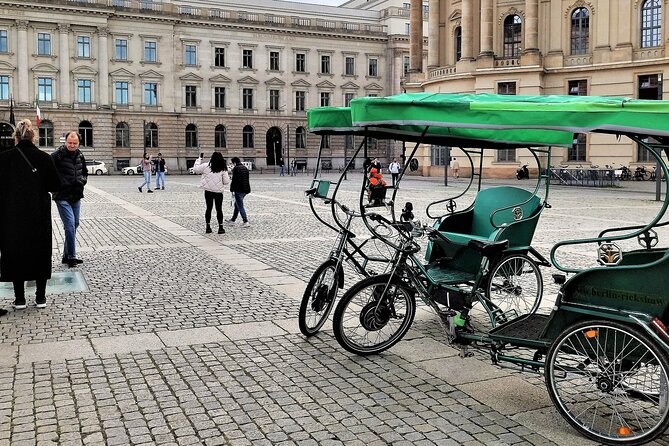
Berlin is easier when you ride, not just walk. This private Berlin e-rickshaw tour rolls you through central sights fast, with a guide who keeps the stories clear at places like Alexanderplatz and Checkpoint Charlie. I especially love the comfort touches, bottled water and blankets, because Berlin weather can swing hard, and it makes the ride feel thoughtful, not rushed.
The second big win is the human pacing. You get hotel pickup and drop-off and a route shaped to your interests, with guides such as Levi and Levent praised for friendly humor and strong English. One thing to factor in: admission for Berliner Fernsehturm is not included, so if you want to go up, you’ll pay separately.
In This Review
- Key points to know before you go
- First, the vibe: why an e-rickshaw makes Berlin make sense
- Pickup, private touring, and the up-to-15 group limit
- The 4-hour route: Alexanderplatz, the TV Tower area, and Museum Island
- Bebelplatz and Gendarmenmarkt: a two-part lesson in Berlin
- Checkpoint Charlie and Topography of Terror: wall history without the maze
- Potsdamer Platz, the Holocaust Memorial, and Brandenburg Gate in one sweep
- Reichstag area, the Sinti and Roma memorial, and the government district
- Price and value: what you get for about $174.22
- Who this tour fits best (and who might want a different plan)
- Should you book this private Berlin e-rickshaw tour?
- FAQ
- How long is the private walking sightseeing local Berlin tour?
- What does the tour cost per person?
- Is this tour private?
- How many people can be in the group?
- Do you offer hotel pickup and drop-off in Berlin?
- Is the tour offered in English?
- What is included on the e-rickshaw ride?
- Is admission included for Berliner Fernsehturm?
- What is the cancellation policy?
Key points to know before you go
- Hotel pickup and drop-off in central Berlin saves real time.
- E-rickshaw ride with blankets and bottled water makes the route comfortable.
- Private tour for your group with a cap of up to 15 people.
- Wall history in the middle of the city at Topography of Terror and the memorials.
- A smart landmark sweep from TV Tower to Brandenburg Gate with short stop windows.
- Multiple tour lengths available, from about 2 hours to a full day.
First, the vibe: why an e-rickshaw makes Berlin make sense
Berlin has a way of feeling big. Distances add up, and walking all day can flatten your energy before you ever reach the major sites. This tour flips the equation. You still get out and look around, but the ride does the heavy lifting, letting you connect neighborhoods and landmarks without spending your whole day on sidewalks.
What I like most is how practical it feels. The e-rickshaw is built for city movement, so you can get to spots and angles that are harder to reach in a standard car. Even better, the small comfort extras, like bottled water and blankets, take the edge off cold mornings or breezy afternoons.
And it is not just about convenience. A good guide turns famous places into something you can actually place on a mental map. That matters a lot when it is your first day in Berlin, because it helps you decide what to revisit later.
More Guided Walks in Berlin
- Discover Berlin Half-Day Walking Tour
★ 5.0 · 9,624 reviews - Berlin City walk Government District and Places of Democracy
★ 4.7 · 8,467 reviews - Berlin: Third Reich & Cold War Guided Walking Tour
★ 4.9 · 8,378 reviews
Pickup, private touring, and the up-to-15 group limit
This is a private experience, meaning you and your group are the only participants. That difference sounds small, but it changes the whole tone. You are not stuck watching what someone else wants to do. You can ask questions, slow down, or shift your attention when something catches your eye.
The group size can reach up to 15 people, which is large enough for families or friends traveling together, yet still manageable for a guided walking-and-riding format. If you are traveling with mobility concerns, the e-rickshaw helps a lot because it reduces long stretches of walking. You will still have short transitions on foot between stops, but the route is designed to keep the effort reasonable.
Hotel pickup and drop-off is also a real value point. Berlin is spread out, and saving the “getting there” time helps you start seeing the city sooner. Plus, it cuts down on the stress of figuring out transit on day one.
The 4-hour route: Alexanderplatz, the TV Tower area, and Museum Island
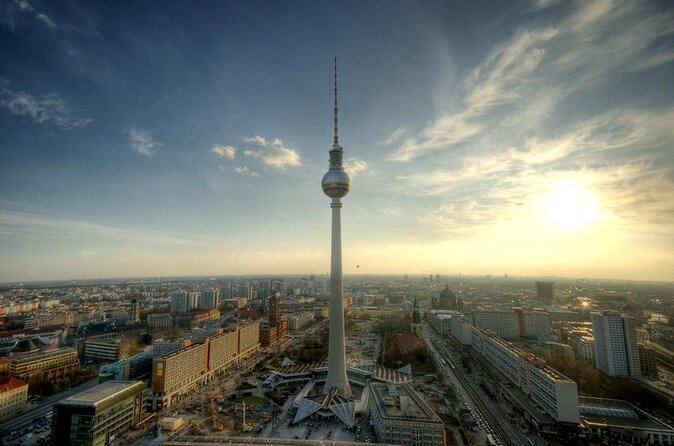
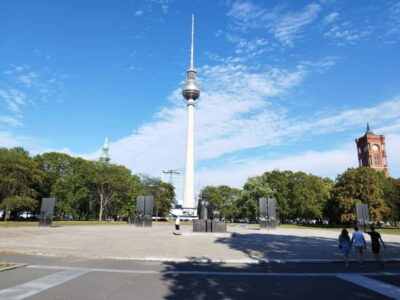
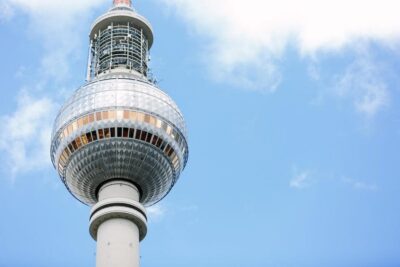
Your tour opens at Berliner Fernsehturm in Alexanderplatz. The TV Tower is Germany’s tallest structure, and it is an anchor point for how Berlin was layered with grand planning. From there, you move past major sights along the way, including the Red Town Hall and St. Mary’s Church, then you arrive at Museum Island.
If you like a “lay of the land” start, this part is ideal. You are getting both a landmark you can recognize from photos and the surrounding streets that explain where the city’s center grew.
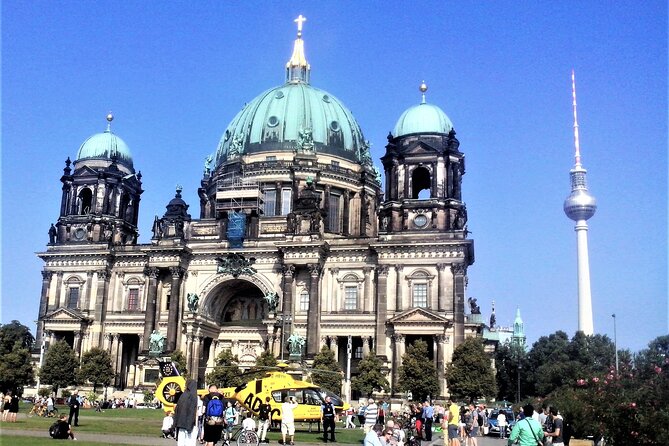
Museum Island is next. This is one of the world’s most important museum complexes and a UNESCO World Heritage Site. Even if you do not go inside any museum, you still get a strong sense of the area’s grandeur. Expect views toward Unter den Linden, and the chance to see recognizable landmarks like the Berlin Cathedral and the unfinished reconstruction of the City Palace. Depending on your route timing, you may also spot several museum buildings tied to the complex, such as the Old Museum, Old National Gallery, Pergamon Museum, and Bode Museum.
Admission is listed as free here, so you can spend your time looking at the architecture and the setting rather than paying for entry. The stop windows are short, so treat these moments like orientation and photo points. If you want deep museum time, you can plan a follow-up day.
One practical note: the Fernsehturm experience itself is not included. That is not a dealbreaker. It just means you should decide in advance if you want to add that viewpoint and budget for it.
Bebelplatz and Gendarmenmarkt: a two-part lesson in Berlin
After Museum Island, you head toward Bebelplatz. This stop works on two levels: architecture and historical memory. The forum around it, tied to Humboldt University and the State Library, frames the square with academic gravitas. You also pass St. Hedwig’s Cathedral, the first Catholic church in Berlin, which adds a different cultural tone to the area.
Then the history lands. Bebelplatz is famous as the Nazi book burning square, where 25,000 books were burned in 1933. There is a memorial to mark the event, and the stop is a short one. Still, it is the kind of moment where a good guide’s framing changes what you take away. You get the place, the event, and why it matters without needing to read a textbook on the spot.
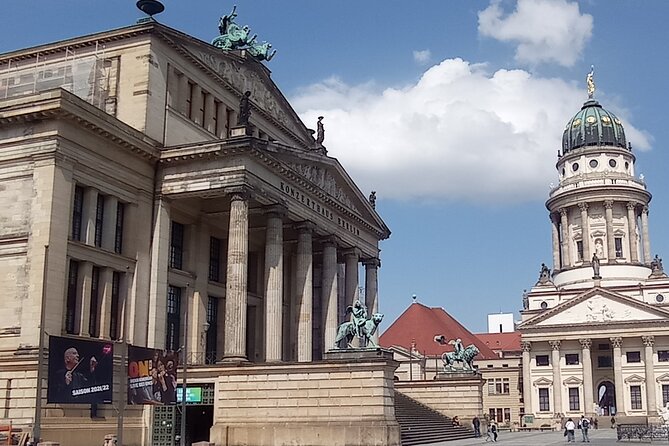
From there you roll into Gendarmenmarkt. This square is often considered among the most beautiful in Europe, and you feel that fast when you see the symmetry. The former Royal Concert Hall sits between the German Dom to the south and the French Dom to the north. It is one of those places that feels made for photos, but it is also worth noticing the relationship between buildings and square design.
This is a good contrast stop. If the earlier square felt heavy, Gendarmenmarkt gives you a visual reset, while still staying in the same central Berlin loop.
Checkpoint Charlie and Topography of Terror: wall history without the maze
Checkpoint Charlie is next, one of the most famous border crossings from the Berlin Wall era. The area is often treated like a symbol, but what makes it worthwhile on a guided route is context. You hear how this crossing almost became the starting point of a third world war. That framing helps you understand the global tension behind what can look like just a historic spot now.
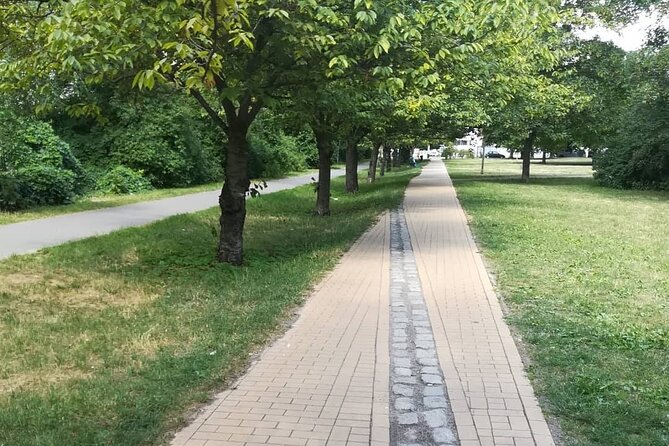
From there you move along the former border strip toward Topography of Terror. Here, you are not only seeing remnants of the Wall, you are also at the site tied to the documentation of National Socialism, including the headquarters of the SS and Gestapo. You get original elements of the Berlin Wall area and a chance to connect the city’s physical geography with what happened here.
The adjacent Martin-Gropius-Bau is also part of the experience. It hosts notable exhibitions, including references to artists like Ai Weiwei and events connected with David Bowie. You also see the Prussian Parliament in front, which helps anchor the area as a layered Berlin moment, not just one era.
Stop times here are brief, so you should use this as a “spotlight” stop. You are getting the key places, the history thread, and the emotional weight. If you want deeper reading, you can choose additional time on a different day.
More German cities at walking speed:


Potsdamer Platz, the Holocaust Memorial, and Brandenburg Gate in one sweep
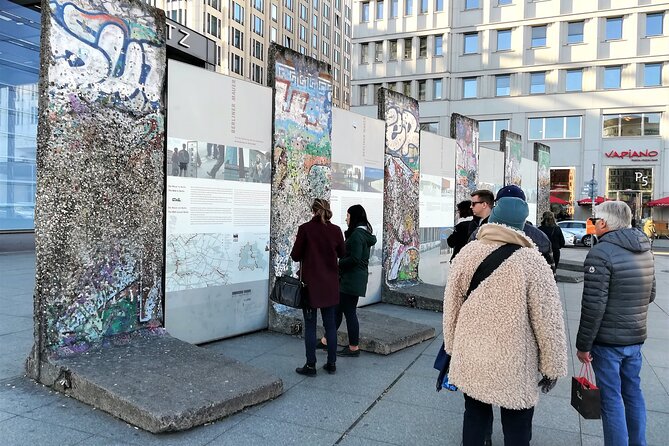
Potsdamer Platz is the next move, and it feels like a time jump. The square was Europe’s largest construction site for decades, and it still reads like a mix of city planning eras. You see skyscrapers and futuristic buildings, with the Sony Center referenced as a landmark feature.
This stop is shorter, but it works because it shows how Berlin rebuilt and reshaped itself. It is not only about what was destroyed. You see how modern Berlin assembled itself around big public spaces.
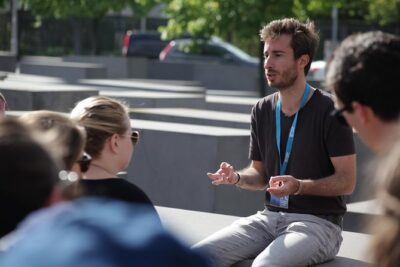
Then the tour reaches the Memorial to the Murdered Jews of Europe, also called the Holocaust Memorial. This memorial opened in 2005 and commemorates the murder of more than 6 million Jews during National Socialism. It is a powerful stop, and you are given time to take it in. A good guide will help you avoid turning it into just another photo moment by placing it in the right moral and historical context.
After that, you continue to Brandenburg Gate. It is one of Berlin’s most famous landmarks, and it works as the “big finish” feel for this section of the city. Even if you have seen pictures before, the scale and visibility in person often hits differently.
This stretch is valuable because it links the Wall-era story to the larger national symbols that came afterward. It is one of the best ways to understand Berlin’s shifts in one guided flow.
Reichstag area, the Sinti and Roma memorial, and the government district
The tour then moves into the government district area, leaving behind the former Eastern part of the city experience and heading toward the Reichstag/Bundestag and Chancellery zones.
Before you settle into the government buildings, there is another memorial stop: the Memorial to the Murdered Sinti and Roma. It is part of the same emotional arc as the Holocaust Memorial, focusing on victims who were persecuted under National Socialism and remembered through place-based commemoration.
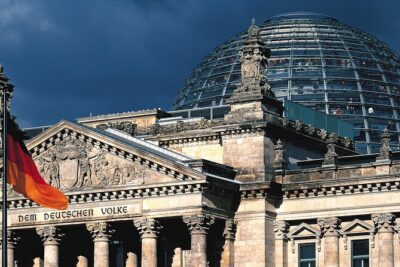
Then you reach the Reichstag Building. Even with a short stop window, you get the sense of what this area represents politically and symbolically. This is the part of the route where the city feels “official,” and it helps you connect the historic streets you just saw with modern Berlin governance.
This stop is brief by design. Treat it as a landing point. If your interests lean heavily into politics or architecture, you can plan an extra walk after the tour ends.
Price and value: what you get for about $174.22
At about $174.22 per person for roughly 4 hours, the price is best understood as paying for time savings, guidance, and comfort. You are not just buying transportation. You are buying a way to cover a concentrated set of central landmarks without the constant stop-start transit planning.
What supports that value:
- Private guiding for your group, not a shared bus lecture.
- Hotel pickup and drop-off, which saves time and energy.
- E-rickshaw ride with bottled water and blankets, helping the experience feel smoother.
- A route that connects major sites in the same central loop, including Wall-related locations and iconic landmarks.
What you should plan for:
- Tips are not included.
- Berliner Fernsehturm admission is not included, so decide if you want that extra experience before you arrive at the tower area.
If you are the kind of traveler who likes to see a lot early, this tour can pay off fast. If you are the kind of traveler who likes deep time in a single museum, pair the tour with a longer second visit elsewhere. Think of this as the “get oriented, learn the story, pick your next move” option.
Who this tour fits best (and who might want a different plan)
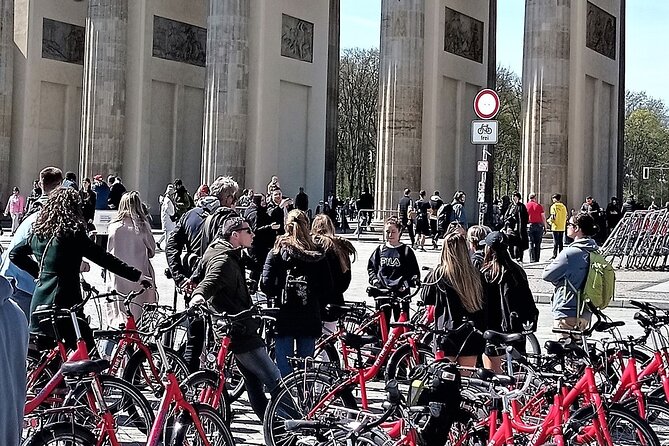
This experience is ideal if you:
- Want an efficient way to see central Berlin in a half day
- Prefer a guided story over solo wandering
- Appreciate a ride that reduces walking, especially in cooler weather
- Travel as a family, a couple, or friends who want your own group’s pace
It is also a great first-day choice. The route gives you anchors you can recognize later, like Alexanderplatz, Brandenburg Gate, and Checkpoint Charlie. Guides such as Levi and Levent are specifically praised for keeping the tone friendly and for explaining the history clearly in English, with humor that keeps the ride from feeling like a lecture.
If you are traveling with a strong interest in one museum collection, you might feel the short stop windows are too brief. In that case, use this for the orientation and then spend your longer time elsewhere.
Should you book this private Berlin e-rickshaw tour?
Yes, if you want a smart, comfortable way to connect Berlin’s biggest landmarks and Wall-era history without spending your whole day commuting or walking. The mix of short, well-chosen stops and an e-rickshaw that handles the distance makes it a very practical Berlin introduction.
Book it especially if:
- You want a first-day bearings builder
- You value hotel pickup and a calm group pace
- You appreciate guides who bring both facts and personality, with English that is easy to follow
Skip it or adjust expectations if you know you want long museum time, because this format is designed for seeing and understanding key places, not for extended gallery hours.
FAQ
How long is the private walking sightseeing local Berlin tour?
The tour runs about 4 hours.
What does the tour cost per person?
The price is listed as $174.22 per person.
Is this tour private?
Yes. It is private, and only your group participates.
How many people can be in the group?
The tour is described as up to 15 people.
Do you offer hotel pickup and drop-off in Berlin?
Pickup is offered, and the tour notes hassle-free pickup and drop-off at your central Berlin hotel.
Is the tour offered in English?
Yes, it is offered in English.
What is included on the e-rickshaw ride?
Bottled water and blankets are provided.
Is admission included for Berliner Fernsehturm?
No. Berliner Fernsehturm admission is not included. Other listed stops have admission listed as free.
What is the cancellation policy?
You can cancel for a full refund if you cancel up to 24 hours in advance of the experience start time. If you cancel less than 24 hours before, the amount paid will not be refunded.
Fresh on the arrivals board for Berlin
Guided Walks in Berlin, compared.
Berlin City walk Government District and Places of Democracy
Read our review →
Berlin’s Best: 2 Hour Walking Tour Third Reich and the Cold War
Read our review →
Third Reich Berlin: Hitler and WWII Walking Tour
Read our review →
Browse the lists this tour appears in