
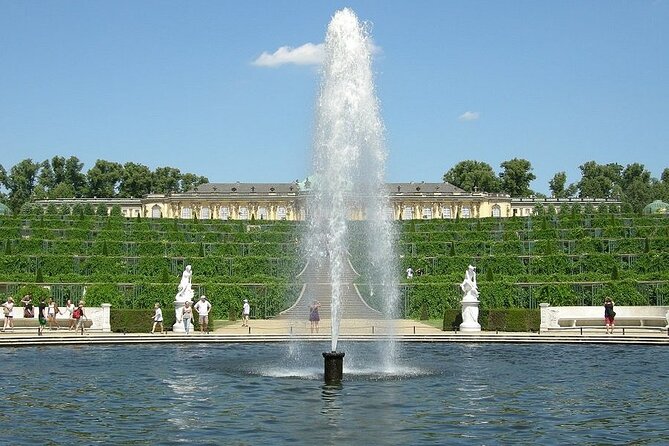
Reviewed · GUIDED WALKS IN BERLIN
Potsdam Private Walk Tour By car from Berlin
Prussian palaces, packed into one calm day. I love the private group setup with a guide who keeps the day moving and explains what you are looking at. I also love the built-in photo wins, especially around Sanssouci Palace. The main drawback to plan for is that the schedule is tight, so you will get comfort visits and highlights, not leisurely museum marathons.
This is a 6-hour, guide-led Potsdam day from Berlin, offered in English with pickup and a mobile ticket. You are centered on UNESCO World Heritage grounds in Potsdam, plus the heavyweight 20th century history at Schloss Cecilienhof, where the Potsdam Conference shaped the postwar order.
In This Review
- Key things I’d bet on before you book
- From Berlin by car to Potsdam, with a guide who sets the pace
- Sanssouci Park: the Prussian Arcadia stage for your first great photos
- Sanssouci Palace: Frederick the Great’s Rococo pleasure palace
- Neues Palais: the big statement at the western end of the main promenade
- The Dutch Quarter: 134 brick houses built by Jan Bouman and the soldier king
- Schloss Cecilienhof and the Potsdam Conference that changed Europe
- Price, tickets, and why the private format can be worth it
- Walking comfort and photo strategy for a smooth day
- Who this private Potsdam day fits best
- Should you book this Potsdam Private Walk Tour from Berlin?
- FAQ
- How long is the Potsdam tour?
- Is pickup from Berlin included?
- What language is the tour guide?
- Is this a private tour?
- Which major sites are included?
- Are admission tickets included for each stop?
- Is the tour mostly walking?
- What happens if the weather is bad?
- Can I cancel for a full refund?
Key things I’d bet on before you book
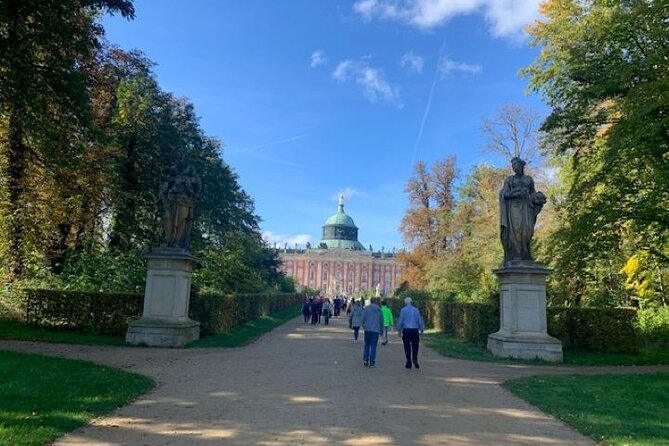
- Private, just your group: the pace and route can be managed for your people, not a big crowd
- Sanssouci Park first: start where the views and context are easiest to grasp
- Top landmarks in a single loop: Sanssouci Palace, Neues Palais, the Dutch Quarter, and Cecilienhof
- Some admissions are on you: park and the Dutch Quarter are free, palace and conference palace entries are not included
- You need decent weather: the experience depends on conditions that affect walking outdoors
From Berlin by car to Potsdam, with a guide who sets the pace
What makes this day work is the handoff from Berlin to Potsdam. Pickup is offered, and you are traveling by car rather than trying to brute-force public transit with luggage, snacks, and everyone’s phone batteries. That matters on a half-day sightseeing plan, because getting there late or scattered ruins the best parts of Potsdam.
Once you are in Potsdam, the guide’s job is not only to point. It is to connect dots fast: who built what, why the king wanted it there, and what you are seeing when styles shift from intimate pleasure to official power. The tour is designed as a walk tour, so you will be on your feet for long stretches, with stops measured in tens of minutes rather than hours.
One more practical note: the included time at each stop is limited, and several sites have optional interior visits that depend on ticket lines and opening access. In a perfect day, it feels like a best-of album. In a less cooperative day, it can feel more efficient than slow and savoring.
More Guided Walks in Berlin
- Discover Berlin Half-Day Walking Tour
★ 5.0 · 9,624 reviews - Berlin City walk Government District and Places of Democracy
★ 4.7 · 8,467 reviews - Berlin: Third Reich & Cold War Guided Walking Tour
★ 4.9 · 8,378 reviews
Sanssouci Park: the Prussian Arcadia stage for your first great photos
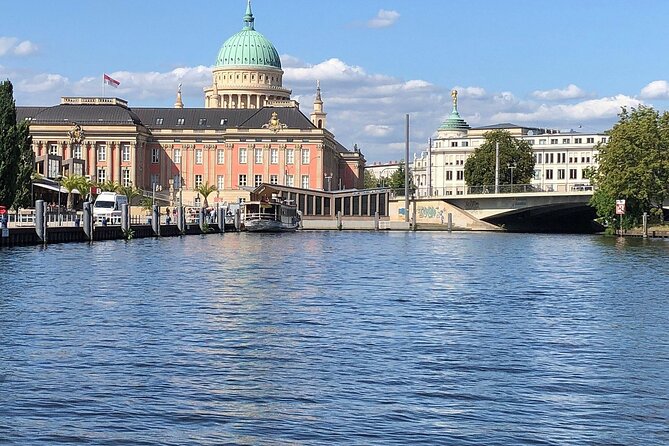
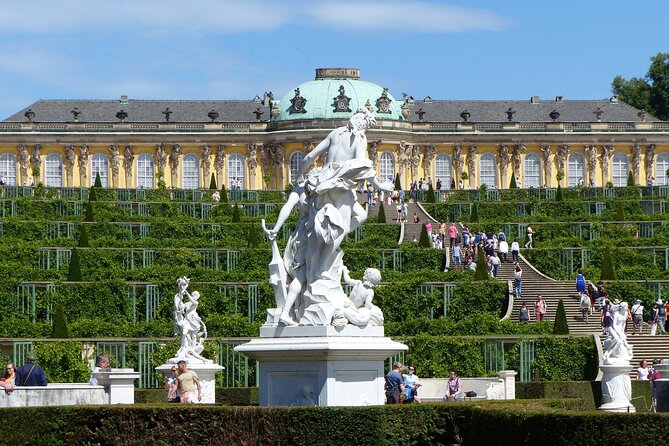
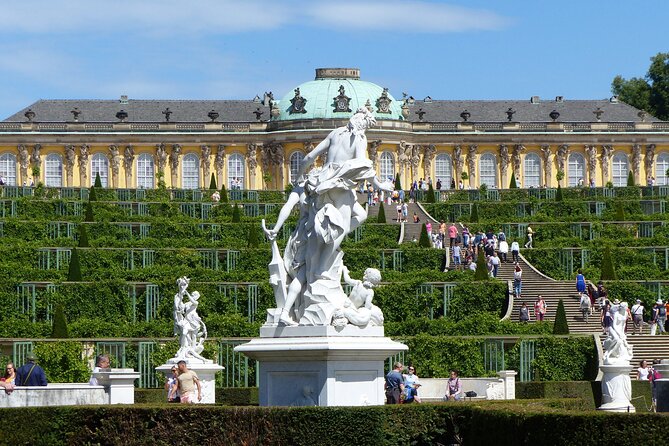
You start in Sanssouci Park, and that is smart. Before you enter the palaces, you get the landscape context. Sanssouci Park sits within the broader UNESCO World Heritage landscape of Prussian palaces and gardens, which has been protected since 1991. The nickname Prussian Arcadia is not just poetic marketing. The whole place is about controlled beauty, symmetry, and carefully planned sightlines.
You have about 45 minutes here. That is long enough to walk a loop, spot major features, and understand why Frederick the Great’s world looks like it belongs in a painting. You also get the photo advantage: you can capture Sanssouci Palace from viewpoints around the park, without starting your day already in a line.
What you should watch for as you wander:
- The park layout is built for perspective, so look for long straight sightlines toward the palace
- Garden sculpture and architecture are meant to be read as part of the same composition
- The atmosphere is airy, but the surfaces are outdoors, so wear shoes you can walk in comfortably
The biggest consideration at this stop is time. If you are the type who wants to linger at every bench, waterfall, and statue, 45 minutes will feel short. If you are more interested in getting your bearings and then learning what you are seeing, it is a solid start.
Sanssouci Palace: Frederick the Great’s Rococo pleasure palace
After the park, the tour moves to Sanssouci Palace. This is the one most people picture when they hear Potsdam. The standout here is the Rococo-style architecture, paired with a garden that feels like it was designed for strolling and showing off taste.
You get about 25 minutes at the palace area. Tickets for the palace itself are not included, so plan on purchasing your entry if you want to go inside. That is a key value factor: you are paying for the guide, the route, and the time management, not for every museum ticket.
A couple of details that make the visit feel more meaningful:
- Sanssouci Palace is tied directly to Frederick the Great’s idea of a “pleasure palace,” not a fortress or purely ceremonial building
- The palace has a specific origin date in the story of the site, with the foundation stone laid on April 14, 1745
- The place is described as a master ensemble of architecture, sculptures, and garden art, so your guide should point out how those elements work together
The drawback here is expectation management. A palace interior takes more time than you think, especially if you want to read anything on-site. If you are craving deep room-by-room attention, treat this as an efficient highlight visit rather than a slow art-history course.
Neues Palais: the big statement at the western end of the main promenade
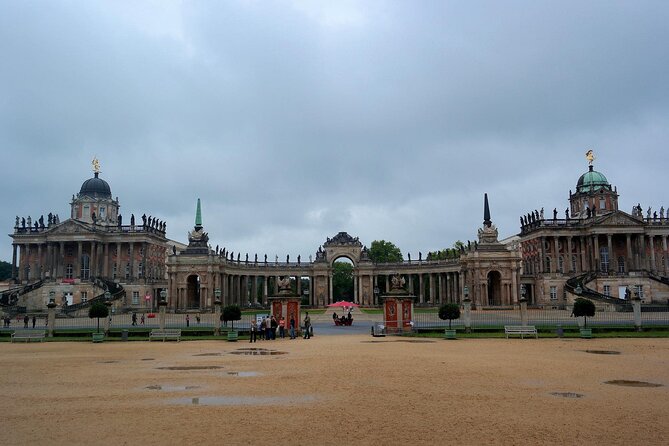
Next comes Neues Palais, the visual contrast to Sanssouci Palace. Where Sanssouci feels more intimate, Neues Palais is built for representational needs. It rises at the western end of the main promenade in Sanssouci Park, and that high tambour dome is the kind of silhouette you notice from a distance.
You have about 45 minutes here. Like Sanssouci Palace, entry is not included, so you will want your tickets ready if you plan to tour interior spaces. If you do go inside, you can expect grand banquet halls, splendid galleries, and regally designed suites, plus a palace theater in the southern wing. The idea is that this complex functioned as a stage for state power, art display, and elite life.
This is also where the story shifts from personal taste to national strength. Neues Palais was the last royal residence Frederick the Great would build in his park, and it served as a visible reminder of Prussian power and wealth after the Seven Years’ War (1756 to 1763). In plain terms, the palace is a political message made of stone.
What might slow you down is optional interior exploration. If you spend too long at one hall or gallery, you will feel the time pinch at the end of the stop. The guide helps here by keeping you moving through the right spaces at the right tempo.
The Dutch Quarter: 134 brick houses built by Jan Bouman and the soldier king
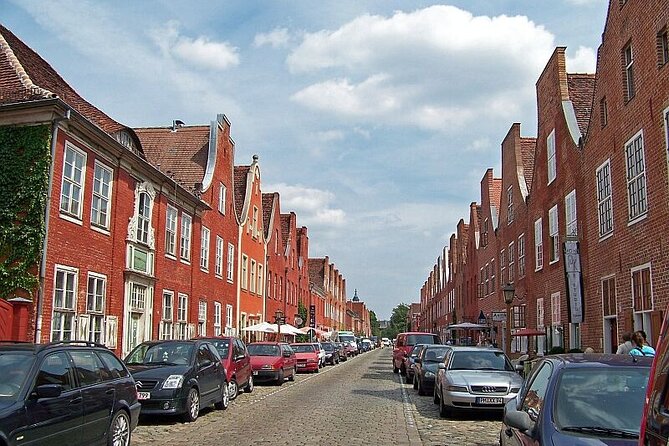
After the palaces, the tour shifts tone with a walk through the Dutch Quarter. This is a surprisingly satisfying change of pace. Instead of one palace with a tight story, you get a district built between 1733 and 1742, composed of 134 brick houses arranged into four squares.
The Dutch Quarter was part of Potsdam’s second city expansion, directed by Dutch master builder Jan Bouman from Amsterdam. The plan also reflects the priorities of Friedrich Wilhelm I, known as the soldier king. Under his reign, the district was planned and the two western squares were built. After his death in 1740, his successor, Frederick II, completed the eastern squares largely according to the earlier plans.
You get about 30 minutes here, and admission is free. That matters because you can enjoy it without worrying about ticket timing. It also works well as a break in the middle of the day, when legs are starting to feel the earlier palace walking.
How to make the most of this short stop:
- Look at the layout as a whole, not house by house. The squares are the point
- Notice how the district feels designed, not random growth
- Use this stop for photos of street geometry and brick character, which are different from the palace backdrops
If you wanted a longer neighborhood walk, 30 minutes will feel like a quick peek. But it is a good contrast, and it gives Potsdam depth beyond just the royal showpieces.
More German cities at walking speed:

Schloss Cecilienhof and the Potsdam Conference that changed Europe
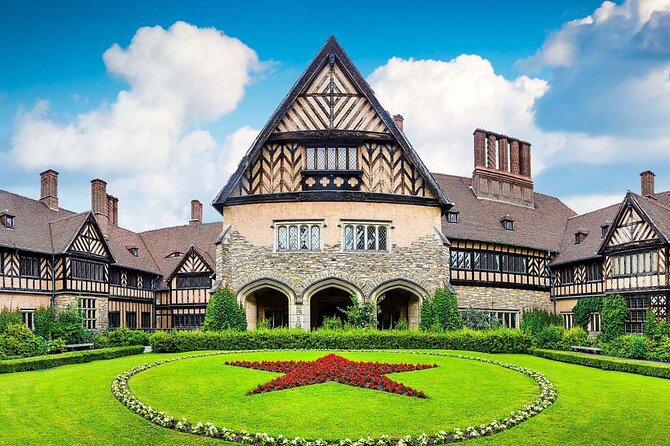
You finish at Schloss Cecilienhof, the last palace erected by the Hohenzollerns. This place is built from 1913 to 1917 in the style of a country manor, planned by Paul Schultze. It is a strong finish because it connects your day to world events, not just royal architecture.
You have about 45 minutes here. Entry is not included, so again, you should expect to buy tickets if you want to go inside. Cecilienhof is famous because it hosted the Potsdam Conference, held from July 17 to August 2, 1945, with the Big Three attending: American President Harry S. Truman, British Prime Minister Winston Churchill (followed by Clement Attlee), and Soviet leader Joseph Stalin.
If you have even a passing interest in how postwar Europe was decided, this stop lands. The Potsdam Agreement adopted at Cecilienhof is widely seen as a turning point, tied to the end of WWII in Europe and the start of Cold War tensions, which helped lead to the division of Europe and later the building of the Berlin Wall.
The most helpful part of having a guide here is pacing through the story. Without context, you might walk through rooms and courtyards and miss what makes a particular space significant. With the right framing, it clicks: the building becomes a container for negotiation, breakdown, and the start of a new political era.
One caution: this is the kind of site that invites reflection. If you want quiet time at the most tragic or weighty moments of the story, the clock can feel unforgiving. The overall tour is fast by design, so decide in advance whether you want brief stops or more time at fewer points.
Price, tickets, and why the private format can be worth it
The price is $420.49 per person for a private day of about 6 hours. That can sound steep until you price out the real components of what you get: private guiding, logistics from Berlin to Potsdam, and a route that layers UNESCO scenery with a high-impact WWII history stop.
Here is the value angle that matters most:
- You are paying for time management. Potsdam is beautiful, but it is also spread out, and you are on a limited schedule.
- You get a structured route that includes major highlights, so you do not need to map everything yourself.
- You are in a private group, meaning the guide can adjust to your pace more than on a crowded group tour.
Now the ticket reality. Some stops are free and some are not. Sanssouci Park and the Dutch Quarter are free to visit. Sanssouci Palace, Neues Palais, and Schloss Cecilienhof are listed as not included for admission, meaning you should budget for tickets on top of the tour price.
Also pay attention to pace. The tour is designed as an efficient highlight walk. A few visitors noted the day can feel shorter or tighter than expected when certain sites take less or more time than planned. Translation: if you want the most relaxed sightseeing possible, you may prefer a slower, multi-day Potsdam plan. If you want a guided hits-and-meaning day, this style fits.
Walking comfort and photo strategy for a smooth day
This tour is a walk tour, so your biggest “upgrade” is footwear. Bring comfortable walking shoes and expect outdoor surfaces at several stops. Even if you are not sprinting, you will cover enough ground that blisters are a real possibility if your shoes are wrong.
For photos, think in sequences. You usually get your best angles when you stop at the right viewpoint first, then move in. For Sanssouci, that means using Sanssouci Park to frame Sanssouci Palace from the outside before you decide how much time to spend in interiors.
For pacing, decide what you are optimizing for:
- If it is photos and orientation, you will love the structure.
- If it is detailed interior reading, you might want to slow down on one palace stop and accept that the others will be “see and learn,” not “study for hours.”
If weather turns iffy, be flexible. The experience requires good weather, since it is heavily outdoors. When skies are cooperative, the park portions are a joy. When not, walking becomes less comfortable and sometimes the day feels rushed to keep things safe.
Who this private Potsdam day fits best
This tour is a great match if you want a guided highlights day with less stress. You do not need to be a royal-architecture superfan. The day is structured so you can enjoy the palaces visually, then understand the why behind the buildings and the political power behind them.
You will likely enjoy it most if you:
- Want a private, English-speaking guide for a family group, couples, or small friend group
- Like UNESCO sites but do not want to spend hours mapping the best route yourself
- Are interested in Frederick the Great and also want a direct link to 20th century history at Cecilienhof
It may be less ideal if you:
- Plan to spend a long time in every interior room, reading slowly and taking notes
- Need a very unhurried walking pace
- Want a fully “included admissions” package, since several key interiors require separate tickets
Should you book this Potsdam Private Walk Tour from Berlin?
Yes, if you want a focused Potsdam day that combines royal park scenery with the Potsdam Conference setting, and you value a guide to keep everything flowing. This is not just “show up and look.” The best payoff is how the guide connects Sanssouci’s elegance, Neues Palais’s power message, the Dutch Quarter’s planned district design, and Cecilienhof’s role in the postwar settlement.
Book it if your travel style is: one strong day, good photos, clear context, and less decision-making for you.
Skip or adjust expectations if you are a slow museum explorer who wants deep time in interiors. In that case, you might still do Potsdam, but consider a plan with more hours or fewer stops.
FAQ
How long is the Potsdam tour?
It runs about 6 hours.
Is pickup from Berlin included?
Pickup is offered.
What language is the tour guide?
The tour is offered in English.
Is this a private tour?
Yes. It is private, so only your group participates.
Which major sites are included?
You will visit Sanssouci Park, Sanssouci Palace, Neues Palais, the Dutch Quarter, and Schloss Cecilienhof.
Are admission tickets included for each stop?
Sanssouci Park and the Dutch Quarter are listed as free. Sanssouci Palace, Neues Palais, and Schloss Cecilienhof are listed as not included for admission.
Is the tour mostly walking?
It is described as a private walk tour, so expect time on foot between stops.
What happens if the weather is bad?
The experience requires good weather. If it is canceled due to poor weather, you are offered a different date or a full refund.
Can I cancel for a full refund?
You can cancel up to 24 hours in advance for a full refund.
Fresh on the arrivals board for Berlin

Guided Walks in Berlin, compared.
Berlin City walk Government District and Places of Democracy
Read our review →
Berlin’s Best: 2 Hour Walking Tour Third Reich and the Cold War
Read our review →
Third Reich Berlin: Hitler and WWII Walking Tour
Read our review →
Browse the lists this tour appears in