

Reviewed · GUIDED WALKS IN BERLIN
Love and War in Berlin: Self-Guided Story Puzzle Walk
Berlin history, one solved clue at a time. This self-guided story puzzle walk strings together WWII-era sites and big-name landmarks in central Mitte, with the freedom to pause whenever you want. I like the no-pressure pace and the way the questions nudge you to look closely at places like the Urania World Clock and Berlin City Hall.
Second, I really appreciate how the route turns sightseeing into an active mission. You’re not just walking past buildings, you’re doing small “find the answer” tasks that guide you to what matters, including a stop tied to Hitler’s former war bunker area. One possible drawback is that some answers are very specific, so if you miss a detail you might feel stuck before the next move.
In This Review
- Key things to know before you start
- A self-guided story puzzle walk through Berlin’s WWII heart
- Price and value: $6 for an hour you control
- Where you start and how you finish (and why that helps)
- Alexanderplatz: the Urania World Clock as your first clue
- Berlin City Hall vibes: Rathaus and Hermann Friedrich Waesemann
- Neptunbrunnen: the Roman god Neptune and a very human pause
- Marx-Engels-Forum and Lustgarten: public space used as power stage
- Neue Wache: Prussian neoclassical form meets memorial meaning
- Bebelplatz Nazi book burning site: why the clue feels heavy
- Gendarmenmarkt: between cuirassiers and a concert hall
- Hamburg’s state representation in Berlin: government in real life
- Memorial to the Murdered Jews of Europe: pacing your silence
- Practical tips if the puzzles feel tricky
- Who should book this self-guided Berlin walk
- Should you book Love and War in Berlin?
- FAQ
- How long is the Love and War in Berlin self-guided puzzle walk?
- Do I need an internet connection to play?
- Is this a group tour with other people?
- What language is it offered in?
- Where does the walk start and end?
- Are any of the stops free to enter?
Key things to know before you start
- Self-guided with flexibility: start any hour in the day, pause for breaks, then jump back in
- Offline puzzle play: you don’t need internet to work through the game
- Private, no human contact: only your group participates, which helps you avoid crowds
- Designed for central Berlin: most stops cluster around Mitte landmarks you can recognize fast
- Some puzzle answers are precise: take your time reading plaques and architectural details
- Holiday timing can affect the route: the walk may pass near Christmas markets at certain times of year
A self-guided story puzzle walk through Berlin’s WWII heart
This is not a sit-and-listen tour. It’s a story puzzle walk where your phone becomes the control panel, and the city becomes the game board. The theme, Love and War in Berlin, is built for people who want more than facts. You’re getting a guided feeling for WWII Germany, but through hands-on tasks that make you slow down and actually read what’s in front of you.
Because it’s private and self-paced, you can set your own rhythm. If you want to race through one square and linger longer at another, you can. If you want a quick coffee break mid-route, you can stop and resume later. That matters in Berlin, where mornings can be brisk and afternoons can mean walking longer than you planned.
Also, the “no human contact” setup is a practical win. You won’t have to meet anyone at a strict hour or follow a group that’s already moving on. That makes it easier to keep the experience calm and personal, especially if you prefer quiet travel.
Finally, there’s a built-in storytelling thread that includes WWII context and a stop associated with Hitler’s former war bunker area. Even if you know the broad timeline, the clues can help you connect the dots between institutions, architecture, propaganda, and memory.
More Guided Walks in Berlin
- Discover Berlin Half-Day Walking Tour
★ 5.0 · 9,624 reviews - Berlin City walk Government District and Places of Democracy
★ 4.7 · 8,467 reviews - Berlin: Third Reich & Cold War Guided Walking Tour
★ 4.9 · 8,378 reviews
Price and value: $6 for an hour you control
At $6.00 per person for about an hour (approx.), this is one of those deals that makes you ask, why is it so low-cost? The key is the format. You are not paying for a guide’s time. You’re paying for the puzzle experience, the curated route, and the offline story content.
If you typically spend more on a walking tour for a guide-led route, this one can feel like a steal because you still get a structured walk with set stops and prompts. And you’re in control of time. If you only have 60 to 75 minutes, it fits. If you’re traveling with multiple ages or moods, you can pace it without stress.
The price also pairs well with central Berlin sightseeing. Many of the stops are public spaces or major landmark exteriors, so you’re not stacking lots of paid admissions. In the itinerary, you’ll see at least two places explicitly marked as free admission, like the Neptune Fountain and the Bebelplatz book-burning site.
In short, you’re buying convenience plus direction. That’s where the value lives.
Where you start and how you finish (and why that helps)
You’ll begin at Alexanderpl. 1, 10178 Berlin and finish at Cora-Berliner-Straße 1, 10117 Berlin. The route is set to unfold through central Mitte, so you’re not crossing the city to reach far-flung neighborhoods.
Opening hours are listed from 5:00 AM to 9:00 PM, with the experience available every day. That gives you real flexibility. I like having this kind of window because it lets you pick a time that matches your energy. If you’re a morning person, start early. If your brain works best after a museum visit, do it later in the day.
Because it ends at a different spot from where you started, plan your follow-up. Ideally, you’ll connect to transit or a meal near the finish rather than assuming you’ll want to backtrack.
Alexanderplatz: the Urania World Clock as your first clue
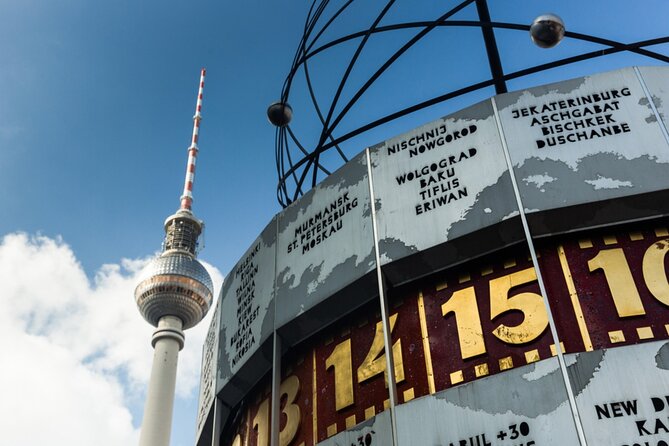
Your walk kicks off at Alexanderplatz, at the Urania World Clock. It’s also called the Urania World Clock, and it’s the big turret-style clock in the public square. This is a strong first stop because it’s immediately visual, and it trains you to look for details.
The puzzle mechanic starts right away: you’ll need to look around, find an answer to advance, and learn the story of the place. That’s a smart way to get you into “game mode” without needing a long briefing.
Practical tip: stand in a spot where you can read the metal markings comfortably. The whole point is to slow down enough to notice what you’d otherwise ignore, like how the clock represents many major cities.
Berlin City Hall vibes: Rathaus and Hermann Friedrich Waesemann
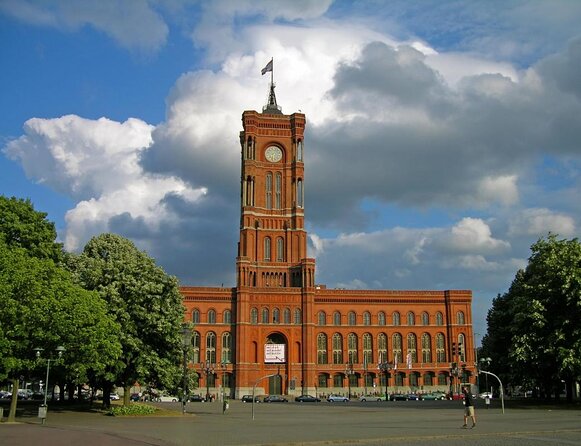
Next comes the Rathaus, built between 1861 and 1869, designed by Hermann Friedrich Waesemann. The style is described as Northern Italy High Renaissance, and it’s modeled on the Old Town Hall of Thorn, today Toruń in Poland. The tower architecture is noted as reminiscent of the cathedral tower of Notre-Dame de Laon in France.
Why you should care: this is Berlin signaling its identity through design. Even before you get into the WWII material, the architecture teaches you something about ambition, civic pride, and how power likes to present itself.
Again, you’ll do a look-around challenge to find an answer and move forward. The Rathaus stop works well for puzzle walkers because the building has lots of readable edges, shapes, and features you can study without needing interior access.
More German cities at walking speed:




Neptunbrunnen: the Roman god Neptune and a very human pause
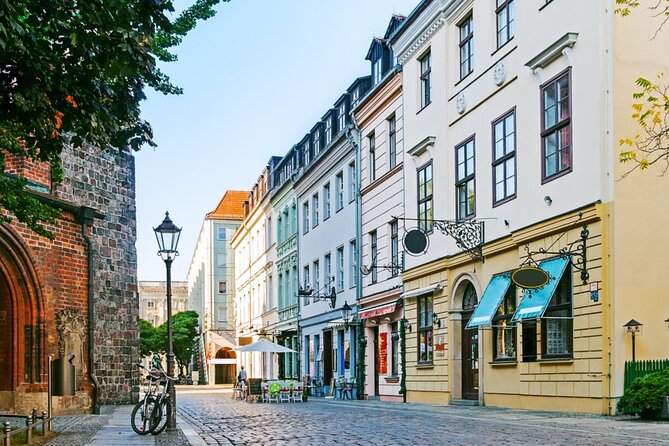
Then you hit Neptunbrunnen, the Neptune Fountain in Berlin’s center. Built in 1891, it was designed by Reinhold Begas and features Neptune in the middle. There’s also a free time marker here, with about 10 minutes mentioned and admission ticket free.
This stop is a breather in the best way. A fountain stop keeps you from feeling like you’re marching through only heavy topics. Neptune is a classical choice, and classical imagery often shows up in German civic art to create a sense of permanence.
Take advantage of the pause built into the pacing. You’ll likely be looking around for your puzzle answer, but you can also just enjoy the fact that Berlin’s “serious” side still has moments of myth and symbolism in public spaces.
Marx-Engels-Forum and Lustgarten: public space used as power stage
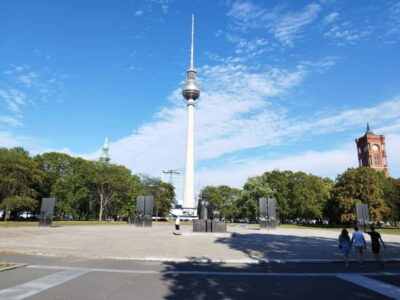
After Neptunbrunnen, you’ll move into Marx-Engels-Forum, a public park in central Mitte. It’s named for Karl Marx and Friedrich Engels, tied to The Communist Manifesto from 1848. The park itself was created by authorities of the former GDR in 1986.
If you like understanding how political systems leave physical fingerprints, this is a great stop. Even if you don’t consider yourself a political-history person, the forum’s existence is a reminder: regimes don’t just control laws, they control names, monuments, and the places where people gather.
Next is the Lustgarten, a park on Museum Island near the former Berliner Stadtschloss (Berlin City Palace). It has served multiple roles over time: a parade ground, a place for mass rallies, and later a public park.
That history is exactly why this section of the walk matters. You can feel the layering. One generation uses the same open space differently than the next. During the puzzle tasks, look for how the space functions, not just what it looks like. Open areas can become stages for propaganda or gatherings fast, depending on who holds power.
Neue Wache: Prussian neoclassical form meets memorial meaning
Your next major stop is the Neue Wache on Unter den Linden. It’s described as a listed building and a major work of Prussian neoclassical architecture. Erected from 1816 to 1818, it was planned by Karl Friedrich Schinkel as both a guardhouse for the Royal Palace and a memorial to the Liberation Wars.
This is a powerful pivot point in the story puzzle. The architecture brings you the “German classic” look, while the memorial purpose forces you to connect architecture with memory and loss.
Here’s how to get the most out of the puzzle part: don’t treat it like a scavenger hunt. Read the context, notice the building’s tone, and think about the message form itself sends. A guardhouse and a memorial in the same building is a blunt contradiction, and Berlin loves these contradictions.
This is also where the overall Love and War theme starts to feel more direct. The route is designed to build you toward WWII-era understanding, including the story thread that connects to Hitler’s former war bunker area. Even without a long lecture, the stop sequence helps you understand that the story is not only about documents, but about locations.
Bebelplatz Nazi book burning site: why the clue feels heavy
Next is Bebelplatz, and this stop is one of the most important, because it’s tied to the Nazi book burnings on 10 May 1933. These ceremonies were initiated and hosted by the nationalist German Student Association, which is specifically noted as stealing a march on the National Socialist German Students’ League.
This is not a “fun facts” stop, and it shouldn’t be. The puzzle here asks you to look around and answer a challenge so you can learn the story of the place. The best way to do this stop justice is to give yourself a little extra time and read carefully.
If you’re the type who prefers a quick photo and move on, slow down here. This is a location where propaganda worked by targeting ideas. Berlin memorials and plaques can feel clinical if you rush. Take your time and let the story land.
Gendarmenmarkt: between cuirassiers and a concert hall
Then you’re at Gendarmenmarkt, one of Berlin’s prettiest squares. It got its name from the “Gens d’armes” cuirassier regiment, whose stables were demolished by Friedrich II. Between the two churches, a new theatre was built, and today it’s known as Konzerthaus Berlin.
This stop gives you contrast, which is key for a “Love and War” themed walk. After the moral weight of Bebelplatz, Gendarmenmarkt feels like a reminder that culture, music, and civic life existed alongside the political machinery.
The puzzle asks you to look around again. Do it with the right mindset: you’re not just solving a riddle, you’re practicing how to read a square. Squares often show you what a city wants to signal, from religion to state power to art.
Hamburg’s state representation in Berlin: government in real life
Another interesting stop is the Hamburg state representation in Berlin, inside the classicist town house on Jägerstraße in the government district. The description says everyday life happens here: the minister-presidents of the 16 federal states, political events, and discussion events tied to current politics. It also notes that over 500 events and encounters take place each year.
It’s a unique angle for a WWII-themed route, but that’s part of why I like it. You see how Germany’s capital machinery runs today, not just how it ran in the past. It’s a living connection between history and modern governance.
Again, you’ll have to find an answer for the next move. Keep your eyes open for architectural cues and the way buildings communicate official identity. Even if you’re not into politics, these stops help you understand how a place keeps functioning long after the original era ended.
Memorial to the Murdered Jews of Europe: pacing your silence
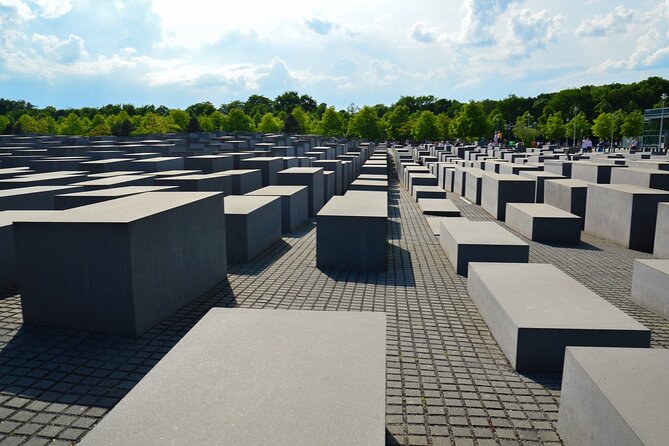
Finally, you reach the Memorial to the Murdered Jews of Europe. The itinerary notes that in 1999 the German parliament decided to create a central memorial site. The design competition was won by New York architect Peter Eisenman, and it was ceremonially opened in 2005.
This stop is one where you should be deliberate. The memorial is designed to make you feel something, and the puzzle mechanic still asks you to look around and answer to learn more. You can treat this as your quiet ending. Walk slowly through the space, then solve the clue with a calm pace rather than trying to rush for completion.
Tip for emotional pacing: if you start to feel overwhelmed, it’s totally fair to pause. The walk is built for breaks and resumes, so you can breathe, step back, and continue when ready.
Practical tips if the puzzles feel tricky
A self-guided puzzle walk lives or dies on how well you handle “stuck moments.” The feedback you’ll likely want to remember is that some questions are easy, others are harder. Also, for some prompts, the answer is taken very precisely, so you might not get credit if you guess.
So here’s what I recommend:
- Read the clue twice before hunting around.
- Look for the exact phrasing on plaques or markings.
- If you think you found the answer but it still does not advance, double-check the detail instead of rushing ahead.
Also, there’s one route reality to keep in mind. The puzzle may take you to areas where Christmas markets are set up. That can mean extra turns or slower walking around stalls. If you’re traveling during Advent, build in a little buffer time and accept that the city is in holiday mode.
Who should book this self-guided Berlin walk
This walk is a good fit if you want:
- a private sightseeing experience that avoids crowds
- a route that mixes famous landmarks with WWII-era context
- a structured walk that still lets you set the tempo
- an activity that works well even if you are not a museum-line person
It’s also great for repeat visitors. The feedback includes the idea that even people who live in Berlin for years can still discover new places and details. That’s often what puzzle walks do best: they make locals look again at what they already pass.
If you’re someone who absolutely needs a human guide to answer questions or provide emotional context on demand, you might find this format too self-directed. But if you like learning at your own pace, you’ll probably enjoy it.
Should you book Love and War in Berlin?
I’d book it if you want an hour in central Berlin that mixes landmark architecture with WWII memory in a way that feels active, not passive. At $6.00, with offline play and a private no-contact setup, the value is hard to beat.
I would skip or think twice if you hate puzzles, get frustrated easily by precise answers, or need constant guidance. This walk rewards patience, careful looking, and a willingness to move slowly.
If you want a calm, efficient way to connect Alexanderplatz, Rathaus architecture, Bebelplatz, and the memorial sites into one story thread, this is a smart choice.
FAQ
How long is the Love and War in Berlin self-guided puzzle walk?
It’s listed as about 1 hour.
Do I need an internet connection to play?
No. The experience says you can play offline, so you do not need internet to play the city game.
Is this a group tour with other people?
No. It’s described as private, so only your group participates.
What language is it offered in?
It’s offered in English.
Where does the walk start and end?
It starts at Alexanderpl. 1, 10178 Berlin and ends at Cora-Berliner-Straße 1, 10117 Berlin.
Are any of the stops free to enter?
The itinerary notes free admission for Neptunbrunnen and Bebelplatz. Other stops are part of the route, but only those specific ones are explicitly marked as free in the provided information.
More Self-Guided Tours in Berlin
- Berlin: Solar Powered Sunset Catamaran Cruise & Audio Guide
★ 4.6 · 1,043 reviews - Escaping and spying on the Berlin Wall Scavenger hunt
★ 4.5 · 128 reviews - Berlin: Self-Guided Family and School Class Scavenger Hunt
★ 4.6 · 128 reviews - Berlin: Scavenger Hunt Self-Guided Tour
★ 4.6 · 79 reviews
Fresh on the arrivals board for Berlin
Guided Walks in Berlin, compared.
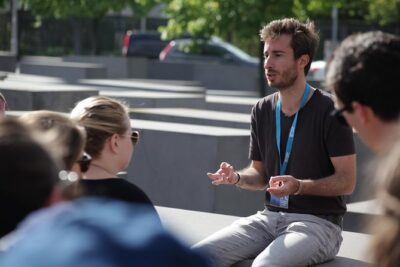

Berlin City walk Government District and Places of Democracy
Read our review →
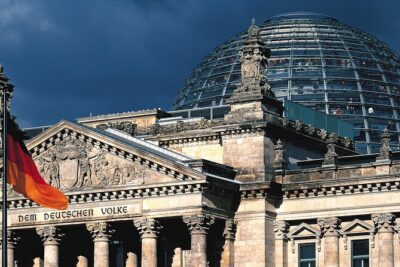
Berlin’s Best: 2 Hour Walking Tour Third Reich and the Cold War
Read our review →
Third Reich Berlin: Hitler and WWII Walking Tour
Read our review →
Browse the lists this tour appears in