
Reviewed · WALKING TOURS
Dresden: Walking Tour with Virtual Reality elements
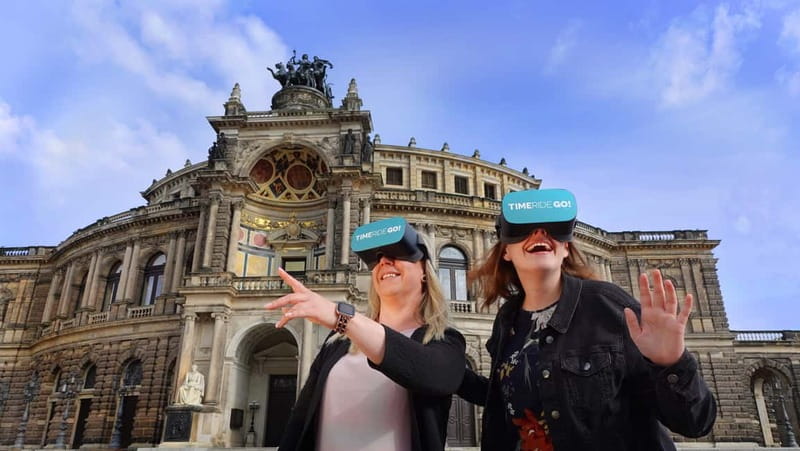
A city feels different when you can see time layers on top of it. This 90 minute Dresden walking tour uses a mobile VR headset to help you compare today’s streets with scenes from centuries past, stop by stop in the Old Town. It’s guided the whole time, so the tech is only half the story, the other half is your guide’s clear, human way of explaining how Dresden changed.
What I liked most was the live guide and the way the tour keeps moving without feeling rushed. I also loved the simple format: you stand at a real place, then look through the headset to see how the same spot could have looked in another era. One possible drawback is that some of the video sequences can feel a bit rough around the edges, so don’t expect cinema smoothness every time.
In This Review
- Quick hits you will actually feel on the ground
- Why VR fits Dresden’s Old Town so well
- Meet at TimeRide GO! and get ready for the headset routine
- Stop by stop: Zwinger, Postplatz, and the Old Town shape
- Pirnaischer Platz and Neumarkt: comparing daily life across the timeline
- Fürstenzug photo stop: when a landmark becomes a time anchor
- Ending at Semperoper Dresden: the rebuild story lands closer than you expect
- The VR effect: what to expect from 360 city views
- Price and time: is $38 worth 90 minutes of walking and tech?
- Who should book this, and who should skip it
- Should you book this Dresden VR walking tour?
- FAQ
- How long is the Dresden walking tour with VR?
- How much does the tour cost?
- Where do I meet the group?
- What is included in the price?
- Is the TimeRide senseum or the Dresden 1719 exhibition included?
- What language is the tour guide speaking?
- Is it suitable for children?
- What should I bring or wear?
- Can the tour be canceled due to weather?
Quick hits you will actually feel on the ground
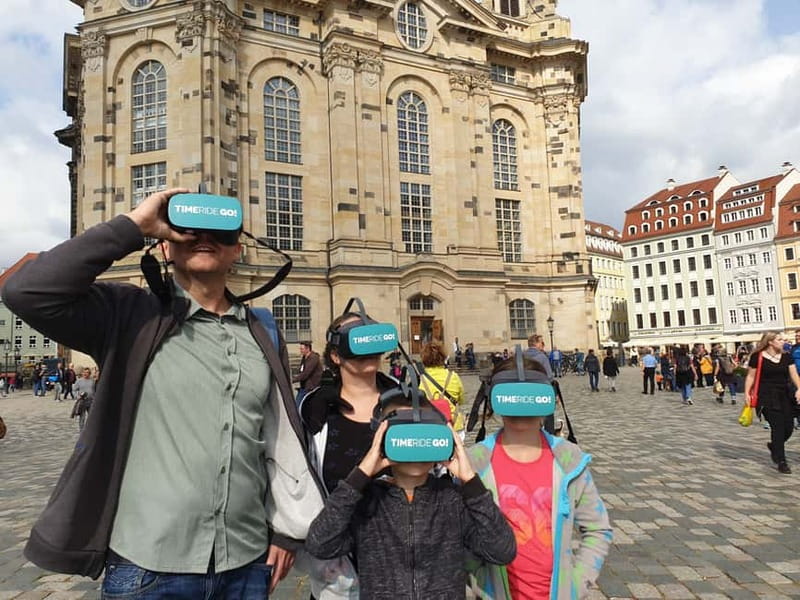
- 400 years, 9 stops: You get time jumps at specific city locations instead of a generic lecture.
- VR 360 views: You look around the space in multiple directions, not just at one fixed screen.
- Dresden’s big eras: Baroque glamour, change into the 1920s, WWII destruction, socialism ideas, then reunification.
- Guide-led pace: A live guide keeps the story clear while you walk.
- Memorable comparisons: You watch the cityscape shift when you swap time layers.
- Practical comfort: The tour is short, but you will need comfortable shoes.
Why VR fits Dresden’s Old Town so well
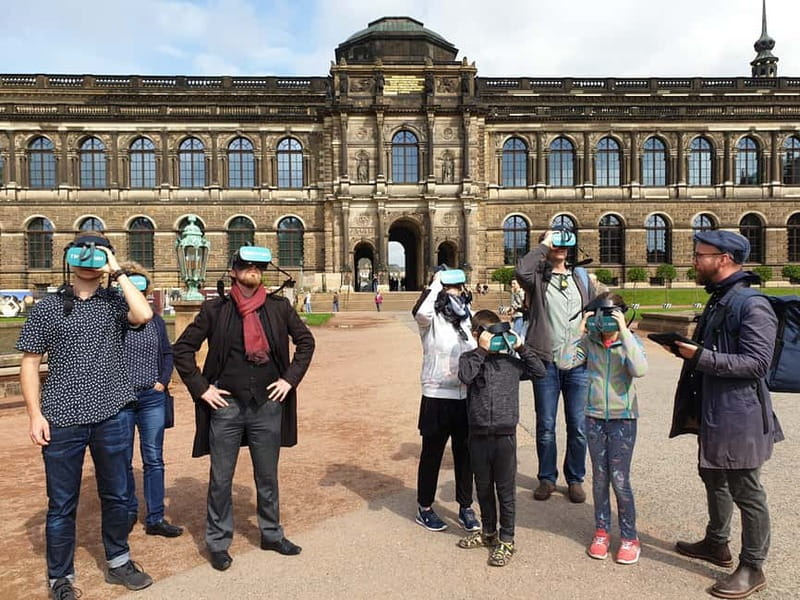
Dresden can be easy to enjoy visually, even if you do not know much history. But this tour changes the way you read the city. Instead of asking you to imagine what used to be there, it gives you a direct comparison, where today’s façade is paired with what came before it. That is the real value: you are not just learning dates, you are seeing how the city’s shape and symbols evolved.
The VR part is not there to distract you from the walking. You still follow a guide, you still move through the center on foot, and you still take in real architecture around you when the headset comes off. That back-and-forth is what makes the experience stick. In a place with major rebuilding, the difference between what was lost and what survived matters a lot, and this format turns that into something you can notice with your own eyes.
More Walking Tours in Dresden
- Dresden: City & Semperoper Guided Walking Tour
★ 4.8 · 2,397 reviews - Dresden: Guided City Walk
★ 4.6 · 2,075 reviews - Dresden: Complete Walking Tour with Frauenkirche Visit
★ 4.8 · 700 reviews
Meet at TimeRide GO! and get ready for the headset routine
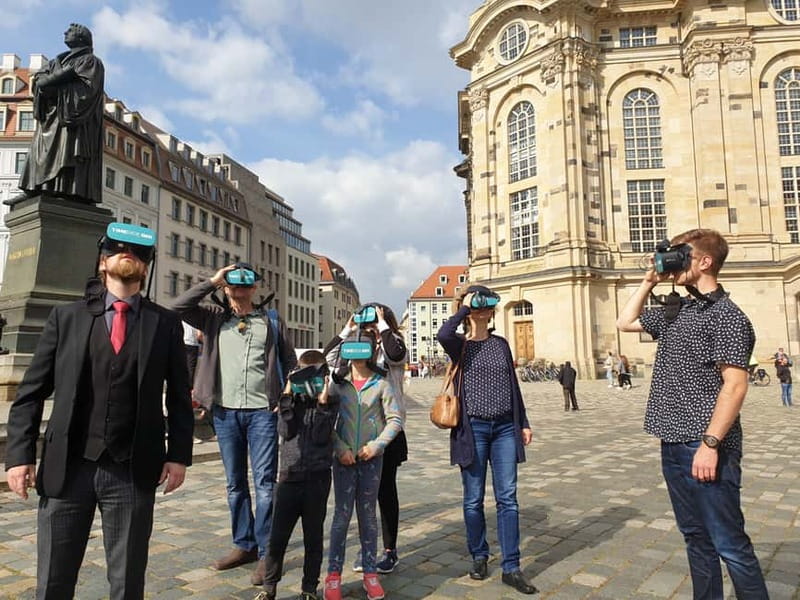
The meeting point is set in front of the TimeRide senseum, at the TIME RIDE GO! flag. From there, you are guided through the VR setup and then you start walking through central Dresden. The tour runs about 90 minutes, so plan on a steady pace rather than lingering for long photo sessions.
A live guide leads everything in German, so if you prefer English narration, this one may not be your best match. That said, the guide’s job here is not just translation. The headset shows 360-degree city views, and the guide helps you connect what you are seeing to the bigger timeline of Dresden.
One practical note: the equipment needs careful handling. Keep your fingers off parts that are not meant to be touched, and move slowly when you put the headset on or take it off. If you are the kind of person who likes to be organized, you will feel more comfortable right away.
Stop by stop: Zwinger, Postplatz, and the Old Town shape
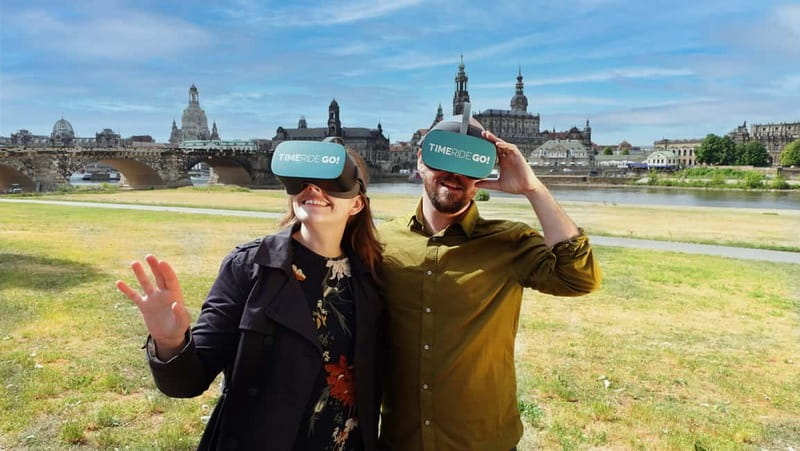
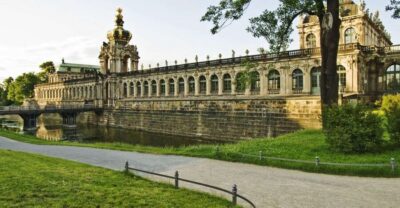
The tour begins near Taschenberg 3, then you head into the Old Town with multiple scenes centered around major landmarks. The Zwinger shows up early, and it does not feel random. It is one of those Dresden locations that automatically signals “this is where the city expressed itself,” especially during the Baroque period. With the headset on, you can compare that sense of grandeur to later layers, so you start to understand Dresden’s changes as something physical, not just something written in a book.
You then move through the center toward Postplatz. This is the kind of stop where the guide’s storytelling matters. When you are standing in a square, it is easy to think you are only looking at buildings. But with the time comparison in play, you notice how public space, movement, and nearby landmarks can shift meaning across eras. It becomes less about one monument and more about how daily life would have flowed around you.
Next, you reach Old Market Square. A market square is a good place for this kind of timeline tour because it has always been about people, routines, and commerce. The headset helps you connect what you see now with what those central public spaces could have represented in earlier centuries. You get a feeling for why certain areas kept their importance even when styles and systems changed.
Pirnaischer Platz and Neumarkt: comparing daily life across the timeline
After Old Market Square, you continue to Pirnaischer Platz. This stop tends to work well for the tour’s core idea: the cityscape can look similar in broad strokes, yet the story behind it changes drastically. With the headset experience, the surrounding streets and buildings become the stage for different periods, so you start noticing how reconstruction and political shifts alter the tone of a place.
Then comes Neumarkt. Neumarkt is one of Dresden’s most talked-about central spaces, partly because it reflects the city’s “before and after” story. Here, the VR comparisons are especially meaningful because this tour is not only about aesthetics. It explicitly moves you through major turning points: the transformation into the early 20th century, the catastrophic disruption during World War II, then new ideas associated with socialism, and finally the shift after reunification.
One of the standout strengths of the tour is how it handles those heavier moments through visuals plus explanation. Some impressions tied to the WWII period can feel very stark, which is exactly why the tour is memorable. It is not just sightseeing. You are asked to hold two versions of the same place in your mind, past and present, and that contrast hits harder than a timeline on a wall.
Fürstenzug photo stop: when a landmark becomes a time anchor
A big moment on the walk is a stop at the Fürstenzug, where you get a photo moment and guided context. This is the kind of landmark that anchors people because it is instantly recognizable as Dresden’s identity made visible. With VR involved, it works even better. Instead of the landmark living only in your present-day camera roll, it becomes part of the city’s layered narrative.
This is also where the tour’s comparison style really pays off. You take in the real object when you are not wearing the headset, then you switch views and see how the surrounding story changes across periods. The result is that the landmark feels less like a static attraction and more like a thread connecting eras.
If you care about photos, use this stop smartly. Take a few shots quickly first, then listen before you settle into a longer view. When you understand what the guide is pointing out, your photos end up meaning more to you later.
More German cities at walking speed:




Ending at Semperoper Dresden: the rebuild story lands closer than you expect
The tour finishes at Semperoper Dresden. Ending at a major cultural building makes sense here because the tour’s theme is transformation. Dresden did not simply survive its darkest chapters and call it a day. The city changed in ways you can see, walk through, and compare, and the ending location helps you feel that “after” moment in a tangible place.
I found it helpful that the tour does not pretend the present is the only version that matters. When you remove the headset for the last stretch, the city you see is not just the city you started with. You have been trained to compare. That changes your final viewpoint, even if you do not do anything extra after the tour.
The VR effect: what to expect from 360 city views
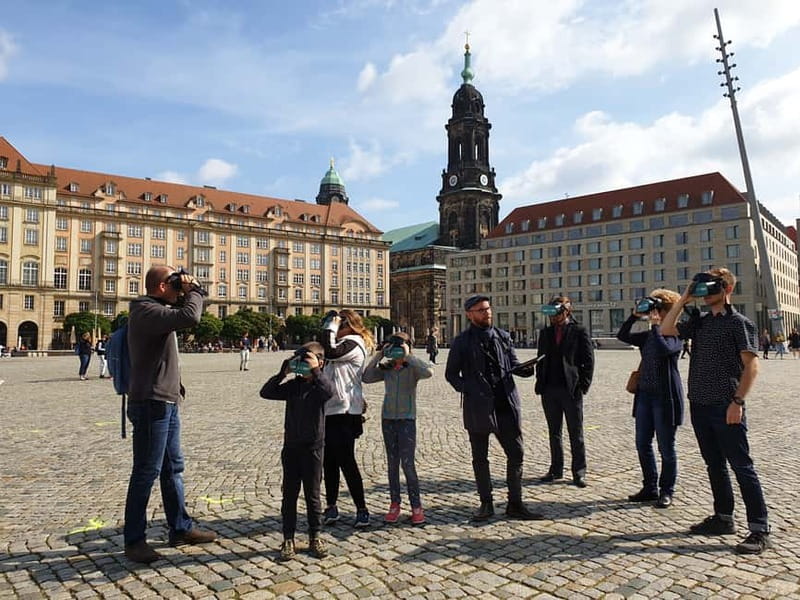
The headset experience is built around looking through virtual reality to see 360-degree views of key places. The idea is simple: you are standing in the right location, then the VR view shifts you into another time layer, while the guide explains what you are looking at.
In practice, the quality varies slightly. Several comments pointed out that some of the films or sequences can feel a bit uneven. That does not ruin the tour, but you should know what you are buying. You are buying a guided city comparison with VR support, not a cinematic production that never stutters.
If you want to get more value from the VR minutes, do this: listen closely while you are waiting for each transition. The guide’s phrasing helps you identify what changed and why. The headset might show you a wider scene, but the guide helps you interpret the details your eyes might otherwise miss.
Also, remember that VR is for looking around. Try to do small head movements while the guide is speaking, so you actually use the 360 feature. It is a simple habit, and it makes the time jumps feel more real.
Price and time: is $38 worth 90 minutes of walking and tech?
At $38 per person for about 90 minutes, this is priced like an experience that expects to sell on value, not on deep museums or long transit days. You get a guide plus the VR headset. That matters because it turns your time into something guided and structured, instead of just renting a self-paced audio tool.
You can think of it as paying for three things:
1) expert storytelling in real time,
2) access to a VR time-comparison format,
3) a compact walking route through central Dresden.
What is not included is worth knowing. Entrance to the TimeRide senseum and the Dresden 1719 exhibition is not part of your $38. You might also see a benefit connected to line-skipping, so you are not stuck waiting around during the VR-related part. Either way, if you are primarily interested in a guided VR city look, you are set. If you also want those extra indoor exhibition components, you may need additional tickets.
For most people, the short duration is a plus. You can fit it into a half-day without burning your whole day on one activity. And because it is walking-based, you also get built-in city orientation for later exploring.
Who should book this, and who should skip it
This tour is a good match if you enjoy architecture and city centers, and you like history that connects to what you can see right now. If you tend to learn best when images are paired with explanation, you will probably get a lot from the guide-led format.
It also suits people who want a “story walk.” Instead of marching through facts, you watch how the city’s meaning changes through the Baroque era, the pre-war shift into the 1920s, WWII destruction, socialism ideas, and reunification. Even if you already know Dresden’s major headlines, the visual comparison can make it feel more personal.
If you want a child-friendly activity, note that it is not suitable for children under 6. And because the tour language is German, it is better for you if you can follow along, even if your German is not perfect. The guide does real-time interpretation through narration, so language does matter.
Should you book this Dresden VR walking tour?
I think this is a smart booking if you want an efficient way to understand Dresden’s “then and now” story at nine real locations. You are paying for guided context plus 360 VR comparisons, and that combo is exactly what makes the experience memorable. One guide name that stands out is Anna, and the tone of her commentary was repeatedly described as relaxed and engaging, with personal anecdotes that kept the walk from feeling like a script.
I would book with one expectation tweak. Some VR video sequences can feel a bit rough. If you are sensitive to technical glitches, you might still enjoy the walking and guide, but the VR part may not feel perfectly smooth every time. Still, even comments that mentioned those imperfect moments also suggested the VR served its purpose.
If your goal is a quick, guided, high-impact way to see Dresden as a changing city across centuries, this $38, 90-minute experience is worth your time. If you want an English-only tour or a fully museum-grade production, you may want to look for a different format.
FAQ
How long is the Dresden walking tour with VR?
It lasts 90 minutes.
How much does the tour cost?
The price is $38 per person.
Where do I meet the group?
Meet at the TIME RIDE GO! flag in front of the TimeRide senseum.
What is included in the price?
Your tour includes a live guide and a virtual reality headset.
Is the TimeRide senseum or the Dresden 1719 exhibition included?
No. Entrance to the TimeRide senseum and the Dresden 1719 exhibition is not included.
What language is the tour guide speaking?
The live tour guide is German.
Is it suitable for children?
It is not suitable for children under 6 years old.
What should I bring or wear?
Wear comfortable shoes and dress for the weather. You also need to handle the equipment with care.
Can the tour be canceled due to weather?
Yes. In really bad weather, the tour may be canceled.
Fresh on the arrivals board for Dresden


Walking Tours, compared.
Berlin City walk Government District and Places of Democracy
Read our review →


Berlin’s Best: 2 Hour Walking Tour Third Reich and the Cold War
Read our review →
Browse the lists this tour appears in