
Reviewed · GUIDED WALKS IN BERLIN
Berlin Walking Tour: Berlin’s Royal Boulevard Unter den Linden
One street tells a whole empire. On this Unter den Linden walking tour, you connect royal power, wartime memory, and intellectual Berlin through landmark architecture, told by an expert local guide. I especially like the tight, stop-by-stop progression from the Humboldt Forum to the Zeughaus complex, and the way the guide ties each site into one clear story. One drawback to consider: it is focused on Prussian and German history, and a couple of indoor visits are not included in the price.
You’ll move at a comfortable pace for about two hours, with a small group size (up to 15) and a mobile ticket that keeps things simple. The route is built around what you can see from the street, so you still get value even when you do not go inside every museum or venue.
The tour runs in English and starts at 11:00 am near the Berliner Schloss area by the Sanchi Gate reconstruction, then finishes at Schinkelplatz. It also depends on good weather, so plan to dress for wind and walking and keep a little flexibility in your day.
In This Review
- Key highlights you should know
- Why Unter den Linden still hits, even years later
- Route and timing: how the 2-hour walk stays manageable
- Humboldt Forum and Lustgarten: from royal façade to political stage
- Deutsches Historisches Museum and the Zeughaus building
- Neue Wache: a neoclassical guardhouse turned memorial
- Humboldt University: ideas, institutions, and the Nazi book burnings
- Gorki Theater and the 1829 Mendelssohn and Bach link
- General Blücher monument trio: Prussia’s Napoleonic memory in stone
- Friedrichswerdersche Church and Schinkelplatz: finishing with Schinkel’s calm architecture
- Guides, storytelling, and why this tour feels “built,” not improvised
- Price and value: what $29.57 buys you in real terms
- Who should book this Unter den Linden tour
- Should you book Beyond and Beneath Tours on Unter den Linden?
- FAQ
- Is this tour in English?
- How long is the walking tour?
- How much does it cost?
- Where does the tour start and end?
- What time does the tour begin?
- Is admission to the museums included?
- What is included in the tour?
- What if weather is bad or I need to cancel?
Key highlights you should know
- Expert local guidance that turns architecture into a timeline you can actually follow
- Small group size (max 15), which makes questions easy and pace calmer
- Stops chosen for contrast, from royal pleasure gardens to national memorial space
- Humboldt University context, including the story of the book burnings
- Bach via Mendelssohn, 1829, linked to the Gorki Theater building history
- Schinkel’s work at the end of the route, finishing in a calmer architectural pocket
Why Unter den Linden still hits, even years later
Unter den Linden is one of those streets that looks straightforward on a map, then turns out to be loaded. You start in the area tied to Prussian royalty and state power, then the story keeps shifting into museums, memorials, education, and culture. The value of this tour is not that you hear facts. It’s that you watch how the meaning of places changes across regimes.
What I like most is the balance between “what happened” and “where you’re standing.” You are not just learning that rulers and generals mattered. You’re seeing how they wanted Berlin to feel, then seeing how later Berliners chose to remember and reinterpret that same space.
And because the guide uses a running narrative, each stop feels like a chapter rather than a random checklist. That’s exactly the kind of structure you need on a history-heavy route, especially in a city as complex as Berlin.
More Guided Walks in Berlin
- Discover Berlin Half-Day Walking Tour
★ 5.0 · 9,624 reviews - Berlin City walk Government District and Places of Democracy
★ 4.7 · 8,467 reviews - Berlin: Third Reich & Cold War Guided Walking Tour
★ 4.9 · 8,378 reviews
Route and timing: how the 2-hour walk stays manageable
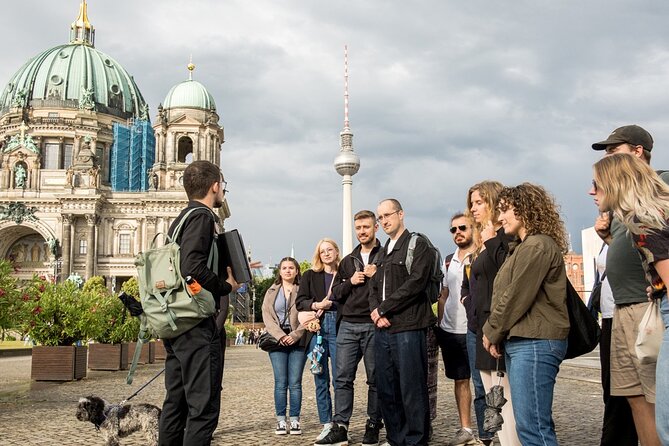
This is an approx. 2-hour walking tour that moves through central Berlin’s most important institutional corridor. It starts at the Rekonstruktion des Sanchi-Tores vor Berliner Schloss area by Am Lustgarten / Berliner Dom (10178 Berlin) and ends at Schinkelplatz (10117 Berlin).
A few practical points help you get more from it:
- You’ll be on your feet for close to the full time, so comfortable shoes matter.
- Some of the best moments are outside, so you still benefit even if you decide not to go in somewhere.
- Two indoor options are not included, so if you care about those, check what you plan to pay on site.
Group size is small, up to 15, which makes it easier to keep up and hear the guide without straining. It’s also offered in English, so you’re not forced to translate your way through a history crash course.
Humboldt Forum and Lustgarten: from royal façade to political stage
Your first major anchor is the Humboldt Forum area. You begin at the baroque façade tied to the Berlin Palace, now reborn as the Humboldt Forum, a museum and cultural space in the heart of historical Berlin. The key idea here is the transformation: this is what a rebuilt façade can teach you about how cities rewrite their own past.
Next comes Lustgarten. This open space has held very different roles over time, including its early identity as a royal pleasure garden, then later its use as a stage for Nazi rallies. Standing here, you feel why the guide keeps returning to the theme of public space. The same location can shift from leisure to propaganda, and that shift is part of the lesson.
What you should watch for as you walk is how the guide connects “power” to “visibility.” The royal garden was designed for display and spectacle. The Nazi rally use was the same logic, just with a darker purpose.
Value for you: this start gives you context before you enter museum walls. You get the street-level meanings first, then the indoor history hits harder.
Deutsches Historisches Museum and the Zeughaus building
After the royal garden and palace-adjacent context, the route brings you to the Deutsches Historisches Museum area, housed in the Zeughaus building. The Zeughaus matters not just because it’s a museum, but because the structure itself carries history. It began life as an arsenal, then became one of Europe’s important history museums.
This stop is about understanding that buildings are archives too. Even before you see exhibits, you’re in the shell of a different era’s priorities. That’s why an included exterior stop can still feel substantial on a walking tour.
One caution: admission to this museum is not included. The itinerary flags the entrance fee as not included, so if you want to go inside for the full experience, plan for the additional cost. In other words, this tour still works if you only do the street-level portion, but the museum lovers will likely want to add on.
Neue Wache: a neoclassical guardhouse turned memorial
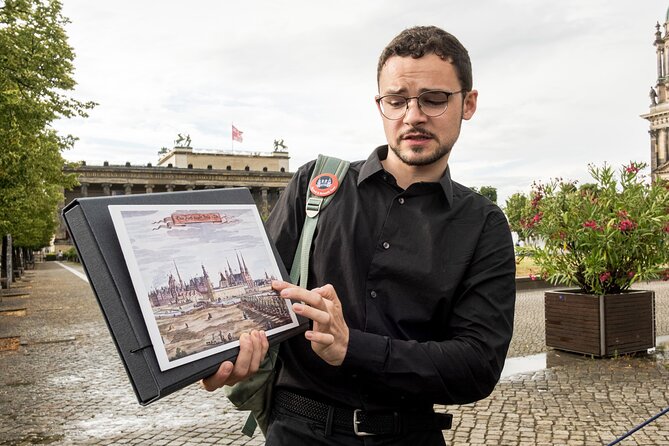
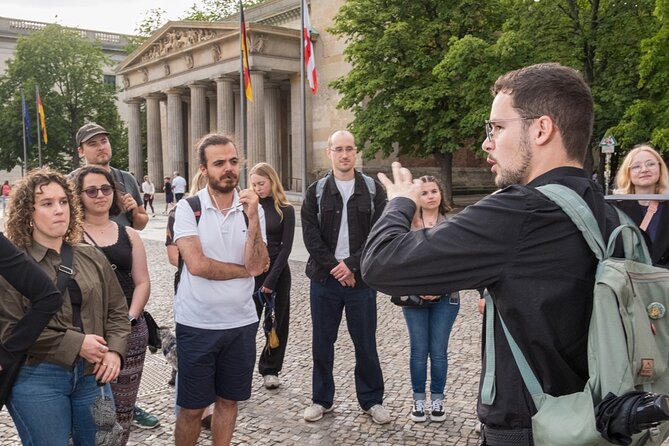
Then you shift to a very different kind of space: Neue Wache. It was originally a neoclassical guardhouse, and now it functions as a national memorial. The emotional weight here comes from the focus on remembrance, honoring victims of war and dictatorship through Käthe Kollwitz’s powerful sculpture.
This stop works especially well when a tour keeps the story coherent. After learning about state power and public spectacle, you come to a place built for acknowledgment, not domination.
If you are the type who likes to understand how societies process trauma, you’ll appreciate that the guide spends time on what a memorial tries to do. It is not just about the facts of history. It’s about the message that shape and sculpture send in the public realm.
Admission is listed as free for this stop, so you can focus on the atmosphere without adding another ticket cost.
More German cities at walking speed:



Humboldt University: ideas, institutions, and the Nazi book burnings
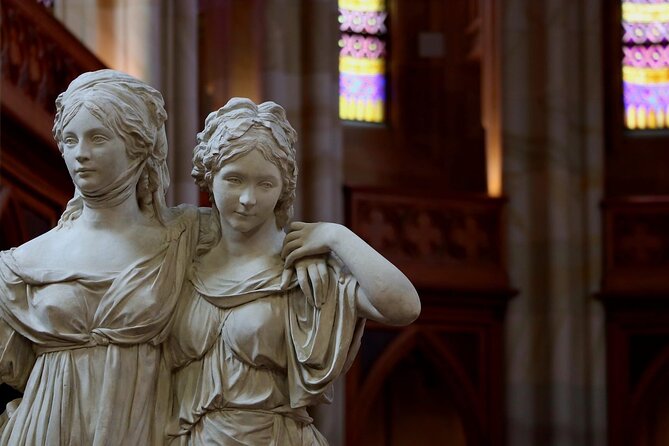
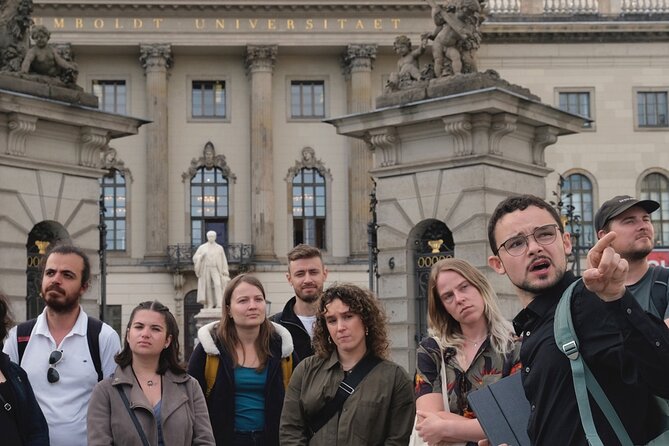
Next up is Humboldt University. This is one of Europe’s prestigious universities, and the tour highlights the big names associated with it, including Einstein, Marx, and the Grimm brothers, as students and teachers. That alone gives you a sense of why Humboldt University belongs in this street narrative.
But the most important lesson is not celebrity. It’s what happened to knowledge under the Nazis. The route points to the story of books being burned under the regime, tying the university’s intellectual mission to the regime’s attempt to control what could be thought and said.
This stop is a reminder that institutions are never neutral. Universities can represent freedom and inquiry, but they can also be pressured or used by authoritarian systems.
Value for you: you get a history thread that is not only military or political. It’s about ideas and how power tries to manage them.
Gorki Theater and the 1829 Mendelssohn and Bach link
The tour moves to the Maxim Gorki Theater, and it takes a smart approach by using the building itself as a historical clue. Today it’s a progressive theatre, but it sits in the former Sing-Akademie. The itinerary connects that space to music history, including Mendelssohn reviving Bach’s St. Matthew Passion in 1829.
This is where the tour adds texture. Berlin’s history is often told through politics and war, but art and performance are part of the story too. The guide’s job here is to show you how cultural life leaves fingerprints, even when the world around it is changing fast.
A practical note: admission here is not included per the itinerary. If you want to attend a performance or go inside, you may need to plan for extra entry or timing. If you only see the external context, you’ll still get the historical link the tour aims to highlight.
General Blücher monument trio: Prussia’s Napoleonic memory in stone
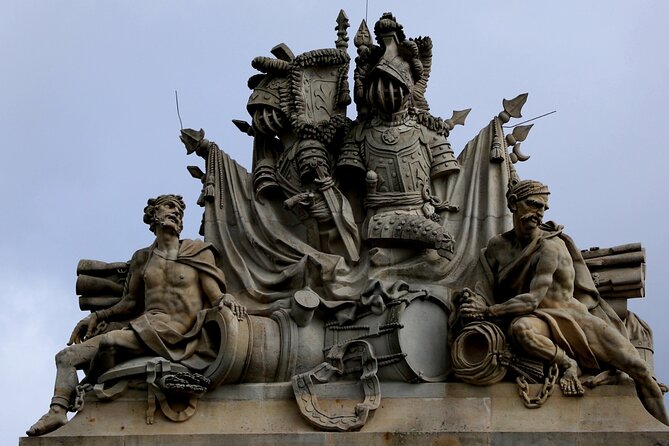
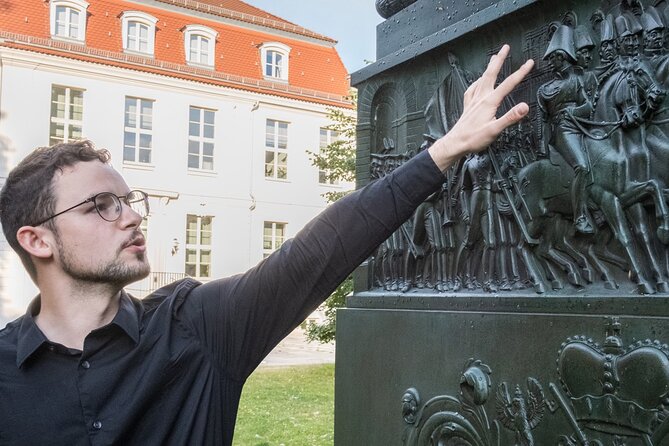
Next is Denkmal General Blucher, a statue honoring Field Marshal Blücher, victor of Waterloo, flanked by Generals Yorck and Gneisenau. This is Prussian military pride translated into public art, with a clear purpose: make the Napoleonic era feel permanent, legible, and honorable to future generations.
On a walking tour, monuments like this can feel one-note. Here, the guide’s narrative makes it more. You’re not only seeing names. You’re seeing how state identity is constructed through sculpture and placement.
It is also a good moment to slow down, look at the lineup, and realize how much meaning can be packed into a relatively small physical footprint.
Admission is listed as free for this stop, so you can treat it as a visual reset without paying.
Friedrichswerdersche Church and Schinkelplatz: finishing with Schinkel’s calm architecture
The last major cultural breath of the tour is the Friedrichswerdersche Church, included in the tour’s visit. This is described as a hidden architectural treat by Karl Friedrich Schinkel, with a Gothic Revival style and a tranquil space showcasing 19th-century sculpture. It’s also noted as one of the few surviving examples of early Prussian romanticism.
This stop matters because the tour does not only end with more politics and memory. It finishes with an environment that helps your brain stop buzzing and start absorbing. If you’re the kind of traveler who likes your last impressions to be visually strong and not emotionally exhausting, you’ll probably like this ending.
Then the tour concludes at Schinkelplatz, finishing where Berlin’s great architect is honored among some of his finest neoclassical buildings. The end point gives you a contrast to the earlier stops, which have stronger emotional or ideological signals. It’s a good place to wrap your understanding of the street, because the guide’s narrative can now land on “how Berlin tried to shape taste, order, and identity.”
Admission is listed as free throughout this ending segment, so you don’t need to plan additional tickets to finish strong.
Guides, storytelling, and why this tour feels “built,” not improvised
The best version of this tour is the version where the guide can keep the timeline threaded across distances and eras. In practice, the reviews attached to this tour put a big emphasis on the guide’s passion and the way they tell stories with structure.
Names matter here. I’ve seen references to guides such as Morgan, praised for balancing walking and talking and for connecting each individual story into a larger narrative. There’s also mention of Martina in other related routes, which suggests the broader guiding style across this provider tends to be organized and story-forward.
You’ll notice this on the route itself. Instead of random historical facts, the guide explains why one place leads to the next, then helps you hold onto the big picture while your feet keep moving.
That’s the kind of guide work that makes a history tour worth your time.
Price and value: what $29.57 buys you in real terms
At about $29.57 per person for around two hours, this tour is priced as an experienced-guided walking route rather than a museum ticket bundle. That’s a good deal for a city where one standalone museum stop can easily cost more, and where transportation time can eat a chunk of your day.
Here’s the value math you can actually use:
- You get an expert local guide, and you visit multiple major landmarks.
- Several stops are free to access, so a lot of the learning happens without extra costs.
- Two indoor admissions are not included, including Deutsches Historisches Museum and the Gorki Theater stop, so your total spend might rise if you decide to go in.
So the question is not just the $29.57. It’s what you want from Berlin today. If you want a guided history framework across key buildings and public spaces, this price makes sense. If you want to spend most of your time inside paid venues, you may need to budget extra on the side.
Who should book this Unter den Linden tour
Book it if you:
- enjoy history that connects politics to architecture and public space
- like a clear storyline rather than disconnected facts
- want an English-led route across major Prussian and German landmarks
- appreciate stops like memorials and universities, not only castles and museums
Consider skipping or pairing it with something lighter if you:
- are doing Berlin for the first time and want a broader, variety-heavy overview
- prefer tours focused on art museums only, with less emphasis on political context
- dislike history that directly addresses the Nazi period and its impact on public space and education
Should you book Beyond and Beneath Tours on Unter den Linden?
Yes, if you want a strong guided narrative along one of Berlin’s most important streets. This route rewards attention. The guide’s structure helps you see patterns, not just dates. You also get a small-group feel, English language access, and a finish in a calmer architectural zone at Schinkelplatz.
If you are trying to keep costs low, this tour can still work well because several key stops are free, but you should plan for potential extra spending at the indoor sites marked as not included. If you want the maximum payoff, choose what you care about most between the museum and theatre options and budget accordingly.
FAQ
Is this tour in English?
Yes. The tour is offered in English.
How long is the walking tour?
It runs for about 2 hours.
How much does it cost?
The price is $29.57 per person.
Where does the tour start and end?
It starts at Rekonstruktion des Sanchi-Tores vor Berliner Schloss Am Lustgarten Berliner Dom, 10178 Berlin and ends at Schinkelpl., 10117 Berlin (Schinkelplatz).
What time does the tour begin?
The start time is 11:00 am.
Is admission to the museums included?
Not always. Deutsches Historisches Museum and Maxim Gorki Theater are listed as not included for entrance. Other stops are listed as free.
What is included in the tour?
You get a visit to Friedrichswerdersche Church and an expert local guide.
What if weather is bad or I need to cancel?
This experience requires good weather. If it is canceled due to poor weather, you’ll be offered a different date or a full refund. There is free cancellation, and you can cancel up to 24 hours in advance for a full refund.
Fresh on the arrivals board for Berlin
Guided Walks in Berlin, compared.
Berlin City walk Government District and Places of Democracy
Read our review →
Berlin’s Best: 2 Hour Walking Tour Third Reich and the Cold War
Read our review →
Third Reich Berlin: Hitler and WWII Walking Tour
Read our review →
Browse the lists this tour appears in