Reviewed · BERLIN TOURS & ACTIVITIES
Privat: Undiscovered Berlin: Small Group Bicycle Tour
Berlin changes fast on a bike. This small-group ride shows you the city beyond the usual postcards, with a route that mixes major East Berlin landmarks and quieter neighborhoods you do not see on standard hop-on tours.
I especially like the Bornholmer Straße wall-crossing area, because the tour gives you the Cold War meaning without turning it into a textbook. Another highlight for me is the Stasi prison compound in Hohenschönhausen, where the city’s political past feels real and close, not distant. The one drawback to plan around is simple: this is a 4-hour cycling experience, so you will be on the move most of the time, not taking long sit-down breaks.
In This Review
- Key points before you pedal
- Why this bicycle tour works in Berlin
- Price and what you get for your money
- Finding the meeting point near Bornholmer Straße
- The start: Bornholmer Straße and the 1989 turning point
- Zeiss Major Planetarium in Thälmannpark, plus a memorial stop
- Velodrom and the Olympic legacy, plus industrial leftovers
- Sportforum: where training shaped careers
- Mies van der Rohe Haus: modernism in motion
- Orankesee for a breather, then Bethanienkirche
- Weißensee artisan energy and a different Berlin pace
- Hohenschönhausen and the former Stasi prison
- What the best guides do for you on this route
- Group size, timing, and how hard it feels
- Bike comfort, rain gear, and what to bring
- Stop by stop, what each area teaches you
- Who this tour is best for
- Should you book this Berlin bike tour?
- FAQ
- How long is the bicycle tour?
- Where does the tour start?
- Is bike hire included?
- What languages is the live guide available in?
- What should I do if it rains?
- Is luggage or a large bag allowed?
- What areas and landmarks are included?
- What is the price and group size?
Key points before you pedal
- Small group feel (up to 8 people): you get more personal attention than big-bus crowds.
- Five distinct districts in one loop: you see different Berlin characters back-to-back.
- Cold War sites with context: Bornholmer Straße and the Stasi compound are explained in a way that clicks.
- Sport and city planning stops: Velodrom and the Sportforum add a surprising angle.
- Water and green space: the route includes areas near Orankesee and the lakes around Weißensee.
- Guides like Katrin and Steffen: the best rides I found are the ones with a guide who makes the neighborhoods feel lived-in.
Why this bicycle tour works in Berlin
Berlin can feel like two cities fighting for your attention. One day you are chasing famous monuments, the next you are walking back into ordinary streets where people actually live. This tour does the second part well, because the focus is on districts that feel different from one another, not just a list of attractions.
You start with the kind of place that instantly explains why Berlin mattered during the Cold War. Then you shift into everyday Berlin: housing blocks, lakeside areas, sports facilities, and local communities that still shape how the city functions.
Also holding a platform in Berlin
- Berlin: Reichstag, Dome and Government District Guided Tour
★ 4.7 · 18,288 reviews - Berlin: 1-Hour City Tour by Boat with Guaranteed Seating
★ 4.3 · 16,993 reviews - Berlin: TV Tower Standard Entrance Ticket
★ 4.4 · 15,883 reviews
Price and what you get for your money
At about $224 per group up to 5 people, this is priced like a true small-group experience, not a mass tour. The math is what makes it feel fair: if you can fill the group, your per-person cost drops a lot, and you still get bike hire plus a live guide.
The practical value here is not just transportation. You get a structured route that moves through multiple neighborhoods, plus local context that is hard to pick up on your own unless you already know what you are looking for. If you like learning through walking and riding, this price makes sense.
Finding the meeting point near Bornholmer Straße
You meet at Bornholmer Straße 75A. The location is handy because it sits just a couple minutes from the key transit stops, so you are not stuck guessing your way across a big city block.
Here is the easy way to arrive:
- Tram stop Björnsohnstraße (lines M1, M13, M50), about 1 minute on foot
- S-Bahn station Bornholmer Straße (lines S1, S2, S8, S25, S85), about 2 minutes on foot toward Björnsohnstraße
- U-Bahn station Schönhauser Allee (line U2), about a 10-minute walk
If you are carrying a bag, note this one rule: luggage or large bags are not allowed. Plan for a small daypack only.
The start: Bornholmer Straße and the 1989 turning point
Most Berlin tours treat the fall of the Wall like a quick fact. This one starts at the doorstep of the moment, the former border crossing at Bornholmer Straße, tied to Platz des 9. November 1989.
The payoff is how the tour uses the location to reset your thinking. Instead of hearing history as a timeline, you see how street-level space and real geography mattered. That makes later stops, like the Stasi prison, feel less like separate attractions and more like part of one bigger story.
Zeiss Major Planetarium in Thälmannpark, plus a memorial stop
After you get rolling, you head to the Zeiss Major Planetarium in Thälmannpark and connect it with the Ernst Thälmann Memorial area. This stop is a good change of pace because it mixes science-adjacent architecture with a political memory tied to the East German era.
What I like is the contrast. You are in a place that feels built for public life and observation, but the surrounding context points back to how the state shaped public spaces. It helps you understand Berlin as a city of layers, not just one era at a time.
Onward connections from Berlin:
Velodrom and the Olympic legacy, plus industrial leftovers
Then comes the Velodrom, the sports venue built for the Olympics 2000. Even if you are not an Olympics person, the building matters because it shows how newer Berlin uses major event infrastructure, not to erase the past, but to repurpose attention and space.
The route also links this area with the former stockyard and abattoir, where old industrial land use and later development have blended. That is one of the more interesting Berlin patterns: big changes often happen next to what used to be there.
Sportforum: where training shaped careers
Next you visit the Sportforum, former home of Berliner Eisbären and BFC Dynamo teams. The tour focuses on sport and training, and you get the sense of how systematic institutions operated in East Berlin life.
This is also where the ride can feel like it is giving you a side of Berlin that many mainstream routes skip. You are not just seeing what was famous. You are seeing what helped people become part of a system, and what kind of daily culture surrounded those institutions.
Mies van der Rohe Haus: modernism in motion
From there, the route includes the Mies van der Rohe Haus. It is a smart stop because it adds architectural reading to the day. On a bike tour, architecture is easy to miss, so a guided pointer here helps you clock details you would otherwise slide past.
If you like design, this moment gives your eyes something different to do between heavier historical stops. It also helps balance the emotional weight of Cold War locations with a more neutral, observational kind of interest.
Orankesee for a breather, then Bethanienkirche
You pass Orankesee, a scenic lakeside area that gives you a natural pause point. Even when you are moving, seeing open water and greenery is a mental reset, especially after dense urban blocks.
Later you reach Bethanienkirche, a church stop that can feel less like a photo stop and more like a landmark for understanding local life. It is the kind of place that helps you see neighborhood identity beyond grand history.
If you prefer long museum breaks, keep expectations realistic. This tour is built for movement and external context, so you might want to plan a snack or coffee on your own schedule before or after the ride.
Weißensee artisan energy and a different Berlin pace
One of the most rewarding parts of the route is Weißensee, described as an up-and-coming district with an artisan community. This is where the day broadens from Cold War landmarks into how Berlin crafts its present.
You get a sense that Berlin is not only famous for walls and politics. It is also famous for creativity, workshop spaces, and neighborhoods that still feel in transition. The lakes chain is also part of this area, and it gives the ride a calmer rhythm than the more intense sections.
Hohenschönhausen and the former Stasi prison
The emotional center of the tour is the visit to the former Stasi prison at Hohenschönhausen. This is not a generic history stop. It is a large compound tied to a real system of detention and control, and the guide’s job is to connect the physical space with what it meant.
I like that the tour does not treat this as a distant story. It frames the prison as a component of how the city operated, which helps you understand why Berlin still carries this memory so strongly in everyday life.
If you are sensitive to heavy topics, give yourself a moment before this stop to adjust your mindset. The ride’s pacing usually helps, but this is clearly the tour’s most serious location.
What the best guides do for you on this route
A bicycle tour can go either way: either the guide points and you follow, or the guide turns the route into something you remember. The rides I saw tied to this program often mention guides like Katrin and Steffen for engaging explanations and an authentic feel for the neighborhoods.
That matters because half the value is interpretation. When a guide connects a district to a specific historical use, it stops being trivia. You start seeing cause and effect in urban planning, from where people lived to how institutions worked.
Group size, timing, and how hard it feels
This is designed as a small-group private tour with a cap around up to 8 people. In practice, that usually means the group stays together, questions get answered, and the guide can keep moving without rushing everyone.
Timing is scheduled for 4 hours. Still, you are cycling and stopping at multiple points, so it will feel like an active outing. If you hate pedaling for long stretches, this might be a stretch. If you like short bursts of seeing, learning, and rolling forward, you are in the right lane.
Bike comfort, rain gear, and what to bring
Good news: bike hire is included, and you also get a rain cape if it is raining. The tour runs in all weather, so you should dress as if you might get damp. Berlin weather has a way of changing mid-day.
One simple tip from the vibe of the ride: bring your own drinks if it looks sunny. Cycling makes you thirstier than you think. Also, because large bags are not allowed, you need a plan for your essentials, like a small bag or backpack you can keep with you.
Stop by stop, what each area teaches you
Here is the core learning arc I think you will feel during the ride:
- You start with the Wall crossing meaning at Bornholmer Straße, which sets the Cold War stakes.
- You move into public-facing space around the Zeiss planetarium and Thälmannpark, showing how East Berlin used major sites for civic life.
- You then shift into sports and built space at Velodrom and Sportforum, illustrating how institutions created identity through training and events.
- Architecture and neighborhood landmarks like Mies van der Rohe Haus and Bethanienkirche add a calmer, observational layer.
- You end with a mix of green open space near Orankesee, plus the community feel of Weißensee.
- Finally, you close with the Stasi prison at Hohenschönhausen, where the history becomes physical.
That sequence matters. It keeps the day from becoming only heavy. It also makes the “new perspectives” promise believable, because the route changes gear multiple times.
Who this tour is best for
This tour is a strong fit if:
- You already know Berlin’s biggest attractions and want a different lens
- You like history tied to real locations, not just descriptions
- You prefer biking between points rather than walking long distances
- You enjoy seeing how districts function as neighborhoods, not just museum zones
It is also a good choice for couples or friends who want a more personal experience. With a max group size like this, you can ask questions and get more specific answers.
If you are traveling with mobility issues or you hate cycling, you might prefer a walking tour or public transit-based option. Nothing about this route is described as gentle walking with short transfers. It is built for bike riding.
Should you book this Berlin bike tour?
Yes, if you want a half-day that gives you perspective. The biggest reason to book is the mix of Cold War sites with real neighborhood texture, plus the fact that it runs in a small group format.
I would book it sooner rather than later if your Berlin time is tight. You cover a lot of ground across five districts in just 4 hours, and the stops feel connected rather than random. Just go in prepared for an active outing, not a long sit-down sightseeing day.
FAQ
How long is the bicycle tour?
The tour duration is 4 hours.
Where does the tour start?
The meeting point is at Bornholmer Straße 75A, 10439 Berlin. You start at the provider office there and also return to the same address.
Is bike hire included?
Yes, bike hire is included.
What languages is the live guide available in?
The tour has a live guide in English and German.
What should I do if it rains?
The tour runs regardless of weather. If it is raining, rain capes are provided.
Is luggage or a large bag allowed?
No. Luggage or large bags are not allowed.
What areas and landmarks are included?
The tour includes multiple stops across Berlin districts, including the former border crossing area at Bornholmer Straße, the Zeiss planetarium in Thälmannpark, the Velodrom, the Sportforum, Orankesee, Bethanienkirche, Weißensee, and the former Stasi prison compound in Hohenschönhausen.
What is the price and group size?
The price is listed as $224 per group up to 5 people, and the experience is described as a small-group tour with a maximum of up to 8 people. It is also offered as a private group.
Fresh on the arrivals board for Berlin

Berlin Tours & Activities, compared.
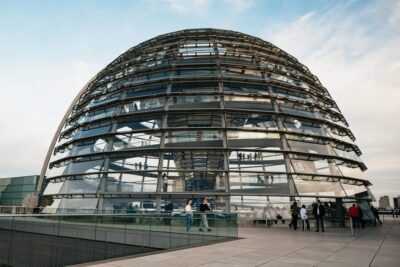
Reichstag, Dome and Government District Guided Tour
Read our review →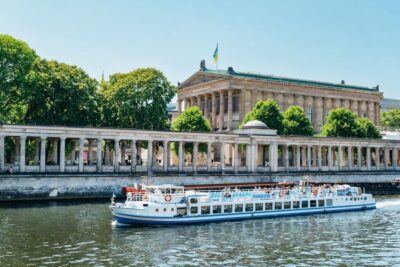
1-Hour City Tour by Boat with Guaranteed Seating
Read our review →
Berlin City walk Government District and Places of Democracy
Read our review →