
Reviewed · WALKING TOURS
Cologne Walking Tour: Explore Top Sights & Hidden Gems
Two hours, nine stops, Cologne in full context. I love how the route links the Cologne Cathedral to everyday life, and I love the built-in pause for Kölsch at Brauhaus FRÜH am Dom. The only drawback is the pace is quick, so you will see a lot, but you may want extra time later if you like to linger.
You will walk with a real guide, and in the past that guide has been Juan, described as polite, warm, and packed with practical info. With a small group size, up to 30 people, it feels easy to ask a question in the middle of the action.
At $36 for about 2 hours, this is a value play because the walk is guided and the scheduled stops are admission ticket free as listed. Still, remember you are paying mainly for the guidance and the right order of sights, not for a long sit-down museum visit.
In This Review
- Key highlights you will actually feel on the walk
- Starting at Kardinal-Höffner-Platz and setting your pace
- Cologne Cathedral: Gothic power, twin towers, and the “why it took so long”
- Brauhaus FRÜH am Dom: Kölsch culture in small glasses since 1904
- Rheinpromenade: a river walk shaped by rebuilding after war
- Tunnes-und-Schal bronze statues: Cologne humor made physical
- Alter Markt and Heumarkt: medieval and everyday city squares
- Duftmuseum im Farina-Haus: perfume roots and a 1709 origin story
- Alt St. Alban: Roman church remains left as a memorial
- Equestrian monument for Frederick William III: a Prussian chapter in bronze
- Heumarkt again, then the Rhine-side return
- Price and value: what $36 buys you in Cologne
- Who should book this tour
- Practical tips for an easy, comfortable walk
- Should you book this Cologne Cathedral and culture walking tour?
- FAQ
- How long is the Cologne walking tour?
- What is the price per person?
- Is the tour offered in English?
- Do I need an admission ticket for the stops?
- Where does the tour start?
- Where does the tour end?
- Is there a limit on group size?
- Do I get a professional guide?
- Are gratuities included in the price?
- Is free cancellation available?
- Are service animals allowed?
- Is public transportation nearby?
Key highlights you will actually feel on the walk
- Cologne Cathedral’s twin towers, plus the big construction timeline from 1248 to 1880
- FRÜH am Dom’s Kölsch tradition, brewed and served in small glasses since 1904
- A Rhine River promenade rebuilt after World War II, so you get a modern city layer
- Tunnes-und-Schal bronze statues, based on fictional characters by writer Adam Wrede
- Farina’s perfume origin at Duftmuseum im Farina-Haus, tied to 1709 and an oldest-registered claim
- Roman church memorial remains at Alt St. Alban, left as a reminder after wartime destruction
Starting at Kardinal-Höffner-Platz and setting your pace
This tour starts at Kardinal-Höffner-Platz 1 in central Cologne and ends back near the meeting point. That matters because it keeps the navigation simple. You are not bouncing around the city on your own schedule, and you are not trying to figure out where to go after the last stop.
The walk is designed for about 2 hours, with short time blocks at each place (often 10 to 15 minutes). Translation: you will get the highlights and the meaning behind them. If your style is more slow and detailed, plan to use this as your orientation lap, then come back later for deeper time in the stops that catch your eye.
If you are going in English, you can relax. The tour is offered in English, and it uses a mobile ticket. That is usually the easiest option when you want to stay flexible in a city where you are often moving between tram or metro stops.
More Walking Tours in Cologne
- Cologne: Night Watchman Old Town Walking Tour
★ 4.6 · 1,638 reviews - Cologne: Old Town Highlights Walking Tour
★ 4.6 · 1,093 reviews - Cologne: Südstadt Guided Foodie Walking Tour
★ 4.6 · 624 reviews
Cologne Cathedral: Gothic power, twin towers, and the “why it took so long”
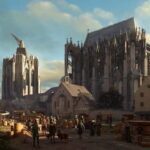
Cologne Cathedral is the first stop, and it is hard to beat as a start. The cathedral is a Gothic landmark that began in 1248 and reached completion in 1880, with the famous twin towers defining the skyline.
Here is what you should look for on this kind of stop. Don’t just treat it like a photo backdrop. Notice how the building still communicates its age through structure and scale. Gothic cathedrals are not fast projects. This one took well over a century, and that long timeline is a clue to how important it was to the people financing, building, and waiting.
A practical note: the stop is about 15 minutes. You will see the outside and get the basics. If you hope for a long, quiet interior session, you will likely need to plan a separate visit. Still, as an opening act, it is excellent because it gives you a clear visual anchor for everything else you will see.
Brauhaus FRÜH am Dom: Kölsch culture in small glasses since 1904
Next comes a classic Cologne tradition at Brauhaus FRÜH am Dom. This is the Kölsch moment, with beer brewed and served in traditional small glasses since 1904.
What I like about including a brewery stop in a walking tour is that it shifts you from “sightseeing mode” into lived-in city mode. You get a taste of how locals experience Cologne on an ordinary day. And because the glass is small, it nudges you to slow down just a bit without turning your tour into a long drinking session.
Also, even if you do not plan to order, the stop still gives you context. You can watch the rhythm of service and get a sense of why Kölsch is so tied to identity here. If you do order, keep it to one round unless you are comfortable slowing down your pace, since you still have more stops after this.
The practical downside is simply timing. This is a short stop. If you want a full beer hall experience, you will need to come back after the tour.
Rheinpromenade: a river walk shaped by rebuilding after war
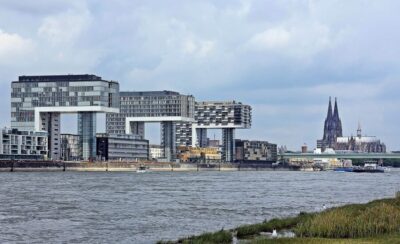
Then you head to the Rheinpromenade. This promenade follows the Rhine River and was rebuilt after World War II, which means you are walking in a place that reflects both the river’s pull and the city’s recovery.
On a city-river walk like this, you want to look out for the broader feel rather than hunting for one specific object. The Rhine is Cologne’s big stage, and the promenade is where the city turns toward it. A rebuilt walkway also helps you understand why Cologne looks the way it does today. It is not frozen in time, and that is true even in the parts you might assume are “old.”
This stop is about 10 minutes, so it is not a long scenic detour. It is enough to reset your eyes and let the city open up before you return to history-close streets.
Tunnes-und-Schal bronze statues: Cologne humor made physical
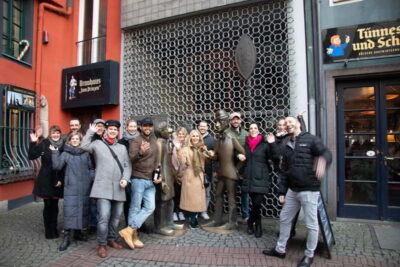
One of the more fun pauses comes at Tunnes-und-Schal-Statuen, the bronze figures showing two fictional characters created by Cologne writer Adam Wrede.
The point of these statues is not just that they look cool. They represent local humor and working-class life. That makes them a great reminder that Cologne is not only cathedrals and formal monuments. It is also day-to-day wit, character, and people telling stories about themselves.
What to do during this stop: look at posture and expression, not just the fact that they are there. The statues are like city punchlines you can walk up to. And because the stop is only about 10 minutes, you get the payoff quickly and then move on.
If you like street-level cultural details, this stop will probably stick with you longer than the more monumental sights.
More German cities at walking speed:

Alter Markt and Heumarkt: medieval and everyday city squares
Cologne’s squares do real work. They host markets, gatherings, and daily movement, and you see that logic in two stops: Alter Markt and Heumarkt.
At Alter Markt, you explore a historic square that served as a marketplace in medieval Cologne. It is a reminder that cities were built around trade long before they had tourist maps. When you stand in a square like this, try to imagine how people moved through it when it was strictly practical: buying, trading, bargaining, and communicating.
Heumarkt is another large square, historically used for markets and public events. Together, these two stops give you a clearer picture of how Cologne’s public spaces function. They are not decorative. They are infrastructure.
Both stops are about 10 to 15 minutes. If you want extra time, these squares are good candidates to revisit later in the day, especially if you like people-watching.
Duftmuseum im Farina-Haus: perfume roots and a 1709 origin story
Next is Duftmuseum im Farina-Haus, and this stop is a different kind of Cologne. You are stepping into the birthplace of the world’s oldest registered perfume, created in 1709.
This is where the tour does something smart for your brain. It mixes art and aroma into an area that might otherwise feel like it is all stone and statues. Even if you have never cared about perfume before, you will likely understand why this story matters. Cologne was connected to trade, craft, and branding long before social media made marketing a daily hobby.
Because it is part of a short walking tour, you will not turn this into a long museum marathon. You will get the key idea and enough context to decide if you want to go deeper later.
Alt St. Alban: Roman church remains left as a memorial
At Alt St. Alban, you see the remains of a Roman church destroyed during World War II and left as a memorial. This is one of those stops where the atmosphere changes fast. The point is not to “tour” trauma. It is to witness a physical reminder that history includes breaks and loss.
Roman Cologne is not something you typically grasp from the modern streets unless you are shown where it survived. The memorial remains connect eras in a very direct way: you are standing in a spot where layers of time overlap, and the city chose to keep the evidence visible.
This stop is about 15 minutes. That is long enough to get the story and look carefully. If you are sensitive to wartime topics, approach this stop with the right mindset. It is meant to be reflective.
Equestrian monument for Frederick William III: a Prussian chapter in bronze
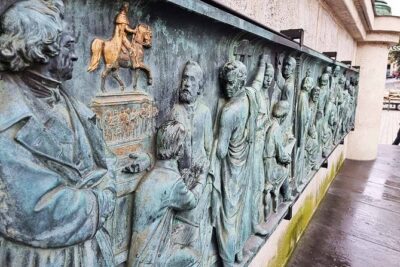
Another quick, meaningful stop is the equestrian monument honoring King Frederick William III of Prussia, who ruled from 1797 to 1840.
Monuments can be tricky. They can feel remote if you only see them as statues. This stop helps you read them more like documents. A monument like this is a way of naming power, memory, and political identity in public space.
If you like history that shows up outside museums, this is a good addition to balance the more religious and commercial stops. It also gives your walk a broader European timeframe beyond medieval Cologne.
The stop is about 15 minutes, so you will get the basics and then move on.
Heumarkt again, then the Rhine-side return
The route keeps you moving through central Cologne, finishing with Heumarkt and then guiding you back to the meeting area. Ending back where you started is convenient. It reduces decision fatigue near the end of the tour when your legs are telling you to call it a day.
This last leg also matters because Cologne Cathedral and the Rhine are such strong bookends. Even if you are not staring at the Rhine constantly, you get the sense of being in a city that is layered, rebuilt, and still active.
Price and value: what $36 buys you in Cologne
At $36 per person for about 2 hours, you are paying for three main things: a professional guide, an efficient route, and context that you would otherwise have to research yourself.
A big value point here is that the scheduled stops list admission ticket free access. That means you are not stacking your budget with entrance fees just to understand what you are seeing. You still bring your spending money if you want to buy a drink during the Kölsch stop, but the sightseeing portion is handled.
For me, the strongest value comes from the order of the stops. Cathedral first gives you the visual spine. Then Kölsch and squares ground you in daily life. Perfume and Roman remains add craft and deep time. The Prussian monument rounds it out with political memory. That mix is exactly what makes a walking tour feel worth the time.
Who should book this tour
This works best for you if:
- You want a fast way to orient yourself in Cologne without getting lost.
- You like a guided approach that includes culture, not only big landmarks.
- You enjoy mixing serious stops with everyday city rhythms like Kölsch.
It may not be ideal if:
- You want long time inside buildings and museums.
- You prefer slow, quiet walks with lots of free time between stops.
Practical tips for an easy, comfortable walk
- Wear comfortable shoes. The tour is short, but Cologne walking adds up.
- Bring a light layer. Weather changes fast near the river.
- If you want to taste Kölsch, keep it simple. You still have several stops after.
- Bring your curiosity for the “small” things, like the Tunnes-und-Schal statues and the memorial remains. Those are often the parts people remember.
Should you book this Cologne Cathedral and culture walking tour?
Yes, if you want a focused introduction to Cologne in just about 2 hours. The route hits the cathedral, the Rhine promenade, historic market squares, perfume roots, Roman memorial remains, and public monuments, and it does it in English with a professional guide.
If you hate rushing and need long stops, you might treat this as a kickoff, then plan a second visit to the places that pull you in. For most people, though, this is a smart way to get oriented, learn the meaning behind the sights, and leave with a clearer sense of what makes Cologne feel like a real city, not just a postcard.
FAQ
How long is the Cologne walking tour?
The tour lasts about 2 hours.
What is the price per person?
The price is $36.00 per person.
Is the tour offered in English?
Yes, it is offered in English.
Do I need an admission ticket for the stops?
The itinerary lists admission ticket free for the scheduled stops.
Where does the tour start?
It starts at Kardinal-Höffner-Platz 1, 50667 Köln, Germany.
Where does the tour end?
The activity ends back at the meeting point.
Is there a limit on group size?
Yes, the maximum group size is 30 travelers.
Do I get a professional guide?
Yes, the tour includes a professional tour guide and a 2-hour guided walking tour.
Are gratuities included in the price?
No, gratuities are optional and not included.
Is free cancellation available?
Yes, you can cancel for free up to 24 hours in advance for a full refund.
Are service animals allowed?
Yes, service animals are allowed.
Is public transportation nearby?
Yes, it is near public transportation.
Fresh on the arrivals board for Cologne
Walking Tours, compared.
Berlin City walk Government District and Places of Democracy
Read our review →
Berlin’s Best: 2 Hour Walking Tour Third Reich and the Cold War
Read our review →
Browse the lists this tour appears in