Reviewed · WALKING TOURS
Ulm Private Walking Tour With A Professional Guide
Ulm is full of oddball landmarks, and this tour makes them make sense. You’ll start at the Town Hall, move to Ulm Minster (a world-class tall-stories stop), and finish with a river panorama. It’s built for first-time visitors who want the big sights and the good explanations in about 90 minutes.
I really like the way the route stays tight. You see the Town Hall murals and 16th-century astronomical clock, the Dolphin Fountain, the crooked-house legend, and key old-town quarters without burning half a day. I also love the private-guide format, because you can ask follow-up questions as you go, not after.
The only real catch is that it’s a walking-only experience. No transportation is needed, so bring comfortable shoes and expect to cover a fair amount of ground at an easy pace.
In This Review
- Key highlights that make this Ulm tour worth your time
- Town Hall murals, astronomical clock, and getting your bearings fast
- Ulm Minster, the 500-year build, and the world-record scale
- The Dolphin Fountain, 52 water jets, and reflections you can photograph
- Butchers Tower and the leaning tower myth, plus the Crooked House over the Blau
- Fishermen’s Quarter: narrow streets, real wealth, and Donau trade stories
- Neu-Ulm river walk, plus the Einstein and Guinness record moments
- How the private guide experience feels in real life (and why questions matter)
- Price and value: is $299.18 per group reasonable?
- Who this Ulm walking tour suits best
- Should you book this private Ulm walking tour?
- FAQ
- How long is the Ulm Private Walking Tour?
- What is the group size for this private tour?
- What language is the tour offered in?
- Where does the tour start and end?
- Is transportation needed during the tour?
- What sights are included on the route?
- What is included in the price?
- What is the cancellation policy?
Key highlights that make this Ulm tour worth your time
- Private guide, group only: You get undivided attention for the full 1.5 hours.
- Ulm Minster in context: World tallest church status, plus the 500-year build story.
- Dolphin Fountain details: The 52 inter-crossing water jets and why the reflections matter.
- Two leaning landmarks, different reasons: Butchers Tower leans, and the Crooked House bends for practical old-town needs.
- Fishermen’s Quarter reality check: Learn how merchants and ship owners shaped the “fishermen” streets.
Town Hall murals, astronomical clock, and getting your bearings fast
Your tour starts at Ulm Minster area, then quickly feeds you the kind of visual info that helps you enjoy the rest of the city. The early stop at the Town Hall is a great opener because it’s both dramatic and instructive.
You’ll look at the bright Town Hall murals first, and your guide will explain what you’re actually seeing: virtues, commandments, and vices painted across the exterior murals, extended into the older building part. It’s the sort of detail that’s easy to miss if you’re just walking by, and it instantly turns Ulm from a list of buildings into a city with ideas behind it.
Also on the building: a 16th-century astronomical clock. If you’re the type who likes turning “cool” into “I get it,” this is one of those moments where the explanation makes the clock feel less mysterious and more like real history on display.
Practical tip: have your camera ready right at the start. The murals are designed to be seen up close, and early light can make the colors pop.
More German cities at walking speed:
- Discover Berlin Half-Day Walking Tour
★ 5.0 · 9,624 reviews - Berlin City walk Government District and Places of Democracy
★ 4.7 · 8,467 reviews
Ulm Minster, the 500-year build, and the world-record scale
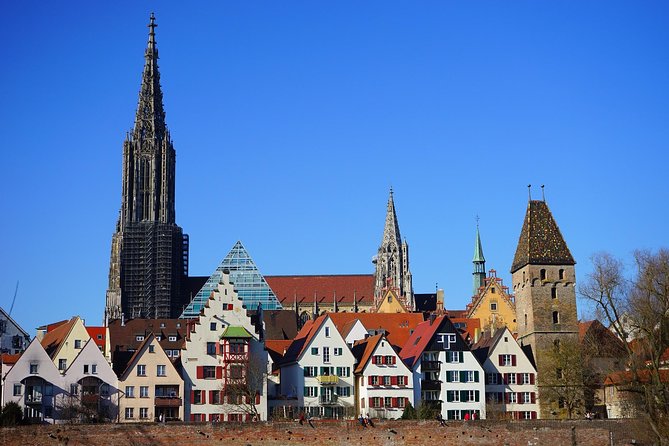
Next up is Ulm Minster, the city’s signature structure. This is more than a pretty tower. The guide frames it in record terms and timeline terms, so you understand why it mattered to Ulm for centuries.
You’ll learn that Ulm Minster is the world’s tallest church, and that it was the 4th tallest building until the 20th century. Then comes the human part: it took around 500 years to finish. That kind of timespan changes the way you look at any church, because you stop seeing it as a single project and start seeing it as generations of local effort.
From a practical standpoint, this stop is ideal for:
- First-time visitors who want a quick “wow” without a long climb.
- People who like architectural trivia, especially when the guide connects it to city identity.
You’ll also hear why it’s one of Ulm’s most important landmarks today. Even if you’re not a church person, the sheer scale makes the explanation stick. It’s the kind of site where your brain automatically switches on, like, OK, Ulm meant business.
Camera advice: get a few wide shots, then one or two closer angles. The tower reads differently depending on where you stand.
The Dolphin Fountain, 52 water jets, and reflections you can photograph
A short hop brings you to the Dolphin Fountain, and this stop is pure “how did they do that?” energy. The fountain has a complex structure, and the guide highlights what makes it special: 52 inter-crossing jets of water.
That number matters because it signals the design philosophy. This isn’t just a decorative splash. The jets are arranged so the water streams interact, creating patterns that change with motion and viewpoint. Then there’s the visual bonus your guide calls out: reflections of wet metal. That’s a huge clue for your camera settings and timing, because water and shine create strong contrast.
If you catch it when it’s floodlit, the water display is particularly attractive at night. Your tour doesn’t promise night timing, but if your departure happens later in the day, keep this in mind. Even in daylight, the fountain is one of those spots where the city’s personality shows up, playful and technical at the same time.
Best use of your time here: pause and watch the jets for a minute. The explanation gives you the “why,” and the fountain gives you the “wow.”
Butchers Tower and the leaning tower myth, plus the Crooked House over the Blau
If you think you’ve seen leaning towers before, Ulm still has a way to surprise you. This part of the tour leans into the city’s quirks in a very controlled way, so you don’t just walk past weird buildings, you learn what’s behind them.
First is the so-called leaning tower of Ulm, which is the Butchers Tower. Your guide explains that it used to be part of Ulm’s fortifications and that it leans 2.05 meters in a northwesterly direction, by 3.3°. A fun comparison is included in the explanation: Pisa’s leaning figure is 5.1°, but Ulm’s tower still holds its own with its own tilt story.
Then the tour moves to the most famous crooked-house sight: the Crooked House. Here’s where Ulm really earns its record badges. The rooftop leans at an impressive 9 to 10° over the river Blau, and in 1997 it was listed in the Guinness Book of Records as the world’s most extremely leaning hotel.
What I like about how the guide presents this is that the Crooked House isn’t just a strange photo. You’ll learn the construction reasoning: it’s narrow at the bottom and wider in the upper stores. The guide connects the design to how it functioned, including:
- A building used for fishing, repair of nets, and fish storage
- A boat landing at the base of the house
- Upper stores working like a kind of roof
That practical purpose is what makes the building click. It’s not a random accident. It’s a shape that fits an older way of living along the water.
Drawback to consider: because these two landmarks are visual and “record-y,” you’ll want time for photos. If you’re traveling with people who rush, remind them that this portion works best when you slow down for shots and explanations.
Fishermen’s Quarter: narrow streets, real wealth, and Donau trade stories
After the crooked-and-leaning sights, you’ll walk into the Fishermen’s Quarter, which is where Ulm turns romantic fast. Expect narrow streets, little streams, bridges, and old houses packed close together. The mood changes from record weirdness to lived-in old-town charm.
Then the guide drops the key twist: don’t let the name fool you. The owners of the houses were not poor fishermen trying to survive. They were merchants and ship owners who made money trading goods along the Donau. The old houses reflect that wealth, which is why the quarter looks so solid and carefully built.
This is one of the best parts of the tour for people who enjoy “the story behind the street.” It also helps you understand why riverside cities often have neighborhoods that look like they were built for work first, beauty second. Here, the guide shows how both happened.
Practical angle: if you’re wearing sandals or shoes that aren’t grippy, this is where you’ll want comfort. Even on a short city walk, cobblestones and tighter passages can feel more tiring than open squares.
Neu-Ulm river walk, plus the Einstein and Guinness record moments
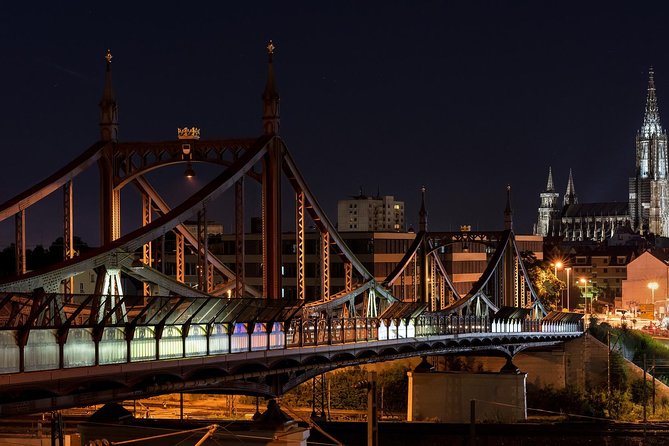
Your tour ends on the Neu-Ulm side with a nice walk along the river, giving you a panoramic view back toward the old town. This finale is smart because it resets your eyes after the architectural close-ups. You get a broader perspective, and it helps everything you saw earlier connect into one city picture.
This ending walk also matters because Ulm is a river-shaped place. Your guide ties together the places linked to the river Blau and the Donau trade story, so the city feels less like a set of stops and more like a system.
Two additional themes you’ll hear about during the tour are Albert Einstein and a Guinness Book of Records building. The exact pinpoints aren’t spelled out in the details you get ahead of time, but your guide’s approach stays consistent: they use the record and the famous name as a thread to help you remember what matters in Ulm.
If you like tours that end with a calm payoff after “crazy architecture moments,” the Neu-Ulm river walk is a good way to close the loop.
How the private guide experience feels in real life (and why questions matter)
This is the part that really sells the experience. It’s private in the sense that your group gets the local guide only for the tour, not a shared free-for-all. The tour format also gives you multiple departure times during the day, which is useful if you’re coordinating with trains or other sightseeing.
In one highlight from a past participant’s note, the guide was Steffan, and the praise was very specific: he was engaging, really strong on Ulm history, and patient with questions. That last part is surprisingly important. Ulm is the kind of city where people ask, “Why is it leaning?” “What did that building actually do?” “What does the mural mean?” A guide who sticks with those questions makes the walk feel personal, not scripted.
You also get fun facts and quirky sights woven into the route. That’s not just trivia dumping. It’s a way to keep you looking up, not just forward, which helps you enjoy the murals, towers, and fountains as real objects, not just backdrops.
If you’re traveling as a couple, a small family, or a group of friends who like stories, the private guide format is where the value starts to show.
Price and value: is $299.18 per group reasonable?
The price is $299.18 per group, up to 15 people, for about 1 hour 30 minutes. That pricing can look steep if you’re comparing to group buses, but it usually makes sense for a private, guided walk.
Here’s how to think about value:
- If you’re a small group, you’ll pay more per person, but you also get focused attention and a route built around explanations.
- If you’re traveling as a larger group within the cap, the cost per person drops quickly, and you get a more “shared” experience with the guide adjusting to your pace.
The best value is for people who want:
- The key landmarks efficiently (Town Hall, Ulm Minster, Dolphin Fountain, record sites)
- A guide who can answer questions as you walk
- No need to handle transport logistics during the tour, because this is a straight walking experience
English is the tour language, and the experience uses a mobile ticket, which is handy if you prefer low-friction check-in.
One more practical consideration: you’ll cover enough that you should plan this as a main activity, not a last-minute filler between other plans.
Who this Ulm walking tour suits best
This is a good fit if you are:
- Visiting Ulm for the first time and want the high-impact landmarks in a short window
- Curious about why things are the way they are, not just what they look like
- Traveling with a group that benefits from private attention
It’s also described as suitable for any age, which matters if you’re planning a mixed-age group. Still, it’s a walking tour, so you’ll want the group to be comfortable with an 1.5-hour walk.
If you’re the type who loves checking off famous sites, you’ll enjoy the “record” thread, from Ulm Minster to the crooked-house Guinness listing. If you prefer art and storytelling, you’ll like the Town Hall murals and the explanation of what the Fishermen’s Quarter name hides.
Should you book this private Ulm walking tour?
I’d book it if your goal is simple: see the real Ulm highlights, understand the stories behind them, and do it in 90 minutes with a guide who answers questions without rushing you along.
Book it especially if you like your tours structured but not stiff. The route moves from Town Hall to Minster to fountain to leaning landmarks to the river view, so you never feel like you’re repeating yourself. And because it’s private, you get the sense that the guide is paying attention to your pace, not the clock on a mass departure.
Skip it only if you want a long, slow, free-roam day with no guiding, or if you know you do not like walking city routes for about an hour and a half.
If you want Ulm’s quirks explained, with record-level sights you’ll remember, this is a solid, well-paced way to do it.
FAQ
How long is the Ulm Private Walking Tour?
The tour lasts about 1 hour 30 minutes.
What is the group size for this private tour?
It’s priced per group and can include up to 15 people.
What language is the tour offered in?
The tour is offered in English.
Where does the tour start and end?
It starts at Ulm Minster, Münsterplatz 21, 89073 Ulm, Germany, and ends at the Neu-Ulm side along the river (the listed endpoint is 89 Ulm, Germany).
Is transportation needed during the tour?
No transportation is needed, since it is a walking tour.
What sights are included on the route?
You’ll see the Town Hall, Cathedral Ulm Minster (Ulm Minster), Dolphin Fountain, Butchers Tower, Fishermen’s Quarter, the Crooked House, and Neu-Ulm.
What is included in the price?
The price includes a local guide who will be with your group only, and a private guided tour.
What is the cancellation policy?
Free cancellation is available. You can cancel up to 24 hours in advance for a full refund. If you cancel less than 24 hours before the start time, the amount paid is not refunded.
Fresh on the arrivals board for Baden Wurttemberg

Walking Tours, compared.

Berlin City walk Government District and Places of Democracy
Read our review →
Berlin’s Best: 2 Hour Walking Tour Third Reich and the Cold War
Read our review →