
Reviewed · GUIDED WALKS IN MUNICH
Munich Walking Tour: Explore Top Sights & Hidden Gems
Munich feels different when you walk it in layers. This 2-hour route strings together royal power and political turning points, plus quiet corners like Viscardigasse alley, where history shows up in the tiniest spaces. I especially like that each stop comes with free admission for what you see.
I also like the pacing and the way the guide keeps the story moving. Patrick, the guide name that shows up again and again in feedback, is praised for staying on track, even when rain tries to ruin the plan.
One possible drawback: it is a short walk with about 10 minutes at each main stop, so you get highlights rather than deep time inside buildings. If you love lingering in churches or reading every plaque, you might want to add extra free time on your own afterward.
In This Review
- Key Highlights You Will Appreciate
- A 2-Hour Munich Walk That Connects Big Turning Points
- Viscardigasse Alley: A Narrow Passage With Moral Weight
- Residenz München: Royal Power Without the Guesswork
- Hofgarten: Courtly Landscaping Around a Central Pavilion
- Dianatempel and the War Memorial: Two Worlds Inside One Garden
- Bavarian State Chancellery: Old Dome, New Glass, Same Political Purpose
- Odeonsplatz: A Square Where History Played Out in Public
- Theatinerkirche St. Kajetan: Birth, Power, and Church Order
- Frauenkirche Towers: Twin Domes and the Archbishop Seat
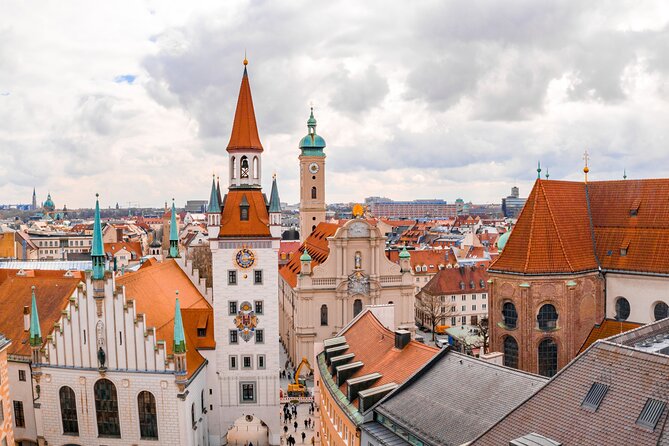
- Marienplatz and Neus Rathaus: Munich’s Main Stage and the Daily Glockenspiel
- Hofbräuhaus München: A Historic Beer Hall for Atmosphere and Story
- Price and Value: Why $32 Works for This Route
- Timing, Logistics, and What to Wear
- Who Should Book This Walk (And Who Might Skip It)
- Should You Book This Munich Walking Tour?
- FAQ
- How long is the Munich walking tour?
- What is the price per person?
- Is the tour offered in English?
- Do I need to buy admission tickets for the stops?
- Does the tour use a mobile ticket?
- Where does the tour start?
- How many people are in the group?
- Is the tour accessible for service animals?
- What if the weather is bad?
- FAQ
- Is gratuities included in the tour price?
- Is there free cancellation?
Key Highlights You Will Appreciate
- Free entry at every listed stop, so your budget stays predictable.
- A tight 2-hour itinerary that hits royal Munich, political Munich, and everyday landmarks.
- Viscardigasse, a narrow alley tied to how locals reacted to a brutal requirement nearby.
- Hofgarten’s center pieces, including the Dianatempel pavilion and the War Memorial in the same garden space.
- A mix of classic and modern architecture, like the Bavarian State Chancellery with its preserved 1905 dome plus post-reunification glass additions.
- Marienplatz and the Glockenspiel, plus a last stop at Hofbräuhaus München that keeps the atmosphere grounded in Bavarian life.
A 2-Hour Munich Walk That Connects Big Turning Points
This tour is built for people who want context fast, without getting lost in a self-guided maze. You walk a compact route through central Munich and end back at the starting point, so you do not have to worry about re-navigating at the end.
The biggest value is the way the stops link together. You go from a local alley tied to Nazi-era pressure, to the royal complex and court garden, then onward to government and political squares, and finally you land at the city’s central heart, Marienplatz, and a historic beer hall.
At $32 per person for about two hours, it is a straightforward way to see the core sights while still learning how Munich fits into Germany’s harder chapters. And because it is offered in English with a live professional guide, you get explanations that you will not get from a quick street-level glance.
More Guided Walks in Munich
- Munich: Third Reich & WWII Walking Tour
★ 4.6 · 6,181 reviews - Third Reich Walking Tour Munich
★ 4.5 · 4,291 reviews - Munich: Old Town & Viktualienmarkt City Walk in German
★ 4.7 · 2,304 reviews
Viscardigasse Alley: A Narrow Passage With Moral Weight
The walk begins with Viscardigasse, a narrow alley that locals used to avoid the required Nazi salute at the nearby memorial. The space is small on purpose, and that matters, because it shows how ordinary people dealt with extraordinary coercion.
I like how this stop sets the tone early. You are not only seeing landmarks, you are learning how people moved through the city under pressure, using the layout itself as protection.
Practical tip: take a moment here before you look for photos. This is the kind of stop where a respectful pause makes the explanation hit harder.
Residenz München: Royal Power Without the Guesswork
Next comes Residenz München, the former royal complex where Bavarian rulers governed for centuries and held official ceremonies. Even if you only get a short look, this is one of those places that explains how Munich became the center of a court culture.
What I like most is that the tour frames the Residenz as an operating system for power. It is not presented as a frozen museum piece, it is described as a place where decisions and ceremonies happened, over and over again.
Given the limited time at each stop, you will want to focus on the overall feeling of a court complex rather than trying to read everything. If you fall in love with what you see, you can always return later when you have more hours to explore.
Hofgarten: Courtly Landscaping Around a Central Pavilion
After the royal complex, the route shifts into green space with Hofgarten. This historic garden was built for the Bavarian court and arranged around a central pavilion from the early 17th century.
Hofgarten is where you start to feel the deliberate design choices. The tour helps you notice that it was planned for how the court lived and gathered, not just for strolling.
In a short tour like this, that is a key skill: you learn to look for the structure first, then let the details come. If you are walking during cooler months, Hofgarten also gives you a gentle change from stone and street corners, even though it still stays central.
Dianatempel and the War Memorial: Two Worlds Inside One Garden
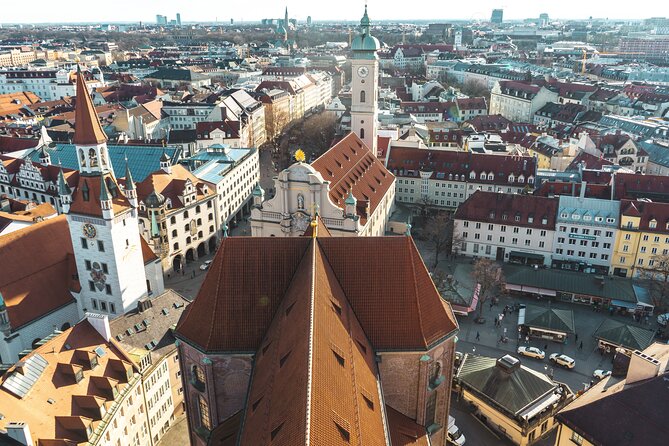
Right in the middle of Hofgarten is the Dianatempel, a 17th-century pavilion built as the garden’s central structure and used for courtly events. The contrast here is striking, because you are standing at a design meant for ceremony and controlled display.
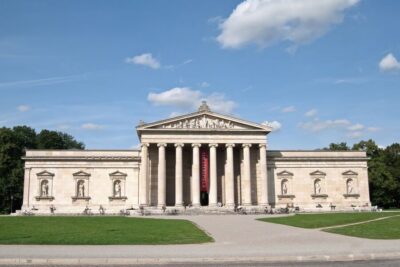
Then the tour brings you to Kriegerdenkmal im Hofgarten, the War Memorial. It was created after World War I to commemorate fallen Bavarian soldiers, and later expanded to include victims of World War II.
I like that the tour does not treat these as separate topics. It uses the same garden space to show how meaning can change over time, even when the setting looks elegant.
If you are sensitive to heavier topics, plan your own pace. Spend the full moment where the guide points, then give yourself a short breath of quiet before moving on.
More German cities at walking speed:


Bavarian State Chancellery: Old Dome, New Glass, Same Political Purpose
The route continues to the Bavarian State Chancellery. Here you can observe a mix of eras: a preserved 1905 central dome, plus modern glass wings added after reunification.
This is one of those stops where architecture becomes a timeline you can see. The tour’s value is that it helps you look beyond the façade and understand what the building is doing, connecting continuity with change.
Because the stop is brief, I suggest you choose one angle and stick with it. Look at how the dome and the newer wings relate, then let the guide’s comments give you the rest of the story.
Odeonsplatz: A Square Where History Played Out in Public
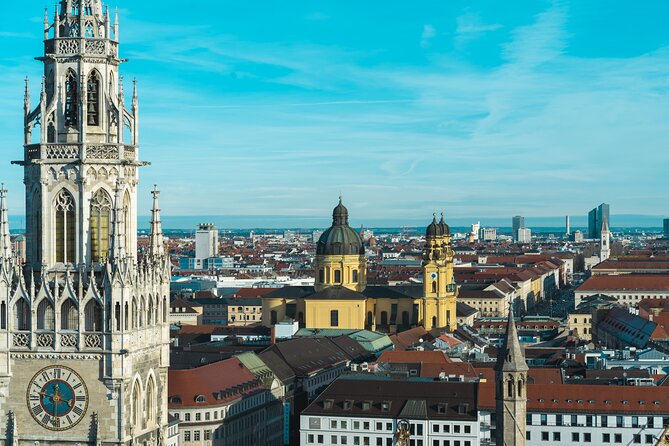
At Odeonsplatz, you stand at a historic square where key political events took place, including the confrontation tied to the 1923 Hitler Putsch. Squares like this are different from “must-see monuments,” because they are stages. People can gather, movements can show themselves, and the city itself becomes part of the narrative.
I appreciate how this stop helps you understand Munich as a place where politics was not tucked away. It happened in open sightlines, in public, with crowds and momentum.
Practical note: with a square stop, you will often have people moving around all directions. Keep your group position tidy and listen first, then look around second.
Theatinerkirche St. Kajetan: Birth, Power, and Church Order
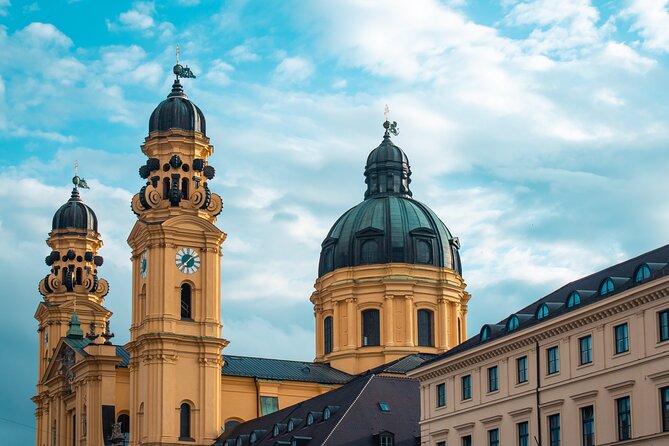
Next is Theatinerkirche St. Kajetan, a 17th-century church founded by the Bavarian rulers to celebrate the birth of their heir, and served by the Theatine order. That one sentence gives you a lot: it tells you the church’s origin reason and the religious structure behind its operation.
This stop also shifts the mood again. Instead of political public space, you are in a quieter world tied to dynasty and faith.
Because the tour time is tight, focus on the why. Let the founding story guide what you notice about the building, rather than trying to absorb everything in one go.
Frauenkirche Towers: Twin Domes and the Archbishop Seat
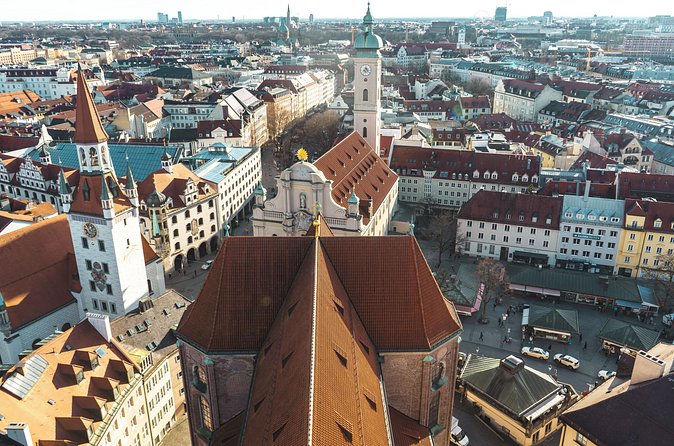
Then you reach Frauenkirche, the cathedral built in the 15th century, known for its distinctive twin domes and as the seat of the Archbishop of Munich. The tour includes time to climb the towers, which adds a physical moment to keep the walk from feeling all flat and observational.
Even with a short visit, the twin-domed identity is hard to miss. The tour helps you connect those domes to the cathedral’s role in church leadership.
Tip for the climb: wear comfortable shoes and go at a steady pace. Tower stairs can feel more demanding than you expect, especially on a day when you are also walking from stop to stop.
Marienplatz and Neus Rathaus: Munich’s Main Stage and the Daily Glockenspiel
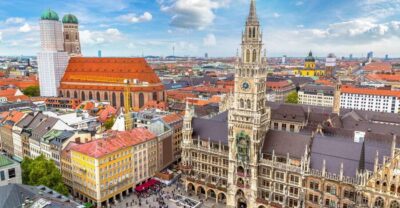
Marienplatz is the city’s central square and main marketplace since the 12th century. It is the sort of place where Munich’s daily life and its ceremonial life overlap.
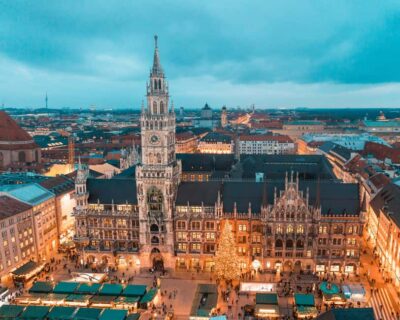
From there you go to the New Town Hall, or Neus Rathaus, a Gothic Revival building completed in 1908, famous for the Glockenspiel that performs daily. If you like a concrete landmark with a repeatable signature, this is it.
I like ending this segment with something that feels alive, not just historical. Even when you only catch the start of the daily show, the moment anchors the tour in real city rhythm.
Hofbräuhaus München: A Historic Beer Hall for Atmosphere and Story
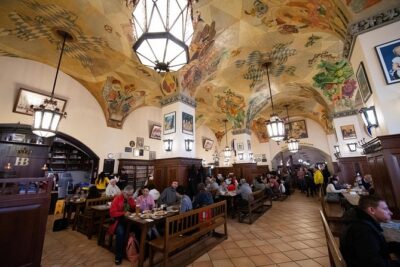
The final stop is Hofbräuhaus München, where the beer hall was founded in 1589 and connected to Bavarian kings brewing and serving their own beer. The tour takes you inside, so you get a sense of the space, not just the outside signage.
This is a smart ending. After politics, war commemoration, and church stories, you finish with something that shaped daily social life. It is not a distraction from the past, it is the human scale that makes the city feel like more than monuments.
In your time inside, keep it simple. Notice the hall as a gathering space, then let the guide’s framing put the founding date into perspective.
Price and Value: Why $32 Works for This Route
At $32 per person for about two hours, this tour hits a sweet spot between cost and coverage. You are paying for a professional guide, a set walking route, and a mobile ticket that makes check-in easy.
The value kicker is that each listed stop has admission included as free for the tour participants. That matters, because it prevents the common problem where walking tours turn into an unplanned series of paid entries.
The group size is also limited, with a maximum of 30 participants. Smaller groups usually mean you stay closer together, and you are more likely to hear explanations without fighting over space.
If you are comparing based purely on price, it looks simple. If you compare based on what you actually learn and see in one compact route, it feels like a bargain.
Timing, Logistics, and What to Wear
The tour is offered in English and lasts about two hours, with roughly 10 minutes per stop. That pacing means you will likely cover a lot of ground on foot, but you will not burn your whole day.
It also ends back at the meeting point, so the last leg is not a problem. The start is listed at 4HRG+GRX in Munich, and the tour is near public transportation, which helps if you are building it around other plans.
Wear comfortable walking shoes. You will do city sidewalks, stair time for Frauenkirche tower climb, and you will likely move quickly between stops. If the weather is rainy, the guide is described as able to keep things on track, which is a big deal when you want the experience to feel organized rather than chaotic.
Who Should Book This Walk (And Who Might Skip It)
This tour is a great match if you:
- want a compact route through central Munich that mixes royal, political, religious, and social landmarks
- like getting straight answers from a live guide rather than reading everything on your phone
- value free admission at the listed stops
You might consider skipping or supplementing it if you:
- want long, unhurried museum or church time
- prefer a more detailed architecture walk where you spend longer at one building
This is a highlights tour with strong storytelling glue, not a slow, deep research project.
Should You Book This Munich Walking Tour?
Yes, if you want the fastest path to understanding what Munich is, beyond postcard views. The route connects powerful themes, from Nazi-era memory in a tiny alley, to Bavarian court life in Hofgarten, to political landmarks at squares and government buildings, and then to Marienplatz and Hofbräuhaus to keep it human.
Book it especially if you like short stops that still come with clear context. For $32, free entry included, and a group capped at 30 people, it is hard to beat for getting your bearings and leaving with names and meanings you can remember.
FAQ
How long is the Munich walking tour?
It is approximately 2 hours.
What is the price per person?
The price is $32.00 per person.
Is the tour offered in English?
Yes, it is offered in English.
Do I need to buy admission tickets for the stops?
The listed stops include free admission for participants, with ticket admission noted as free.
Does the tour use a mobile ticket?
Yes, it is a mobile ticket.
Where does the tour start?
The meeting point start is 4HRG+GRX, Munich, Germany.
How many people are in the group?
The tour has a maximum of 30 people.
Is the tour accessible for service animals?
Service animals are allowed.
What if the weather is bad?
The experience can run in rainy conditions, and the guide is noted for keeping things on track.
FAQ
Is gratuities included in the tour price?
Gratuities are optional and not included.
Is there free cancellation?
Yes. You can cancel up to 24 hours in advance for a full refund.
Fresh on the arrivals board for Munich



Guided Walks in Munich, compared.
Old Town & Viktualienmarkt City Walk in German
Read our review →
Munich Ghosts and Spirits Evening Walking Tour
Read our review →

Birthplace of the Third Reich Guided Walking Tour
Read our review →Browse the lists this tour appears in