
Reviewed · HISTORICAL TOURS
Historic Dresden Small-Group Walking Tour in English
Dresden tells its story one square at a time. I like the small-group attention and the way the guide strings together what you’re seeing with what happened to Dresden over centuries. It’s also practical, with plenty of chances to ask questions, but one drawback to note is that there are no headsets, so hearing can get tough if the group feels spread out.
You’ll walk a focused route through the city’s big visual anchors, from Semper Opera House views to the Frauenkirche reconstruction story. And because the stops are mostly outdoors or in courtyards, you’re not constantly hunting tickets. The pace is generally manageable for many people, though there are some stairs.
If you want a guided “orientation plus highlights” tour that helps you decide what to see later on your own, this is a strong fit. The price is about $30.25 for roughly two hours, which feels reasonable when you consider the small group size and the free viewing stops.
In This Review
- Key highlights I’d prioritize
- Theaterplatz to Semper Opera House: Dresden’s cultural control room
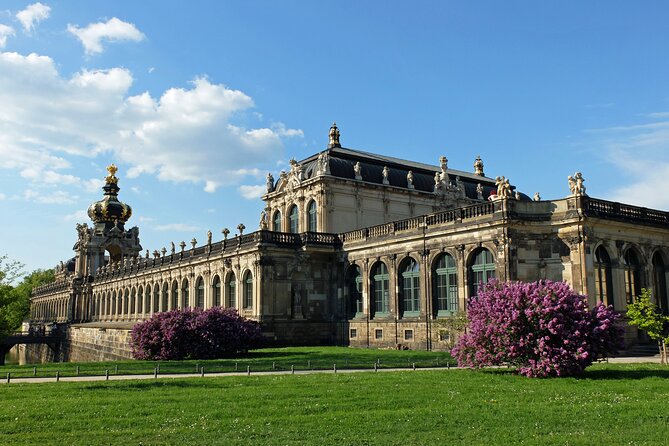
- The Dresden Zwinger: why the palace entrance never became a palace
- Royal Palace courtyards and Sgraffito: see the art, skip the extra ticket
- Stallhof to Fürstenzug: court life, then 100 meters of porcelain stories
- The Royal Cathedral of Dresden: a court church with a twist
- Brühl’s Terrace: the Balcony of Europe view over the Elbe
- Neumarkt and Frauenkirche: reconstruction that still feels personal
- Price and value: $30.25 for a guided “choose-your-own-adventure” plan
- Who this tour suits best, and how to get more out of it
- Should you book Historic Dresden Small-Group Walking Tour in English?
- FAQ
- How long is the Dresden walking tour?
- What language is the tour offered in?
- What is the group size limit?
- Where does the tour start?
- Where does the tour end?
- Is a mobile ticket provided?
- Are there admissions included for the stops?
- What is included in the price?
- Are tips included?
- Can I cancel for a full refund?
- Are service animals allowed?
Key highlights I’d prioritize
- Theaterplatz framing that sets up Dresden’s top landmarks in one view
- Zwinger Palace stories, including what commissioned it and details you might miss
- Sgraffito courtyard art at the Royal Palace area, plus smart pointers on museum tickets
- Fürstenzug (the princes mural), a long porcelain artwork with hidden details to look for
- Brühl’s Terrace views of the Elbe and the historic-steam-boat scene
- Frauenkirche’s rebuilding story and what to do in the church and crypt after the walk
Theaterplatz to Semper Opera House: Dresden’s cultural control room
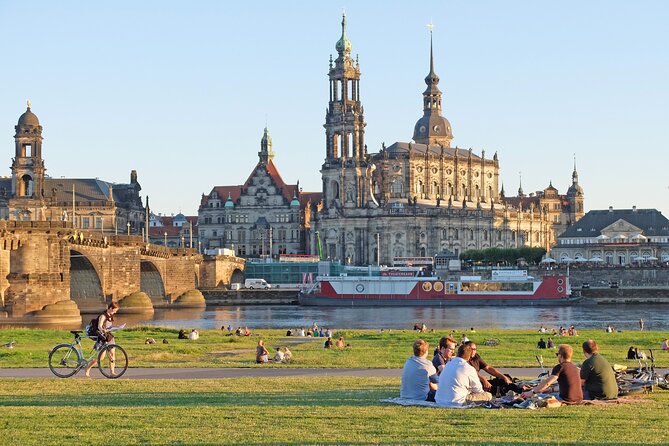
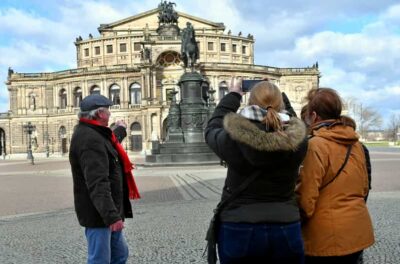
The tour starts at Schloßplatz, and right away you hit Theaterplatz, one of Dresden’s showpiece squares. Your guide connects the architecture to the city’s identity, and the star of the view is the Semper Opera House. Even if you have never stepped inside an opera house, the building’s presence makes it easy to understand why Dresden became so tied to music and performance.
This first stop is valuable because it gives you a mental map fast. From here you can spot relationships between major sights: the Zwinger Palace nearby, the Residenzschloss area, and the Dresden Cathedral rising with a quieter sort of dignity. You’ll also get a prompt to look for the Old Masters Gallery from this viewpoint, which helps later when you decide whether you want to add museum time.
I also like that guides keep it conversational here. Names that come up often in this tour experience include Christina, Laura, and Doris, and the consistent theme is that they answer questions rather than just recite dates. One caution: on a first stop like this, the group can bunch up in crowded corners. If you hate shoulder-to-shoulder, hang back until the guide points the main angles.
More Walking Tours in Dresden
- Dresden: City & Semperoper Guided Walking Tour
★ 4.8 · 2,397 reviews - Dresden: Guided City Walk
★ 4.6 · 2,075 reviews - Dresden: Complete Walking Tour with Frauenkirche Visit
★ 4.8 · 700 reviews
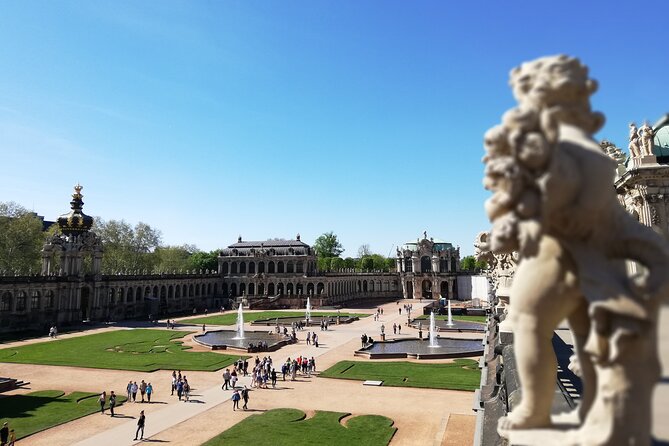
The Dresden Zwinger: why the palace entrance never became a palace
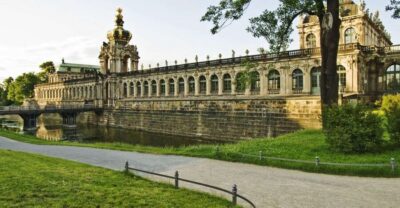
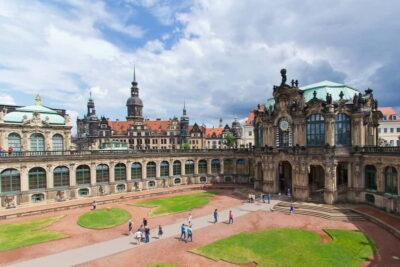
Next you move to the Dresden Zwinger, described as an architectural idea that was meant to serve as a grand entrance to a palace that never got built. That detail changes how you look at the building. Instead of thinking only “beautiful Baroque complex,” you start thinking “big ambition, big plans, and history forcing a rewrite.”
Your guide talks about the ruler behind it, with a focus on Augustus the Strong and his appetite for spectacle and beauty. That’s the kind of context that makes the place feel more personal, not just postcard pretty. It also helps you notice the craftsmanship instead of zoning out after the first ornate corner.
There’s a practical upside too. The Zwinger stop is listed as admission ticket free for what you’ll do here, so you can enjoy the exterior and key areas without turning the walk into a budgeting problem. If there’s time and if it’s open, the guide may point out an open-air grotto that’s hidden from general view. That’s one of those “worth paying attention” moments, because the grotto is exactly the sort of detail you’d miss on your own.
If you’re a detail hunter, this stop rewards you. If you’re tired from jet lag and just want the big visuals, it still works, because the guide keeps pointing out what to look for next.
Royal Palace courtyards and Sgraffito: see the art, skip the extra ticket
One of my favorite parts of this route is the Royal Palace segment, because it’s built around the idea of “history in the open.” You walk through a courtyard where you can spot Renaissance art technique called sgraffito. It’s a slow-looking kind of art, but your guide helps you understand what you’re seeing so it doesn’t feel random.
What I like here is the balance. You do not go into the museum itself during the walk. Instead, the guide focuses on orientation, the feel of the palace complex, and what you might want to do later. Then you get advice on the treasures and collections so you can decide if it’s worth buying a ticket for the museum during your own time.
That approach is smart for value. Two hours is not enough to turn Dresden into a museum marathon. By seeing the palace courtyards plus learning how the collections are organized, you leave with a plan rather than a pile of loose facts.
One consideration: if you were hoping for guaranteed indoor time in the museum, this tour is not built for that. It’s a guided walk and viewpoints experience, with “optional later” museum time handled by you, after the tour.
Stallhof to Fürstenzug: court life, then 100 meters of porcelain stories

After the palace, you head to the Stallhof, a Renaissance courtyard tucked behind the Residenzschloss. This is the calmer, enclosed contrast to the big squares. The courtyard’s arcades and sandstone columns create a space that feels intimate even though it’s part of royal surroundings.
Your guide also gives you the context that it once hosted jousting tournaments and royal festivities. That changes the tone. Instead of “cool courtyard,” it becomes “a stage where power performed itself.” You end up imagining the movement of people and ceremonies, which is exactly why a guided stop like this can feel more real than photos.
Then comes a stop that’s hard to forget: the Fürstenzug, the long porcelain mural often described as 100 meters long, made with 24,000 tiles, and claimed to be the longest outdoor porcelain artwork in the world. Your guide tells you there are secrets and stories hidden within it, and challenges you to spot them.
This is where small-group size matters. If you’re near the right viewing angle, you can actually follow the details rather than just admire the overall length. If you’re far back, you’ll likely see the mural as a wall of color and costumes. So try to move up when the guide gives the “look for this” pointers.
The Royal Cathedral of Dresden: a court church with a twist
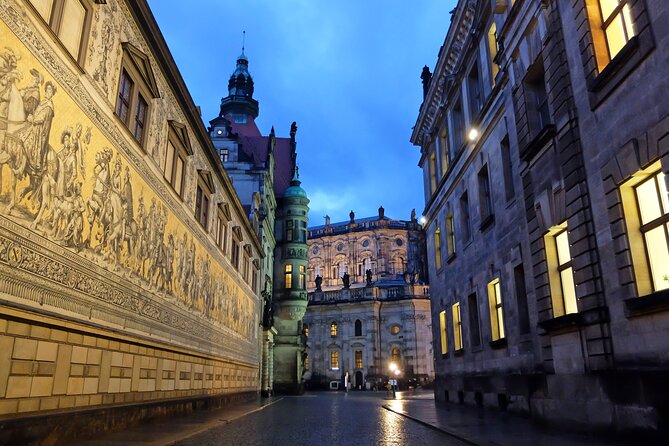
Next, you see the Royal Cathedral of Dresden from the outside. The story is unusual on purpose: it was built in secret by a Catholic ruler in Protestant Saxony, and it served as the former court church. Your guide also explains that it’s one of the burial sites of the Royal family.
Even outside, this stop feels meaningful because it adds tension and contrast to the palace-and-opera storyline. It’s not only art and music. It’s also religion, power, and secrecy. The cathedral’s story complements what you’ve learned earlier about Dresden evolving through political and religious change.
Because it’s an outside viewing stop, it’s efficient. You’re not waiting in lines or switching tickets mid-walk. You get the structure and the key context, and that’s often all you need before deciding whether you want additional time on your own.
More German cities at walking speed:




Brühl’s Terrace: the Balcony of Europe view over the Elbe
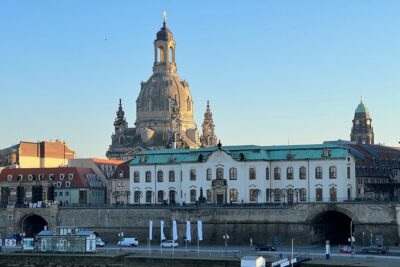
Brühl’s Terrace is the next big visual payoff, known as the Balcony of Europe. Your guide positions you for wide views across the Elbe River and out toward the city. You’ll look at river traffic in a historical way too, with attention to the White Fleet of historic steam boats.
The key is what the guide points out from the stairs and the viewpoints. Expect landmarks tied to the river, church steeples in the distance, and the idea of wine slopes far away. This stop helps you understand Dresden as more than a tightly packed old town. It’s a city with river life, directions, and nearby possibilities.
This is also a great moment to ask questions. People often want to know where to go next for dinner, a short walk, or a river-side stroll. A good guide makes those suggestions practical, not random.
If you dislike heights or open viewpoints, note that you’ll be on a terrace promenade and stair access is part of the planned experience. It’s usually manageable, but it’s not a “no stairs at all” walk.
Neumarkt and Frauenkirche: reconstruction that still feels personal
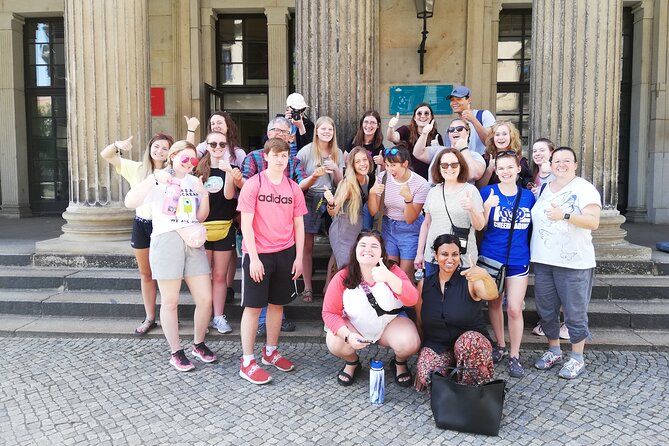
The tour typically ends at Neumarkt, a restored 18th-century square anchored by the Frauenkirche. This is one of the best endings in Dresden because it turns into a natural pause point for your independent exploring. The square is framed by colorful Baroque façades, and it’s also where you can quickly find places to eat with minimal extra planning.
At the heart of Neumarkt is the Frauenkirche, the symbol of Dresden rising from the ashes. Your guide shares the dramatic arc of destruction, decades-long reconstruction, and the worldwide effort that brought the baroque masterpiece back to life. Even if you’ve seen photos before, the storytelling helps the rebuilding feel less like a project and more like a decision.
Your guide will also suggest what to do next. You can go into the church later on your own, and you can go down to the crypt to see a small exhibition about the rebuilding. This is a smart way to keep the walk within two hours while still guiding you toward a deeper experience without forcing you into it on schedule.
One more value point: the stops you’ve seen along the way are mostly ticket-free in the practical sense, so you haven’t spent your time and money just to get a distant view. You finish at a landmark where paid indoor time, if you choose it, feels emotionally worth it.
Price and value: $30.25 for a guided “choose-your-own-adventure” plan

At about $30.25 per person for roughly two hours, the value comes from two things: the tight route and the guide’s ability to shape your next steps. You see the core anchors you’d want for a first visit, and you also get context that helps you decide what’s worth paying extra for, like museum time later.
This tour also benefits from the small-group limit of up to 15 travelers. That size is large enough to feel social, but small enough for a guide to keep an eye on questions. The best guides on this walk, including people like Leo, Karen, Helga, Marion, and Laura, consistently focus on clear English communication and answering what you actually want to know.
There is one caution that shows up in the feedback. Headsets are not provided, so hearing can depend on where you stand in the group. On a crowded day, you may need to adjust your position to hear key explanations, especially at stops that get busy like Neumarkt or Theaterplatz.
If you plan your day around a short guided orientation, this price usually feels fair. If you want a museum-heavy route with guaranteed timed entry, you may prefer a different format.
Who this tour suits best, and how to get more out of it
This is ideal for first-timers who want to understand Dresden quickly without feeling rushed. It’s also a good fit for history lovers who like stories connected to real buildings, not just a list of dates. If you enjoy art details, you’ll like the sgraffito courtyard stop and the pointers about what to look for in murals.
If you’re traveling with seniors, the pace is generally described as not too demanding, though there are some stairs. That means it’s not a zero-stair walk, so plan for slow moments and take breaks if needed.
To get the most from the experience:
- Stand where you can hear the guide, not only where you can see the landmark.
- Use the tour to get clarity on what you want to do after, since the walk ends near the best “go inside later” options.
- Ask about collections and ticket choices while the guide is still with you, since the tour is designed to set that up.
Guides in this experience often include an art history angle, and you can see that in how they teach what to notice. That’s why the tour can feel more like talking with someone who loves Dresden, rather than collecting facts.
Should you book Historic Dresden Small-Group Walking Tour in English?
I’d book it if you’re:
- Visiting Dresden for the first time and want a guided way to get your bearings fast
- Interested in how Dresden rebuilt itself, especially through the Frauenkirche story
- Looking for a small-group walk where you can ask questions and get direct answers
I would think twice if:
- You strongly prefer museum interiors during a guided session
- You know you struggle with hearing without headsets, since this tour does not provide them
If you want a short, high-impact introduction that helps you plan the rest of your day, this tour hits the sweet spot. It ends where you’ll actually want to linger, and it gives you the context to make that lingering more meaningful.
FAQ
How long is the Dresden walking tour?
It runs for about 2 hours.
What language is the tour offered in?
The tour is offered in English.
What is the group size limit?
The tour has a maximum of 15 travelers.
Where does the tour start?
The meeting point is Schloßplatz, Schloßpl., 01067 Dresden-Altstadt, Germany.
Where does the tour end?
It ends back at the meeting point.
Is a mobile ticket provided?
Yes, you receive a mobile ticket.
Are there admissions included for the stops?
The listed stops are marked as Admission Ticket Free. At the Royal Palace area, you walk through a courtyard and do not go into the museum itself during the tour.
What is included in the price?
The price includes the 2-hour walking tour and a professional guide.
Are tips included?
No, tips and gratuities are not included.
Can I cancel for a full refund?
Free cancellation is available if you cancel at least 24 hours in advance of the experience start time.
Are service animals allowed?
Yes, service animals are allowed.
Centuries Per Block
- Elbfloren: Historical city tour
★ 4.8 · 929 reviews - Dresden: Guided Beer Tour of the Historic Old City
★ 4.8 · 95 reviews - Historic Dresden Private Walking Tour
★ 5.0 · 32 reviews - Leipzig: City History Canal Sightseeing Tour on a Motorboat
★ 4.7 · 7,671 reviews
Fresh on the arrivals board for Dresden


Historical Tours, compared.
City History Canal Sightseeing Tour on a Motorboat
Read our review →

Browse the lists this tour appears in