
Reviewed · BOAT TOURS IN BERLIN
Berlin East Side Tour 2.5 hour cruise with commentary
Follow Berlin’s story by boat.
This 2.5 hour ride connects Museum Island, the Wall-era waterfront, and the modern government core, with live English and German narration as you glide along the Spree. You also get that rare benefit of seeing places like the Oberbaum Bridge area and the East Side Gallery without fighting for curbside photo spots.
I love two things about this cruise. First, the top deck views give you angles you do not get on foot, especially around the bridges and sculptures. Second, the commentary keeps you oriented, so landmarks like the Reichstag, the Humboldt Forum, and the East Side Gallery feel like a connected story instead of random photo stops.
One drawback to consider: seating and temperature can be hit or miss. Some seats are tight, and the upper and lower areas can feel very warm, so plan to dress for changing conditions and be ready to move if needed.
In This Review
- Key highlights to know before you board
- A 2.5 hour Spree cruise that hits the big stuff fast
- Top deck strategy: where you sit changes everything
- Museum Island start: Berlin Cathedral and the Humboldt Forum
- Mühlendammschleuse and the founding waterways of Berlin
- East Side Gallery, Oberbaum Bridge area, and Molecule Man
- Nikolaiviertel, Berlin TV Tower, and the view toward Reichstag
- From Humboldthafen to House of World Cultures and Palace of Tears
- Along Schiffbauerdamm, bridges, and Museum Island details you can spot again later
- Price and value: is $36.04 worth it?
- Should you book the East Side Tour 2.5 hour cruise?
- FAQ
- How long is the Berlin East Side Tour?
- Where does the tour start?
- What time does the tour begin?
- Is the commentary available in English?
- Do I need to bring cash for food or drinks?
- Is there a restroom on board?
- How big is the group?
- Can I cancel for a full refund?
Key highlights to know before you board
- Top deck perspective for bridge views, sculpture moments, and skyline photos
- East Side Gallery pass with context about the artists, the length, and what is still original
- Mühlendammschleuse lock time plus founding-era waterway history
- Big Berlin icons in one loop, including the Reichstag and Museum Island area
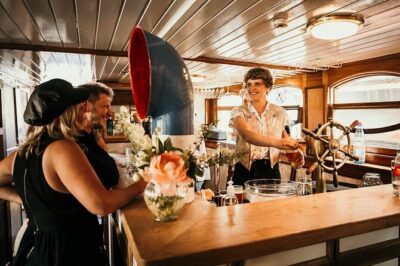
- Onboard bar for drinks while you stay seated and keep sightseeing
A 2.5 hour Spree cruise that hits the big stuff fast
This is the kind of sightseeing that works when you want a strong overview without doing a full day of walking. The timing is right for an afternoon: long enough to get multiple major districts into the story, short enough that you are not wiped out by evening.
At 2 hours 30 minutes, you cover a lot of Berlin waterfront variety. You move from historic and museum-heavy stretches around Museum Island to Wall-era memory sites on the east side, then onward into the city’s government and cultural zones. The route also includes key “wow” moments like a lock experience and pass-by views of bridges that define Berlin’s skyline.
I like that the boat experience feels relaxed. The cruise is limited to up to 55 travelers, so it does not feel like one massive cattle line. Add live narration in both English and German, plus onboard restrooms, and you get a comfortable way to learn while still taking pictures.
If you are the type who gets restless on long tours, the length is still manageable. But if you want deep, slow history for every stop, you should treat this as a strong orientation plus highlights, not a full lecture.
More Boat Tours in Berlin
- Berlin: 1-Hour City Tour by Boat with Guaranteed Seating
★ 4.3 · 16,993 reviews - Berlin: Boat Tour Along the River Spree
★ 4.4 · 11,252 reviews - Berlin: 1-hr Boat Tour with Bilingual Live Guide (DE/EN)
★ 4.7 · 5,653 reviews
Top deck strategy: where you sit changes everything
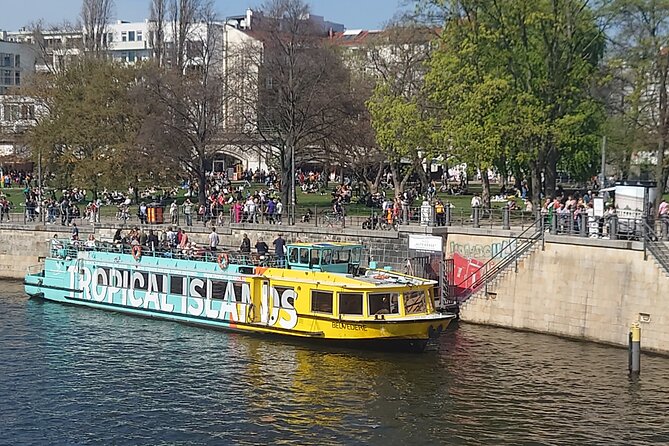
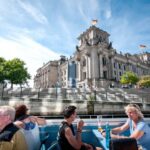
You will have the best views from the top deck. That is the simple truth, and it shows in how people describe the experience: when the weather cooperates, you can see a lot from above the waterline and frame buildings, sculptures, and bridge spans more easily.
Still, your comfort depends on where you end up. Some riders have flagged that the upstairs area can get hot, and that the boat layout can make certain seat groupings feel cramped. Others also report that hearing the narration can be harder up top, which matters because you will be learning as much from the commentary as from the scenery.
My practical advice: pick your seat with two things in mind, sun and sound. If you burn quickly, bring sunscreen and light layers, because you may not want to stay upstairs the whole time. If you care most about hearing English clearly, try to position yourself where audio carries best, and be ready to relocate if the sound is muffled from your spot.
Also note the language flow. The narration runs in German and English, and some English-focused riders reported that English starts after German, so plan to listen early even if you are waiting for the English segment.
Museum Island start: Berlin Cathedral and the Humboldt Forum
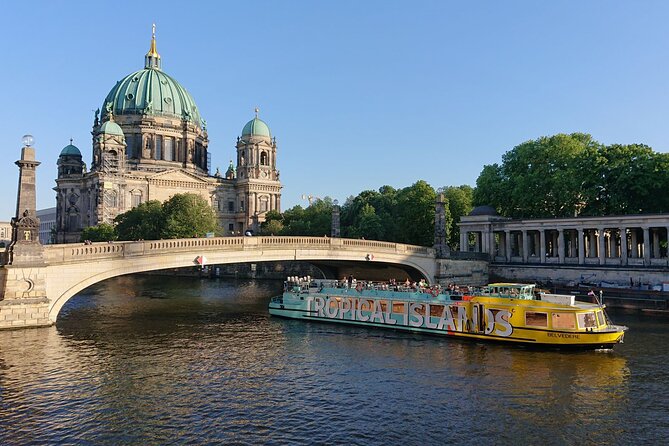
The cruise puts you in the “Mitte by the water” mood right away, with the Museum Island zone anchoring the background. The Berlin Cathedral at Lustgarten (Oberpfarr- und Domkirche zu Berlin) is a Protestant landmark built in the years 1894 to 1905, designed by Julius Raschdorff in Neo-Renaissance and Neo-Baroque styles. It is not just pretty from the outside, it is also tied to dynastic burial history, which gives your first museum district sight a deeper meaning.
Right in the same orbit is the Humboldt Forum in the Berlin Palace. If you have not studied it yet, this is a universal-museum space that includes the Ethnological Museum and the Museum of Asian Art, plus related cultural programming, events, and guided tours. It is also described as having a Humboldt Laboratory, which makes it feel less like a static showcase and more like a living cultural platform.
What you gain from seeing these landmarks from the Spree is scale and perspective. From ground level, Berlin’s museum buildings can feel “blocky” and separated. From the water, the spacing reads cleaner, and you can understand how the whole UNESCO-scale museum landscape sits along the river corridor. If you later walk the area, you will already have a map in your head.
One small consideration: this part is visually rich, but it is not the easiest zone for instant sightseeing selfies if the lighting is harsh. Use the cruise for orientation, then go back on foot for the details you want to slow down.
Mühlendammschleuse and the founding waterways of Berlin
A real standout on this cruise is the Mühlendammschleuse, where you get lock-related time and a history lesson you cannot replicate from a normal street stop. This lock lies east of Mühlendamm, in the Mitte district along the Spree, within the Spree-Oder waterway system.
The details matter here. The lock was put into operation in 1942, and it overcomes a drop of 1.51 meters. That kind of practical engineering fact is exactly why boat tours can be better than museum-only days. You see the river as a working route, not just a scenic backdrop.
It also connects to the city’s origins. The area is tied to the early water link between towns like Berlin and Cölln, and it is described as the place where Berlin was founded. There is also mention of older wooden bridge structures and a customs-duty setup, including the idea of a closed passage at night using a thick, iron-nailed trunk often referred to as the tree.
Even if you are not a “history details” person, this is where the cruise earns its keep. You stop being a spectator and start understanding why Berlin grew where it did, and why the river was both traffic and control.
East Side Gallery, Oberbaum Bridge area, and Molecule Man
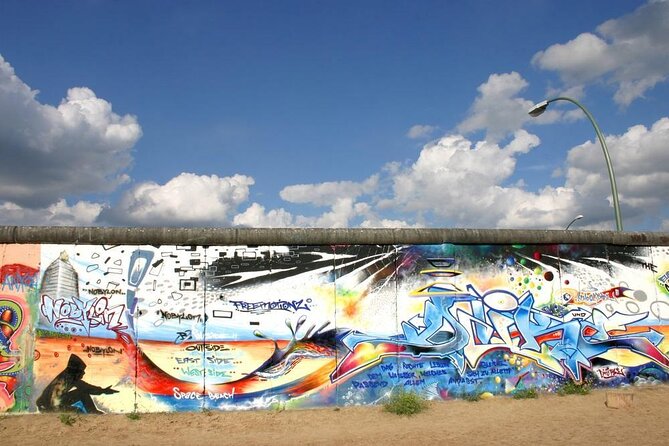
This is the emotionally charged segment, and it is also one of the most photographable. The East Side Gallery is a permanent open-air memorial on the longest surviving section of the Berlin Wall on Mühlenstraße, stretching along the Spree between Berlin Ostbahnhof and the Oberbaum Bridge.
What makes it special is how many artists and countries are involved. After the Wall opened in spring 1990, this section was painted by 118 artists from 21 countries across 1316 meters. They created around a hundred works on the wall’s side that previously faced East Berlin, responding to political changes of 1989 to 1990.
Important reality check for your expectations: due to urban planning, the wall is no longer preserved in its entirety. What exists today includes replicas made in 2009, not all the original paintings. Still, the meaning is there, and the cruise narration is what helps you grasp the difference between what you see now and what the Wall era looked like.
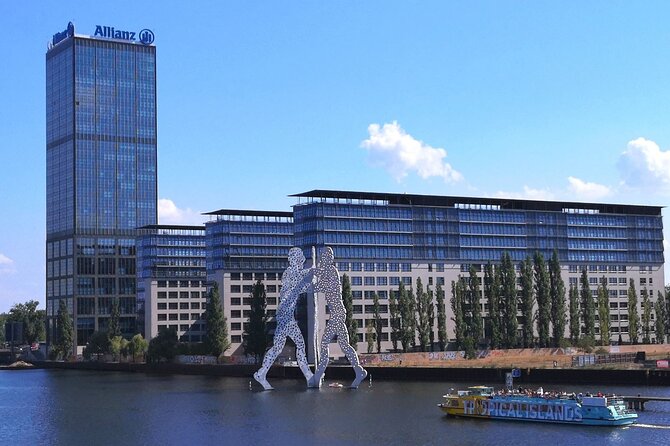
From this zone, you also glide into the Oberbaum Bridge area and the sculptural highlights. The Molecule Man is a monumental piece by American sculptor Jonathan Borofsky, created in May 1999. It is a three-person sculpture installed in the Spree between Elsenbrücke and Oberbaumbrücke near where Kreuzberg, Alt-Treptow, and Friedrichshain meet.
This is one of those stops that feels instantly modern, even if your head is still in Wall-era mode. It is also very “Berlin,” meaning it mixes memory, architecture, and contemporary public art into the same river frame.
More harbours and rivers from deck height:
Nikolaiviertel, Berlin TV Tower, and the view toward Reichstag
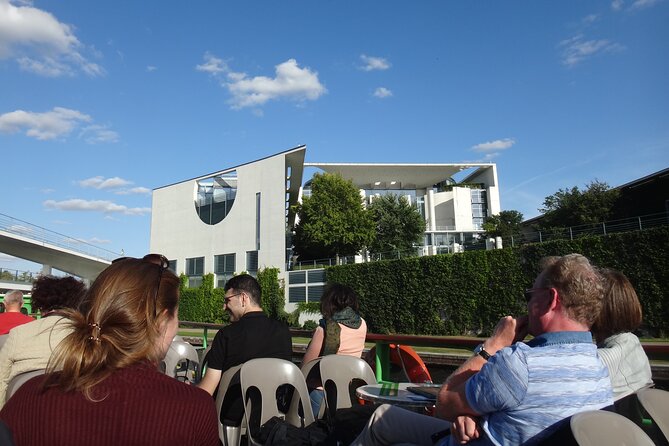
As the cruise continues into central Berlin, you get a shift from memorial and waterfront art into heritage reconstruction and major landmarks. The Nikolaiviertel is presented as the oldest settlement area in the capital. Much of it was destroyed in World War II, then rebuilt in 1980 to 1987 by architect Günter Stahn for the East Berlin magistrate, connected to the city’s 750th anniversary.
From the water, this district can feel like Berlin trying to look back at itself. You see the ensemble around the reconstructed Nikolaikirche and the surrounding town houses and adapted prefabricated buildings built on an almost medieval floor plan. It is not just a pretty neighborhood frame, it is a story of restoration and political-era choices about what Berlin wanted to present.
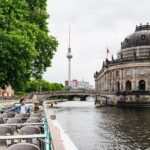
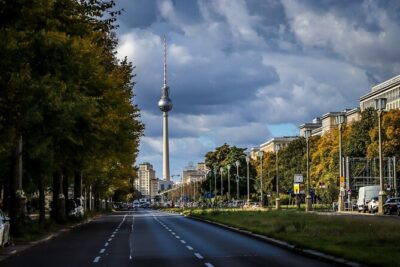
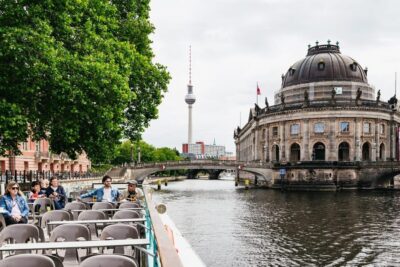
Next comes one of Germany’s most recognizable “point” silhouettes, the Berlin television tower. At 368 meters, it is the tallest building in Germany and the fifth tallest television tower in Europe. Completed in 1969, it was briefly the second highest in the world. The cruise helps you see it in relation to everything else, which is harder when you only stand in the city and look up.
Then you move toward the political heart. The Reichstag building sits on Republic Square, home of the German Bundestag since 1999. Erected from 1884 to 1894 in Neo-Renaissance style by architect Paul Wallot, it went through major damage, restoration, and a later redesign by Norman Foster for permanent parliamentary use. The accessible glass dome above the plenary hall is a standout feature in the skyline.
If you want one reason to book this cruise instead of just doing landmarks on foot, it is this: seeing the Reichstag and its surrounding government buildings from the river gives you a stronger sense of how the city is staged.
From Humboldthafen to House of World Cultures and Palace of Tears
Not all the cruise is “top sights.” Some of it is also about architecture that carries a specific message. The Humboldthafen is described as a listed dock and pool named after Alexander von Humboldt. You see a water surface of 33,500 square meters with around 3.5 meters depth.
Nearby along the government district vibe is the House of World Cultures (HKW). It is an exhibition space for international contemporary art and discussions, with a focus on non-European cultures and societies. The building you see is tied to modernist architecture, and it has a nickname in Berlin. Because of its shape, it is often called the Pregnant Oyster.
Then comes one of the most important reminders of the Cold War border reality. The Palace of Tears (Palast der Tränen) is the colloquial name for the former departure hall of the Bahnhof Friedrichstrasse border crossing. This is where S-Bahn and U-Bahn trains ran to West Berlin and where long-distance trains traveled via West Berlin to the Federal Republic. The name comes from how East Germans reportedly said goodbye to western visitors in tears.
The narration also ties it to the security apparatus. The control and check-in counters were manned by Ministry for State Security employees in GDR border troop uniforms. Even if you do not stop there to enter the building, just knowing what the place used to be turns an ordinary station context into something heavy and real.
Together, these stops make the cruise feel like a full Berlin timeline. It is not only about monuments. It is about systems and how people moved under political pressure.
Along Schiffbauerdamm, bridges, and Museum Island details you can spot again later
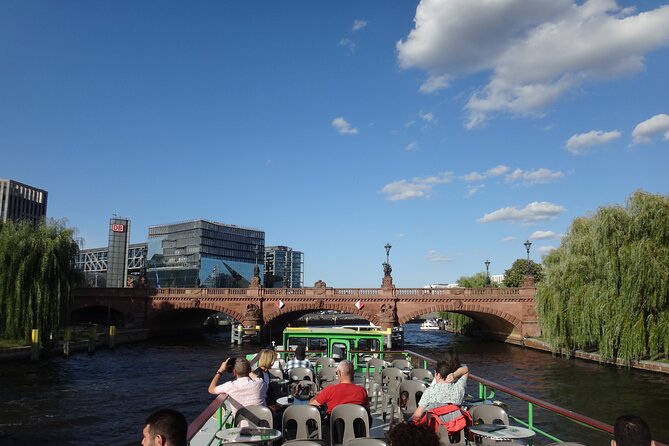
As you move through Mitte again, you get more “read the city” moments. The Schiffbauerdamm is a street on the right bank of the Spree between Weidendammer Bridge and Reinhardtstraße. The name refers to shipbuilding companies that used to be there, so it is a reminder that this river was industrial and practical long before it became a leisure corridor.
Bridges are part of the story too. The Kronprinzenbrücke connects Mitte and Tiergarten and sits near the government district, with cycle and pedestrian paths alongside road lanes. Nearby are the Spreebogenpark and a daycare center connected to the German Bundestag.
The Weidendammer Bridge is another key link. It traces back to an original bridge from the 17th century, making it the third oldest bridge in that old Berlin city center area. Today, the current construction is listed as a heritage structure and has even shown up in literature, which is a fun reminder that Berlin’s infrastructure has culture attached.
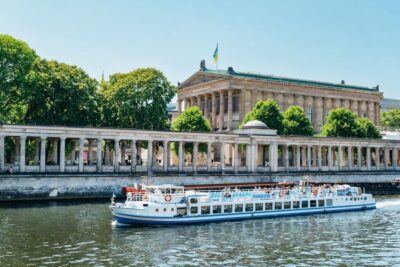
On the Museum Island side, the cruise also brings the Bode Museum into your field of view as part of the UNESCO-listed museum ensemble. The Bode Museum was built between 1898 and 1904 by Ernst von Ihne in Neo-Baroque style as the Kaiser Friedrich Museum for Kaiser Wilhelm II. It houses the Sculpture Collection, the Museum of Byzantine Art, and the Coin Cabinet.
One more practical tip: during your cruise, do not try to memorize everything perfectly. Instead, note the 2 or 3 places you will return to later. Museum Island and the Reichstag area are usually the best bets for a follow-up walk, because the river perspective you get here helps you choose where to go and what to prioritize.
Price and value: is $36.04 worth it?
For $36.04 per person, you are paying for three things: time on the water, live commentary in English and German, and a route that strings together major sights without needing constant transfers. Compared with a short 1 hour cruise, the extra time is not just length. It usually means you cover more territory and reach the more memorable stretches like the East Side Gallery zone and lock moments.
You also get a small-group feel. With a max of 55 travelers, it is easier to find a decent spot and keep moving between viewing areas. Add a restroom onboard and a bar service, and it becomes an easy way to handle an afternoon when you do not want to coordinate a bunch of separate activities.
Is it perfect value for everyone? Not necessarily. If you want long explanations for fewer stops, you might feel the pacing is still fast. Some riders have also reported that sound quality from the top deck can be tricky, so if you care most about crisp narration, you might want to be selective about seating and be ready to shift below when needed.
But if your goal is day-one orientation and a different angle on Berlin’s best-known landmarks plus Wall history, this price is fairly reasonable for what you pack in.
Should you book the East Side Tour 2.5 hour cruise?
I would book this if you want a single afternoon plan that touches big Berlin names and meaningful Wall-era sites, with live narration to tie it together. It is especially good on a clear day when you can enjoy the top deck and take in bridges, sculpture, and skyline views. It also works well if you do not want to commit to a full walking day of museum hopping.
Skip it or choose carefully if any of these are dealbreakers for you. If you are sensitive to cramped seating, or if you dislike warm indoor areas, plan to have a backup spot where you can cool off and still see enough. If you are an English-first listener, expect that the narration alternates between languages, and the English portion may come after German.
My bottom line: this cruise is a strong value when you treat it like a guided overview with a water-level perspective. It is not trying to replace in-depth museum visits. It is trying to get you oriented fast, with real Berlin textures you will want to revisit later.
FAQ
How long is the Berlin East Side Tour?
The cruise is about 2 hours 30 minutes.
Where does the tour start?
It starts at Anlegestelle Alte Börse / BWSG Berliner Wassersport und Service GmbH, Burgstraße 27, 10178 Berlin, Germany.
What time does the tour begin?
The start time listed is 2:45 pm.
Is the commentary available in English?
Yes. The tour offers live commentary in English and German.
Do I need to bring cash for food or drinks?
Food and drinks are available onboard, but they are not included in the price, so you will pay own expense.
Is there a restroom on board?
Yes, there is a toilet on board.
How big is the group?
The tour has a maximum of 55 travelers.
Can I cancel for a full refund?
Yes. You can cancel up to 24 hours in advance for a full refund.
Fresh on the arrivals board for Berlin

Boat Tours in Berlin, compared.
1-Hour City Tour by Boat with Guaranteed Seating
Read our review →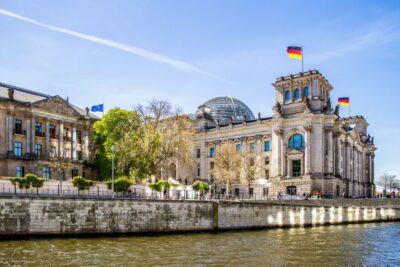
1-hr Boat Tour with Bilingual Live Guide (DE/EN)
Read our review →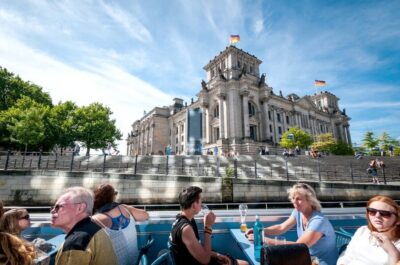
2.5-Hour East Side Boat Cruise with Commentary
Read our review →
Exclusive Boat Tour on a Solar-Powered Catamaran
Read our review →Browse the lists this tour appears in