
Reviewed · SELF-GUIDED TOURS
Ghosts of Munich: The Haunted Apprentice Exploration Game
A city tour you control, with a spooky goal. This is the Ghosts of Munich haunted apprentice game, a self-guided, offline adventure through the center. You follow clues from square to church to landmark, and the story is delivered with English audio you can use without worrying about phone data.
What I like most is how you set your own pace. You can start anytime after booking, pause for breaks, and keep going when it suits your group. I also love that it feels like Munich history, not just photo stops, since each location comes with a specific question tied to something you can actually see and notice.
One drawback to consider is that parts of the route involve places where admission is not included. That means you may need extra time, and you might still need to pay if you want to go inside or up for views.
In This Review
- Key Points Worth Noting Before You Play
- Ghosts of Munich: A Self-Guided Haunted Game, Not a Regular Tour
- Price, Time, and When You Should Schedule It
- Your Route, Stop by Stop, and What Makes Each One Interesting
- Stop 1: Odeonsplatz, where a 1921 showdown shaped the story
- Stop 2: Hofgarten, a Renaissance-style garden with a darker question
- Stop 3: Theatinerkirche St. Kajetan, baroque detail you should not rush
- Stop 4: Sitzender Keiler, the Sitting Boar and a luck ritual
- Stop 5: Frauenkirche, two towers and a Devil’s footprint at the entrance
- Stop 6: Munich Marienplatz, where the city keeps meeting itself
- Stop 7: St. Peter’s Church, survival, mixed styles, and a tower climb
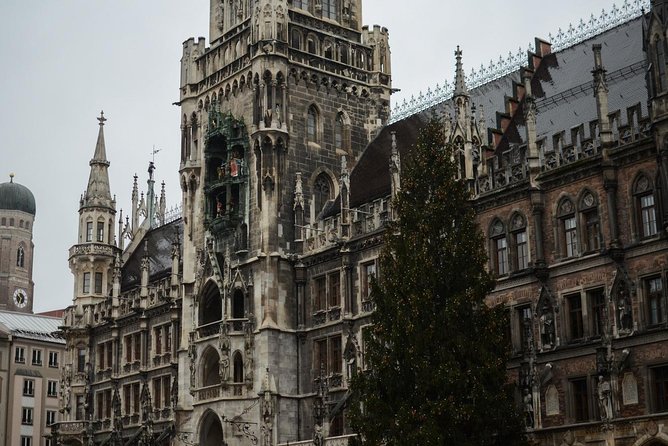
- Stop 8: New Town Hall (Neus Rathaus), the Glockenspiel and a post-plague story
- Offline by Design, and Why That Matters in Munich
- How the Private Format Changes the Whole Experience
- Language and Device Expectations
- Value Check: Is This Worth $7.21?
- Who Should Book Ghosts of Munich
- Quick Practical Notes Before You Start
- Should You Book It?
- FAQ
- How long is the Ghosts of Munich haunted apprentice game?
- What is the price per person?
- Do I need mobile data during the game?
- Is it available in English?
- Where do I start and where does it end?
- Do I need to join at a specific time?
- Is there a physical tour guide with the group?
- Are admission tickets included for the stops?
Key Points Worth Noting Before You Play

- Offline access helps you avoid expensive phone data charges
- Private self-guided format keeps you out of crowd pressure
- English audio stories make the mystery easy to follow
- Flexible timing lets you start at any hour and pause anytime
- A mix of free and ticket-required stops lets you budget your add-ons
- Short, puzzle-style visits make it a good fit for families and mixed ages
Ghosts of Munich: A Self-Guided Haunted Game, Not a Regular Tour
This is not a guided walk where someone talks at you the whole time. The Ghosts of Munich: The Haunted Apprentice Exploration Game is more like a city challenge you play on your phone, using stories and tasks tied to real places in central Munich.
For you, the big win is control. If you want a slower pace, you take it. If you want a quick sprint between stops, you can do that too. And because it is private, it is just your group, which makes the whole thing feel more personal and less like you are squeezed into a mass departure.
Also, the price is low enough that it works even if you are traveling on a tight budget. At $7.21 per person for a roughly 1 to 2 hour experience, you are paying for the game format and audio storytelling, not for a long, expensive ticket-heavy day. Just plan for the fact that some sites have admission not included, so your total cost depends on what you choose to enter.
Also holding a platform in Munich
- Munich: Scavenger Hunt Self-Guided Tour for Children
★ 4.5 · 101 reviews - Munich: Scavenger Hunt Self-Guided Tour
★ 4.1 · 51 reviews - 800 Years of History: A Munich GPS Audio Tour
★ 4.5 · 12 reviews
Price, Time, and When You Should Schedule It
The stated duration is about 1 to 2 hours, so you can treat it like a focused afternoon activity or a fun pre-dinner plan. Since it can be played anytime after booking and the local operating window is listed as essentially all day, you are not stuck chasing a tour slot.
I’d suggest doing it when your feet are ready for a walk, but you are not trying to cram in a full museum day. Think of it as a way to get oriented quickly in central Munich. The route moves through major landmarks and squares, and the puzzle prompts make you look up, look around, and notice details you might otherwise zip past.
If you are traveling with teens or multi-generational friends, this format often lands well because it creates mini goals. People naturally split attention between solving and sightseeing. The one downside is that it is still a phone-based experience, so if your device battery is low or your screen brightness is poor, you might feel the strain. Bring a charger if you can.
Your Route, Stop by Stop, and What Makes Each One Interesting
The game runs from Odeonsplatz at the start to Rindermarkt 17 at the end. Along the way, you hit eight stops. Some are free to access, and some are marked as admission not included. The trick is using the clues to stay present at each spot, rather than just snapping pictures and rushing on.
Stop 1: Odeonsplatz, where a 1921 showdown shaped the story
You begin at Odeonsplatz, a central Munich square designed in the early 19th century by Leo von Klenze in an Italian-like style. It looks grand, but the game uses that setting to pull you into a tense moment from 1921.
The story prompt is about an obscure leader of a minor band who tried to seize control of Bavaria. Authorities were ready with machine guns at the square, and the outcome was deadly, but the leader escaped. Your task here is to figure out who that controversial character was by solving the challenge.
Why it works: the square is a real, walkable place in Munich’s center, so you are not learning theory. You are standing in the right setting and connecting the clue to what you see around you.
Time and cost: this stop is listed at about 10 minutes, and admission is free.
Stop 2: Hofgarten, a Renaissance-style garden with a darker question
Next you reach Hofgarten, a small park at the edge of Munich’s historic old town. It was designed in the 17th century by Elector Maximilian I and draws inspiration from an Italian Renaissance garden.
The game framing is simple and effective. You are prompted to notice the calm, “rose” kind of feeling of the place, then ask whether such a neat setting might hold ancient secrets. You take another step forward by looking around carefully and answering the question the game gives you.
Why it works for you: this is where you get a break in the walk without losing momentum. It also slows you down at the right time, which makes the whole mystery feel more grounded.
Time and cost: about 10 minutes, admission free.
Onward connections from Munich:




Stop 3: Theatinerkirche St. Kajetan, baroque detail you should not rush
The third stop takes you to the Theatine Church of St. Kajetan, built in the mid-17th century by Elector Ferdinand Maria and his wife Henriette Adelaide. The outside is striking, with a facade color that became a well-known symbol for the city and influenced German Baroque architecture.
Don’t skip the interior if you choose to go in, because the game nudges you toward that contrast: an ornate white interior paired with the brighter yellow facade. The clue here is tied to the church, not just its postcard looks, so you should plan a minute or two for careful looking.
Possible drawback: the listing says admission is not included. If you want the full experience at this stop, you may need to budget extra money and time.
Time and cost: about 10 minutes, admission not included.
Stop 4: Sitzender Keiler, the Sitting Boar and a luck ritual
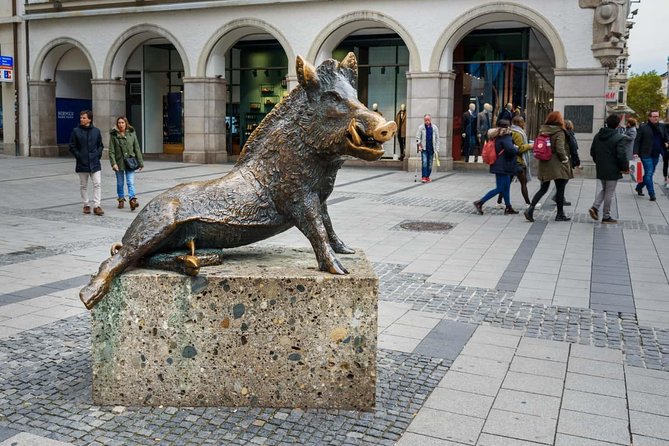
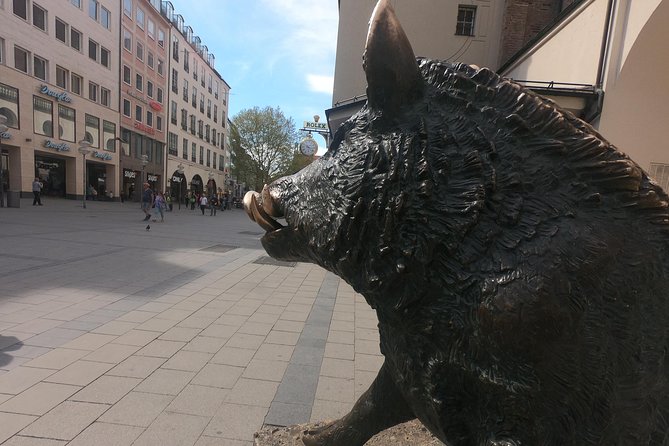
Now you hit something playful and unmistakable: Sitzender Keiler, the Sitting Boar. The statue guards the entrance to the Hunting and Fishing Museum, and yes, it is a quirky image, a pig-like figure perched in a funny stance.
The game adds a practical little ritual. You will need to rub its nose for luck, and then use the location to uncover the boar’s mystery. It’s one of those moments where you can stop thinking like a tourist for a second and just follow the silly instruction.
Why I like this stop: it is memorable, easy to find, and quick. It also breaks up the more solemn church and history stops, which keeps the game from feeling heavy.
Time and cost: about 10 minutes, admission free.
Stop 5: Frauenkirche, two towers and a Devil’s footprint at the entrance
At the fifth stop, you will almost certainly notice the twin towers of the Frauenkirche first. This is one of Munich’s best known landmarks, and the game uses that scale to set the mood.
The prompt centers on a legend about a bet with the Devil. The builder supposedly made a bet that the church would have no windows. When the Devil realized he was tricked, he left a footprint at the entrance. Your job is to solve the challenge linked to this idea and piece together the story.
Also, the listing mentions the church interior includes intricate vaulted ceilings and long stained glass windows, which is exactly the kind of detail you want to see rather than only read about.
Possible drawback: admission is not included here. If you are on a strict schedule or budget, you can still enjoy the exterior and the legend setup, but the full payoff may depend on going inside.
Time and cost: about 10 minutes, admission not included.
Stop 6: Munich Marienplatz, where the city keeps meeting itself
You continue to Marienplatz, Munich’s central square. It is the place where big events happen, from Christmas markets to city celebrations and football fan moments.
The game gives you context for why this square matters. Marienplatz has been central since Munich’s founding in the 12th century, and important streets and historic events gathered here. Your clue at this stop is tied to something that happened there, and the game asks you to answer a question and move on.
Practical tip: this stop can be busy at many times of day, even when you are playing privately. The game helps because it gives you a job to do at the square, so you are not just stuck waiting for crowds to thin out.
Time and cost: about 10 minutes, admission free.
Stop 7: St. Peter’s Church, survival, mixed styles, and a tower climb
Next is St. Peter’s Church, Munich’s oldest Catholic church and a symbol that has survived major fires and wars across about 800 years. Because of frequent reconstructions, you might see a blend of architectural styles, including Gothic, Baroque, and Rococo elements.
What makes this stop feel worth it is the tower. The game points you toward the bird’s eye view you get by climbing the 299 steps to the tower of St. Peter’s parish church. When you reach the top, you get a Munich center view that makes the climb feel like more than just exercise.
Possible consideration: admission is not included. If you want the climb and the viewpoint, you will likely need to plan for time and any ticket cost at the site.
Time and cost: about 19 minutes, admission not included.
Stop 8: New Town Hall (Neus Rathaus), the Glockenspiel and a post-plague story
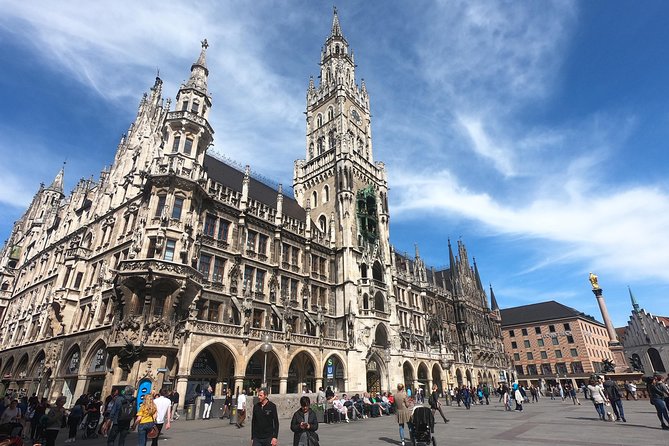
Your last stop is the New Town Hall, also called Neus Rathaus. It is part of Munich’s political life and also famous for FC Bayern fans seeing the balcony during championship wins.
The game highlights the Glockenspiel in the tower, which has performances and stories that attract attention. One specific tale included here is about a plague epidemic and the barrel makers, who were among the first people said to risk stepping back onto the streets and dancing despite fear. Your final challenge is part of this spirit, and it ends with you completing the last clue.
Why this ending works: it feels like a payoff. You reach a major landmark, you get a story that ties culture and fear and recovery together, and you finish the route with momentum.
Time and cost: about 10 minutes, admission not included.
Offline by Design, and Why That Matters in Munich
One of the strongest practical highlights is that the game can be accessed offline. That is not a small detail. In Munich, you are likely to hop between transit and street-level sights. Offline access means you can keep moving without hunting for data, and you avoid the risk of your route stalling when the signal gets weak.
It also makes this a calmer experience. You are not constantly staring at your screen for loading spinners. You can focus on looking up at towers, spotting entrances, and reading what the challenge asks for.
A simple move that helps: keep your device charged before you start. Even offline games still drain battery, especially if audio is running.
How the Private Format Changes the Whole Experience
Because this is a private, self-guided activity, your group is not competing with strangers for shared space around each clue. That is a big deal at places like Marienplatz, where foot traffic can spike.
You also have pause control. You can stop for a coffee, wait out a shower, or let everyone catch up. Then you resume later without needing a guide to gather everyone back up.
For families, this often feels easier than a traditional tour. Everyone can work at their own speed, and the challenge structure gives kids a reason to pay attention. One five-star review highlighted teamwork and observational skills with a wife and two teen girls, which is exactly the type of dynamic this game seems built for.
Language and Device Expectations

The game is offered in English, with audio stories for the English version. That matters because some city clues rely on narration rather than heavy reading, so you can keep walking without stopping to translate.
You should also plan for basic tech friction. One low-star review mentioned the experience did not work and that there was a charge, plus confusion about purchase. The takeaway is not to panic, but to be ready. If possible, test the app before heading out, confirm you have everything downloaded or accessible, and use a fully charged phone.
Value Check: Is This Worth $7.21?
At $7.21 per person, the value depends on two things: whether you want a guided storyline without a guide, and how much you plan to spend on admission at the stops marked not included.
If you treat the game as a 1 to 2 hour city orientation plus a fun puzzle route, it is good value. You are paying for a format that keeps you active and engaged, and you are avoiding the more expensive guided-tour price range.
Where you might lose value is if you do not plan to enter any ticketed locations and you end up mostly outdoors. You can still enjoy the exterior legends at places like Frauenkirche, but the game includes stops where interior access is relevant. If you budget for that, the experience feels more complete.
Who Should Book Ghosts of Munich
This is a great fit if you want:
- A self-guided way to see central Munich without locking into one tour schedule
- A playful activity for families, couples, or small groups that like puzzles
- An English audio city game with offline access
- A route that mixes squares, churches, and a fun statue moment
It might be less ideal if:
- You strongly prefer a human guide telling you stories out loud
- You dislike phone-based tasks and prefer walking purely for scenery
- Your group has very limited phone or battery comfort
Quick Practical Notes Before You Start
- Start at Odeonsplatz (Odeonspl., 80 München-Altstadt-Lehel, Germany).
- End at Rindermarkt 17 (80331 München, Germany).
- It runs about 1 to 2 hours, and you can start any hour after booking.
- Admission is listed as free at several stops, but not included at others like Theatinerkirche St. Kajetan, Frauenkirche, St. Peter’s Church, and the New Town Hall.
Should You Book It?
Yes, if you want a low-cost, smart way to explore central Munich with stories and challenges that slow you down at the right places. The offline feature, English audio, and private self-guided format are the big selling points for me, especially when you want control and flexibility.
I would book it with a realistic mindset: a phone game that includes both free sights and a few ticketed stops. If that sounds fun, you will likely enjoy the mix of spooky legend and real-city details, and you will come away seeing Munich with sharper eyes than you started with.
FAQ
How long is the Ghosts of Munich haunted apprentice game?
The experience is listed as about 1 to 2 hours.
What is the price per person?
The price is listed as $7.21 per person.
Do I need mobile data during the game?
No. The game can be accessed offline, which helps you avoid expensive phone data charges.
Is it available in English?
Yes. The experience is offered in English with audio stories for the English version.
Where do I start and where does it end?
You start at Odeonsplatz (Odeonspl., 80 München-Altstadt-Lehel, Germany) and end at Rindermarkt 17, 80331 München, Germany.
Do I need to join at a specific time?
You can start anytime after booking, and you can start and pause for breaks, then resume later.
Is there a physical tour guide with the group?
No. This is a private self-guided experience, so there is no physical tour guide.
Are admission tickets included for the stops?
Some stops are marked as admission free, such as Odeonsplatz, Hofgarten, Sitzender Keiler, and Marienplatz. Other stops are marked as admission not included, including Theatinerkirche St. Kajetan, Frauenkirche, St. Peter’s Church, and the New Town Hall.
Fresh on the arrivals board for Munich






Self-Guided Tours, compared.

Neuschwanstein Castle Skip-the-Line Ticket with Audio Guide
Read our review →
Solar Powered Sunset Catamaran Cruise & Audio Guide
Read our review →
Füssen: Neuschwanstein Castle Express Ticket and Audio Guide
Read our review →
Neuschwanstein Castle Ticket With Audio Guided Tour
Read our review →
Spicy’s Gewürzmuseum Entry Ticket and Audio Guide
Read our review →
Browse the lists this tour appears in