
Reviewed · HAMBURG TOURS & ACTIVITIES
Dialog im Stillen (Dialogue in Silence)
Silence teaches fast. Dialogue in Silence in Hamburg turns that into a lesson, using sign language, facial expressions, and body cues to show you how communication works when sound is gone. It is guided by deaf experts who make the process feel human, not academic, and you start the moment you step into Dialogue House.
I especially love the tour design, because it eases you in with hands-on stations, not lectures. You also get a real confidence boost from learning to “listen” with your eyes, even when you do not know the first sign. One possible drawback: if you freeze with eye contact or feel awkward acting out gestures, you might need to remind yourself to treat it like a playful practice session.
In This Review
- Quick hits before you step into silence
- Dialogue House Hamburg, where the tour starts with silence
- The 1-hour flow: check-in, silent stations, and a bilingual reset
- Hands and eyes: what you actually practice (and what it changes)
- The bilingual finale in English or German, and why it matters
- Price and value: is $26 for an hour fair?
- Who should book this silent communication tour?
- Should you book Dialogue in Silence?
- FAQ
- Where does the tour start?
- How long is Dialogue in Silence?
- What languages are used during the tour?
- Is the tour silent the entire time?
- What should I bring or wear?
- How much does it cost, and what is the cancellation policy?
Quick hits before you step into silence
- Noise-cancelling headphones help you switch off sound and focus on what your eyes catch.
- Deaf guides lead the experience, so you learn from the people who use these cues every day.
- Creative exercises push you to express ideas, not just copy signs.
- Facial expressions matter as much as hand shapes and movement.
- A bilingual final station brings you back to English or German to ask questions and reflect.
Dialogue House Hamburg, where the tour starts with silence
This experience happens at Dialoghaus Hamburg gGmbH, in Northern Germany, and it runs for one hour with a guided format. You are not just visiting a room or watching a show. You are asked to participate, which is the big difference between learning sign language from a distance and learning what communication feels like up close.
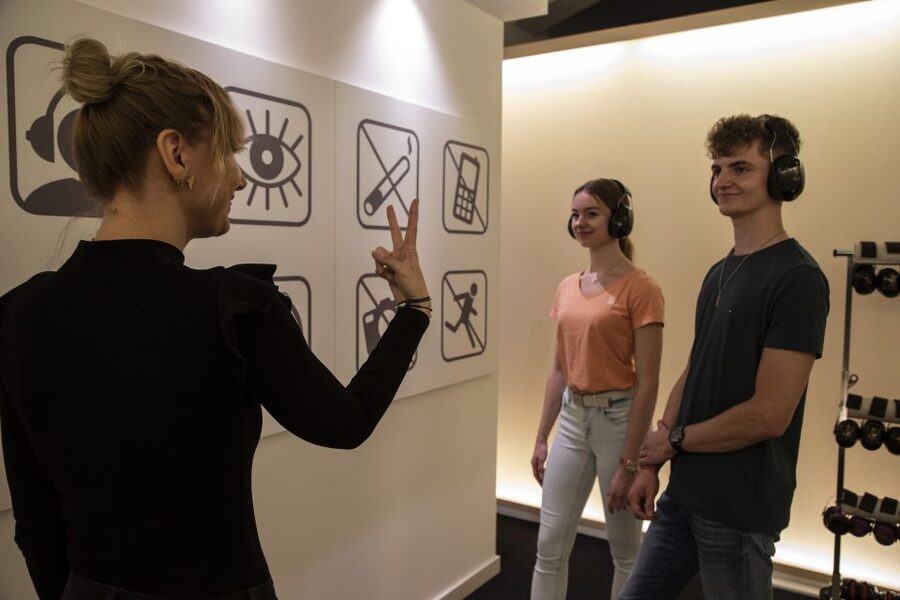
The start is simple and smart. You check in at the Dialogue House, and your guide brings you into a controlled quiet space. Then you put on noise-cancelling headphones, which sounds obvious, but the effect is real. Sound drops away, and suddenly you notice how much you normally rely on hearing to interpret the world.
I like that the environment is designed to make you stop guessing. When spoken language is blocked, you cannot “cheat” by waiting for familiar phrases. Instead, you pay attention to posture, hand position, timing, and expression. You learn the rhythm of meaning without the safety net of words.
The practical side is also worth flagging. Wear comfortable shoes and comfortable clothes, because you will be moving through stations and doing gestures. This is not a sit-and-watch activity, even if you are given structure. If you go in expecting to be entertained only, you will miss the point, and the point is exactly what people love most.
Also holding a platform in Hamburg
- Hamburg: Sex and Crime in St. Pauli Tour for Ages 18 +
★ 4.7 · 17,793 reviews - Hamburg: 1.5-Hour Harbor and Speicherstadt Day Cruise
★ 4.6 · 14,200 reviews - Hamburg: 90-Minute Evening Lights Harbor Cruise
★ 4.5 · 7,728 reviews
The 1-hour flow: check-in, silent stations, and a bilingual reset
The tour has one main location stop, but the hour itself is broken into stages inside the experience. That matters, because stepping into a “no audio” world can feel intimidating at first. The tour keeps you busy enough that you do not overthink it.
First, you settle in with your guide. After the headphones go on, the rules of the space become clear: you will communicate without spoken sound for most of the session. That means you watch more than you talk, and you follow visual cues instead of listening for instructions.
Then come the stations, and this is where you build the skill. Expect a sequence of practice moments that starts with basic sign and grows into more complex expression using hands and the rest of your body. You might be asked to form gestures, repeat them carefully, and then adjust as your guide corrects your visibility and clarity. The goal is not perfection. The goal is understanding how small changes can change meaning.
As the hour progresses, the focus shifts from learning signs to building full meaning. Facial expression and body language move from “extra” to “required,” because they carry tone and intention when sound is not available. This is also where the tour helps lower fear. Once you realize the guide is watching what you do and not judging you, you relax faster and try more.
Finally, you reach the ending station, where the communication format changes. This is the bilingual finale, and it is designed for reflection and questions. Depending on the language option, you will be able to return to English or German when it is time to connect the dots and talk things through.
Hands and eyes: what you actually practice (and what it changes)
The heart of Dialogue in Silence is learning how communication works when you remove sound from the equation. That sounds simple, but it changes everything about how you approach people. You stop treating interaction as a two-step process (talk, then understand), and you start treating it as a single visual exchange (watch, interpret, respond).
One of the strongest parts of the experience is that it is interactive in a playful way. The exercises are creative enough that your brain stops focusing on performance anxiety. You do not just copy motions like a robot. You practice expressing an idea and matching it with the right look, timing, and posture.
In practical terms, here is what you will likely notice during the stations:
- You become more accurate when you slow down your movements and keep your hands visible.
- You understand others faster when you track both hands and facial cues.
- You stop relying on background conversation and start reading the person in front of you.
The tour also helps correct common misunderstandings. A lot of hearing people assume sign language is only about hands. In this experience, you learn that meaning is a whole-body package. Facial expression can shift intent the way vocal tone would. Body orientation can tell you who a message is directed to. Even pauses can matter.
I also like the human focus. The guides are described as authentic and expressive, and that shows in how the sessions are run. You are not learning sign language as a curiosity. You are practicing communication with respect, and that creates a bridge in a way that feels real, not forced.
A small but important consideration: the experience asks you to pay close attention and keep up visually. If you have eye strain or strong sensitivity to attention tasks, plan to pace yourself mentally. Also, if you are expecting a “class,” this is more like guided practice than formal instruction.
The bilingual finale in English or German, and why it matters
The final part of the hour is the moment you go from doing to understanding. During the silent portion, you concentrate on reading. At the end, the tour shifts so you can reflect and ask questions in English or German.
This bilingual reset is not just for convenience. It helps your brain make sense of the patterns you practiced. You connect what you saw with what it means, and you can clear up confusion before it turns into bad assumptions.
If you choose English or German for the final station, you might still notice how different the communication feels after a full hour of hands and eyes. That switch can be surprising, and it can even highlight how language knowledge shapes comprehension. The tour is clearly aware of this, which is why it ends with a time for discussion rather than abruptly stopping.
This is also where you get the benefit of being able to ask straightforward questions. You can talk about what was hard, what felt natural, and what you want to understand better. The closing format gives you a chance to connect the experience to real everyday communication.
And yes, there is likely an element of guided conversation that makes the hour feel complete. One of the most positive themes people take away is that the ending builds understanding bridges, because it brings everyone back into a shared space of meaning.
Price and value: is $26 for an hour fair?
Dialogue in Silence costs $26 per person, lasts one hour, and includes a guide plus entry fees. For a short experience, that price can be either expensive or fair depending on what you expect.
Here, it feels fair because you are getting guided, hands-on instruction from deaf experts in a structured setting. You are not paying for a pass to look around quietly. You are paying for active coaching, and for a space designed to help you practice non-verbal communication safely.
You are also paying for a format that is hard to replicate on your own. Noise-cancelling headphones and a silent-flow structure are key parts of why the learning works. Without them, you might not experience the same shift in attention and understanding.
The value is strongest if you like experiential learning and you enjoy trying, even with mistakes. If you want passive tourism, you might feel the hour is too short to justify the cost. But if you want a practical perspective on communication, this is compact and direct.
Another value point: the tour is conducted without audio until the final station. That means the “silent” part is not decorative. It is the whole teaching method for most of the session.
Onward connections from Hamburg:




Who should book this silent communication tour?
I think this tour fits best if you are curious about how people communicate when sound is not available. It is also a strong choice if you like learning by doing, because you will be working through visual cues and expressing yourself.
It is a good fit for:
- People who like interactive activities and do not mind looking a little silly while learning.
- Travelers who want more than a museum visit and prefer hands-on cultural experiences.
- Anyone who wants a fresh perspective on everyday barriers and miscommunication.
It might be a tougher fit if:
- You dislike activities that require eye contact and physical expression.
- You get stressed when you cannot rely on spoken language.
- You need a traditional lecture format to feel comfortable.
One more tip. Because the tour is silent for most of it, you cannot use your normal language skills as a crutch. Go in with a beginner mindset and a sense of humor. That is how you get the most out of it, and that is how the exercises feel light instead of intimidating.
Should you book Dialogue in Silence?
If you want an hour in Hamburg that changes how you think about communication, I would book it. The deaf guides, the silent learning method, and the hands-on stations are the reasons this experience has strong appeal, and they also explain why people leave feeling more connected than when they arrived.
Book it if you are open to practicing with your body and your face, not only your memory. Skip it only if you know you will not handle a sound-free environment and you do not want to participate.
If that sounds like you, then Dialogue in Silence is a smart, low-risk way to try something genuinely different in northern Germany.
FAQ
Where does the tour start?
The tour starts at Dialoghaus Hamburg gGmbH (Dialogue House).
How long is Dialogue in Silence?
The experience lasts 1 hour.
What languages are used during the tour?
The tour guide communicates in German and English, with the final station shifting to a bilingual format in English or German.
Is the tour silent the entire time?
The tour is conducted entirely without audio until the final station, when communication shifts to English or German.
What should I bring or wear?
Bring comfortable shoes and comfortable clothes.
How much does it cost, and what is the cancellation policy?
It costs $26 per person. You can cancel up to 24 hours in advance for a full refund, and you can reserve now and pay later.
Fresh on the arrivals board for Hamburg





Hamburg Tours & Activities, compared.
Sex and Crime in St. Pauli Tour for Ages 18 +
Read our review →
1.5-Hour Harbor and Speicherstadt Day Cruise
Read our review →




Reeperbahn Lust & Laster Tour for Adults Only
Read our review →Browse the lists this tour appears in