
Reviewed · BIKE TOURS IN MUNICH
Best of Munich Electric Bike Tour
Munich on an e-bike is the smartest way to see a lot. You get electric help for an easy ride and a live guide who strings the sights into a story so you do not waste time guessing. The downside is that with a max group size of 20, you have to bike in a pack, which can feel tight on busier road sections.
I love how the route hits both postcard Munich and the real historical stuff, from the Wittelsbacherbrunnen fountain and Königsplatz art quarter to major sites tied to the early 1900s. It is also built around short stops, so even in cold or wet weather you can stay moving instead of standing around. One more consideration: food and drinks cost extra, including the traditional beer tasting add-on at a legendary beer hall.
In This Review
- Key reasons this e-bike tour works so well
- Getting on the electric bike: ease, safety, and pacing
- Price and value: what you actually pay for
- The route starts at Karlsplatz, then curves through Munich’s core
- Wittelsbacherbrunnen: a fountain with a “water forces” message
- Karolinenplatz: Bavaria and France in early 1800s symbolism
- Königsplatz: neoclassicism and the museum quarter feel
- Old and modern art hits: Alte Pinakothek and Pinakothek der Moderne
- The Fuhrer Building: a Nazi-era structure still in use
- Alte Pinakothek: a dose of Old Masters without the marathon
- Pinakothek der Moderne: modern art under one roof
- Victory Gate, Beer Hall Putsch ground, and the places you cannot ignore
- Siegestor: memorial arch, then peace after the rubble
- Odeonsplatz: developed in the early 1800s, scarred in 1923
- Royal Munich in motion: Residenz and the Hofgarten garden lines
- Residenz München: Germany’s largest city palace feeling
- Hofgarten: an Italian Renaissance garden inside the city pace
- Bayerische Staatskanzlei: modern government built on older ground
- English Garden and the Chinese Tower beer garden break
- Englischer Garten: one of the world’s largest urban parks
- Biergarten am Chinesischen Turm: beer that belongs to the city
- Eisbachwelle and Friedensengel: water energy and a peace viewpoint
- Eisbachwelle: a standing wave for experienced surfers
- Friedensengel: the Angel of Peace with a column viewpoint
- Parliament, the Deutsches Museum, and Viktualienmarkt food energy
- Maximilianeum: student foundation turned state parliament
- Deutsches Museum: science at large scale
- Viktualienmarkt: food market with serious variety
- Ohel Jakob Synagogue: a modern Jewish landmark with solemn timing
- Who should book this tour, and who might want a different style
- Should you book this Best of Munich Electric Bike Tour?
- FAQ
- What is the duration of the Best of Munich Electric Bike Tour?
- How much does the tour cost per person?
- What is included in the tour?
- Are food and drinks included?
- Where do you meet, and where does the tour end?
- Can I cancel for a full refund?
Key reasons this e-bike tour works so well
- Electric bikes reduce fatigue, so you can keep going without the burn from stop-and-go streets.
- A guide-led route saves stress, especially when you are trying to place buildings and history in your head.
- Major landmarks in a short time, with quick photo stops and context at each stop.
- Art plus beer plus parks, so it never feels like only museums or only drinking.
- Safety and pacing matter, and the guides are active about keeping the group together.
Getting on the electric bike: ease, safety, and pacing
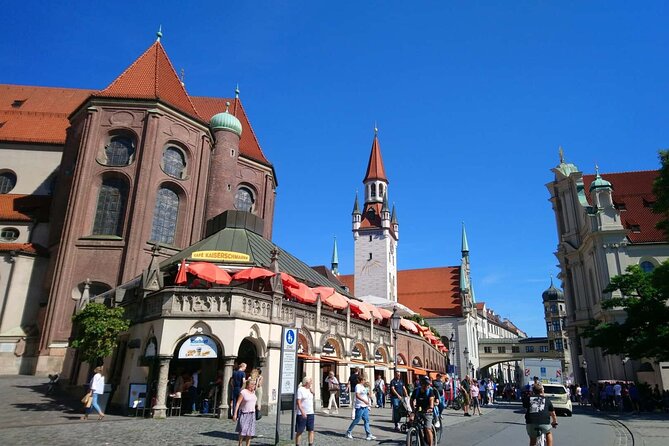
This is a 4-hour ride built for people who want a strong overview, not a fitness test. The electric bike plus helmet are included, and that changes the whole feel of the day. You still pedal when you want, but the assist helps you keep a steady rhythm instead of burning out before you reach the parks and museums.
The pace is one of the big wins. Stops tend to be short, around 5 to 10 minutes, which means you spend less time standing in crowds and more time covering ground. You will get your bearings fast, then you can choose what to revisit later on your own.
Safety is handled by the guide, and that matters because you are riding through real city traffic, not a closed park loop. The group can be mixed with non-e-bikes, which is fine, but it does mean the ride is managed as one unit. If you prefer lots of personal space while riding, plan to be patient during transitions between stops.
More Bike Tours in Munich
- Munich 3-Hour Guided Bike Tour
★ 4.5 · 1,731 reviews - Classic Mike’s Bike Tour daily @ 11.30 incl Beer Garden & Surfers
★ 5.0 · 1,246 reviews - Neuschwanstein Castle by Bus Incl. Bike Ride or Hohenschwangau
★ 5.0 · 607 reviews
Price and value: what you actually pay for
At $71.90 per person for about 4 hours, you are paying for three practical things: a guide, the e-bike, and the helmet. You are not paying separately for the bike rental, and you are not paying admission for many of the places you stop at, since the tour time at stops is listed as free for the sights you visit.
Food and drinks are not included. That is important because Munich can turn quick into a snack budget, especially if you add the traditional beer tasting option at the legendary beer hall. I like that the tour does not force you into a fixed meal, but you should still plan money for beer, pretzels, and whatever looks good during the beer garden stop.
Also, the tour ends where it starts, back at Karlsplatz. That is a convenience factor, especially if you want to reconnect with transit or continue your day without another long walk.
The route starts at Karlsplatz, then curves through Munich’s core
The meeting point is Karlsplatz 4, 80335 München, and the tour ends back at the meeting point. From there, you roll toward the edge of the city center and begin with dramatic city geometry, starting with the Wittelsbacherbrunnen.
This part of the ride is a good mental warm-up. You are learning what the city looks like at street level, plus you get early history context before you hit the big museum quarter. It is also a chance to get comfortable on the e-bike before longer stretches.
Wittelsbacherbrunnen: a fountain with a “water forces” message
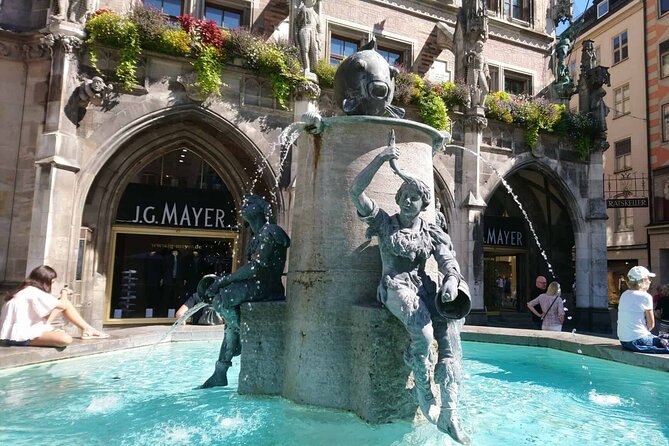
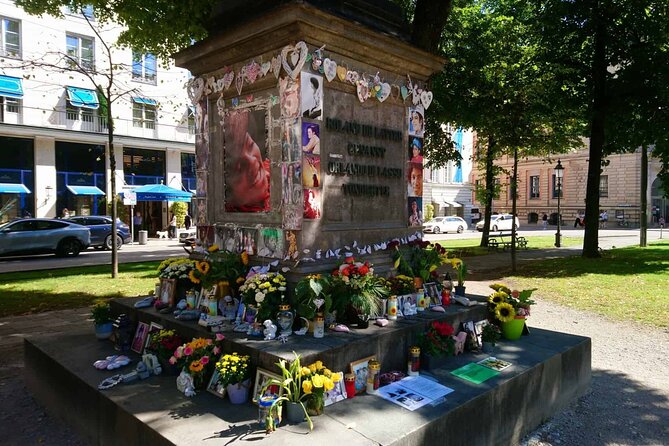
The Wittelsbacherbrunnen sits right by the transition between Lenbachplatz and Maximiliansplatz. It was built between 1893 and 1895 and designed in a Neo-Classicist style by sculptor Adolf von Hildebrand. The fountain is more than decoration, it is an allegory for the primal forces of water.
If you like symbolism in architecture, this is a fun opener. It sets the tone for the rest of the tour, where you keep noticing how Munich’s builders used art and style to communicate power, faith, and identity.
Karolinenplatz: Bavaria and France in early 1800s symbolism
Next is Karolinenplatz in Maxvorstadt. It is named after Queen Caroline of Bavaria, and it also symbolizes the relationship between Bavaria and France in the early 19th century. If you have only seen Munich as beer and royal palaces, this stop widens the view to diplomacy and dynasties.
This is a quick stop, but the guide context helps you see the square as political history, not just empty space for selfies.
More flat kilometres by bike:
Königsplatz: neoclassicism and the museum quarter feel
Königsplatz, the King’s Square, is where the tour starts to look like a guidebook come to life. The square is European Neoclassical in style and features the Propyläen Gate. Across from it sit major institutions including the Glyptothek and Staatliche Antikensammlungen, part of Munich’s Kunstareal museum quarter.
The practical value here is simple. You are in the right area to continue exploring later without needing to figure out how it all connects. Even if you do not plan to go inside every museum, you will understand the neighborhood layout.
Old and modern art hits: Alte Pinakothek and Pinakothek der Moderne
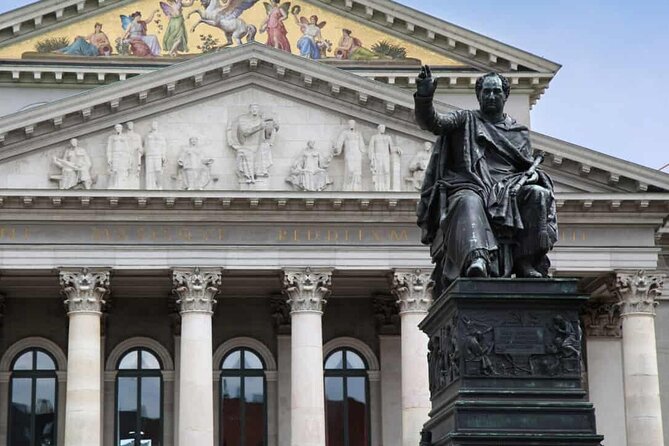
After the early squares, you ride into the art-heavy stretch of Maxvorstadt. This is one of the reasons the tour works for history buffs and culture lovers at the same time, because the route mixes political sites with art buildings.
The Fuhrer Building: a Nazi-era structure still in use
One of the most serious stops is the Führerbau, built between 1933 and 1937 during the Nazi period, and used heavily by Adolf Hitler. Unlike many Nazi-linked buildings that disappeared, it still stands, and today it houses the University of Music and Performing Arts Munich.
If you want the “Munich story” in full, you cannot skip this kind of stop. It also reminds you to look at buildings differently, not just as pretty facades. The guide framing helps keep it respectful and clear.
Alte Pinakothek: a dose of Old Masters without the marathon
The Alte Pinakothek is Old Pinakothek, and it is one of the oldest galleries in the world. You get a short stop here, and the focus is on what the collection is known for: Old Master paintings in a historic museum setting.
You might not see a full gallery walkthrough on this tour, but that is the point. This stop gives you names, context, and a reason to come back later if you want the deeper version.
Pinakothek der Moderne: modern art under one roof
Pinakothek der Moderne gathers several modern and contemporary collections under one umbrella building. It unites the national collection of modern art, works on paper, a design and applied arts collection, and even an architecture museum tie-in.
This is a satisfying contrast after the Old Masters idea. The tour gives you an “art map,” so when you choose between classics and modern works later, you already know where you are.
Victory Gate, Beer Hall Putsch ground, and the places you cannot ignore
You do not just ride through pretty squares. You also pass sites tied to Munich’s harder moments, and that is where a good guide makes the difference.
Siegestor: memorial arch, then peace after the rubble
Siegestor, the Victory Gate, has three arches and a statue of Bavaria with a lion-quadriga on top. It was originally dedicated to the glory of the Bavarian army. After World War II restoration, it became a reminder to peace.
The way you experience it from a bike is interesting. You see the monument in context of street scale, not just as a zoomed-in postcard.
Odeonsplatz: developed in the early 1800s, scarred in 1923
Odeonsplatz is a large square at the southern end of Ludwigstraße. It is tied to an older concert hall area and the Residenz forecourt atmosphere, with the Theatine Church and Feldherrnhalle nearby. This is also the scene of a fatal gun battle that ended the march tied to the 1923 Beer Hall Putsch.
This stop can hit hard, but it is also one of the most important “why Munich is Munich” points on the route. The guide helps connect dates and locations so you are not just reading about events later without knowing where they happened.
Royal Munich in motion: Residenz and the Hofgarten garden lines
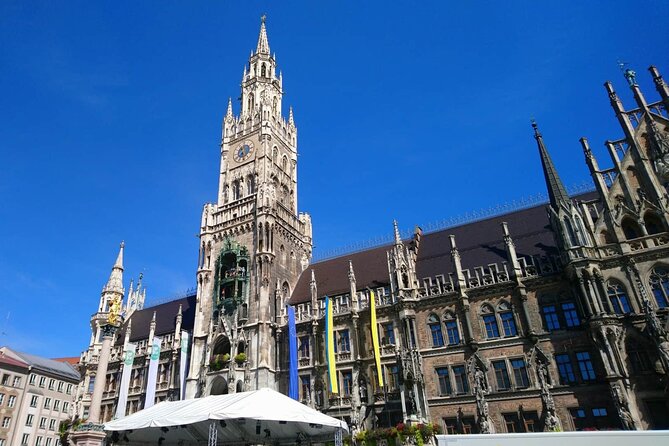
After the squares and monuments, the tour shifts into royal territory.
Residenz München: Germany’s largest city palace feeling
The Residenz is the former royal palace of the Wittelsbach monarchs of Bavaria. It is the largest city palace in Germany and it is open for visits, with architecture, rooms, and former royal collections.
Even if you only get a short stop on the bike tour, the value is the layout comprehension. You start seeing where rooms and courtyards connect, and you get a feel for why the building dominates the center.
Hofgarten: an Italian Renaissance garden inside the city pace
The Hofgarten sits between the Residenz and the Englischer Garten. It was built in the early 1600s, in an Italian Renaissance garden style, by Maximilian I. The central pavilion is for the goddess Diana, built in 1615.
This is a calmer moment on the ride. If you like architecture, statues, and symmetry, this stop helps you appreciate the “designed nature” side of power.
Bayerische Staatskanzlei: modern government built on older ground
Bayerische Staatskanzlei houses offices for the chancellery staff. The current building was erected from 1989 to 1993 around the central dome of a former Bavarian Army Museum structure built in 1905, then demolished after World War II.
This stop is brief, but it is a strong reminder that cities keep changing while still carrying layers. It is a good place to notice how the past sits under the present.
English Garden and the Chinese Tower beer garden break
Then the route turns toward the big park lungs of Munich.
Englischer Garten: one of the world’s largest urban parks
The Englischer Garten is enormous, with 3.7 km2 (370 hectares). It is designed in an English garden style, which became popular in England from the mid-1700s into the early 1800s.
On an e-bike, this stop feels like a breath of space. You get to see how a city can be both historic and open, not locked into old walls.
Biergarten am Chinesischen Turm: beer that belongs to the city
A highlight for beer lovers is the Biergarten am Chinesischen Turm. Beer gardens are Bavarian by tradition, and this one is especially famous, with a very large seating capacity. It sells Hofbräu beer and you get a real taste of how Munich does outdoor social life.
This is where you might spend extra money, because drinks and food are not included. But honestly, this is the kind of stop that makes the tour feel like Munich, not just Munich on maps. If you are cold, order a hot drink too, not only beer.
Eisbachwelle and Friedensengel: water energy and a peace viewpoint
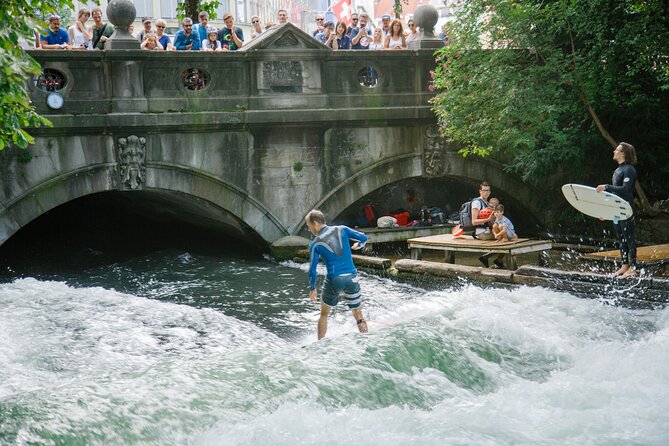
After the park break, you keep rolling along the river and into another “Munich identity” moment.
Eisbachwelle: a standing wave for experienced surfers
Eisbachwelle is a standing wave about one meter high formed by the river near the Haus der Kunst area. It is a known river surfing spot, but the water is cold and shallow, sometimes only around 40 cm deep, and it is suited for experienced surfers.
From a bike tour angle, this stop is a visual pause. You see how people use city nature in a bold way.
Friedensengel: the Angel of Peace with a column viewpoint
Friedensengel sits in Maximilian Park as a viewpoint along Prinzregentenstrasse sight lines. Next to the Isar you find an open space with water features, staircases leading to an observation deck, and a column topped by a six-meter statue of the Angel of Peace. It is a replica of the Nike of Paeonius.
This is another stop where context matters. The guide can explain why it is located where it is, and how the monument fits the peace theme of the route.
Parliament, the Deutsches Museum, and Viktualienmarkt food energy
You finish the tour with more city layers, from government to science to food.
Maximilianeum: student foundation turned state parliament
The Maximilianeum was built as the home of a gifted students foundation, and since 1949 it has housed the Bavarian State Parliament. Even if you do not go inside, seeing it on the bike route links education and governance in one building.
Deutsches Museum: science at large scale
The Deutsches Museum is huge, described as the world’s largest science and technology museum, with about 125,000 objects across 50 fields of science and technology. It also draws about 1.5 million visitors per year.
On this tour, you get a short stop, but it is enough to plant the idea. If you are the type who loves hands-on or big historic inventions, you will likely want to come back for a full day later.
Viktualienmarkt: food market with serious variety
Viktualienmarkt started as a farmers market and became a gourmet market with lots of stalls and shops. The area includes flowers, exotic fruit, game, poultry, spices, cheese, fish, juices, and more.
Even for people who do not love markets, it helps you understand how locals eat and shop. It is also a good “before you leave” moment if you want to buy snacks or plan dinner.
Ohel Jakob Synagogue: a modern Jewish landmark with solemn timing
The Ohel Jakob Synagogue is the new main synagogue for Munich’s Jewish community, built between 2004 and 2006. It was inaugurated on 9 November 2006, which is the 68th anniversary of Kristallnacht.
This stop is short, but it is meaningful. It adds a modern layer to the historical arc you saw earlier in the ride.
Who should book this tour, and who might want a different style
This tour is ideal if you want a big Munich overview without walking all day. If you like architecture stories, art building context, and a beer garden moment, you will probably have a great time.
It can also suit mixed groups, including families with teens, since e-bikes help flatten the effort curve. But if you want a quieter ride with lots of space, you may find the grouped biking style less ideal, since the tour can include up to 20 travelers.
Weather can also matter. I think e-bikes help keep the day moving in rain or cold, but you should still dress for it, bring layers, and expect a bit of chill on the river and park sections.
Should you book this Best of Munich Electric Bike Tour?
Yes, if your goal is a fast, guided, high-impact introduction to Munich’s highlights, this is a strong pick. At $71.90 for a 4-hour ride with an e-bike and helmet, you are buying convenience, coverage, and context in one go, without having to add bike rental cost.
Skip or modify your expectations if you only want a long time inside museums. This is built for stops and orientation, not for a full museum day. Also, plan a little budget for drinks and food, and if you want that traditional beer tasting add-on at the legendary beer hall, treat it as an optional splurge.
If you are the type who likes to leave a city with a clear mental map and a short list of places to revisit, this tour does that job well.
FAQ
What is the duration of the Best of Munich Electric Bike Tour?
It runs for about 4 hours.
How much does the tour cost per person?
The price is $71.90 per person.
What is included in the tour?
The tour includes a live guide, an electric bike, and a helmet.
Are food and drinks included?
No. Cost of food or drinks is not included. The beer tasting at a legendary beer hall is also an extra expense.
Where do you meet, and where does the tour end?
You meet at Karlsplatz 4, 80335 München, and the tour ends back at the meeting point.
Can I cancel for a full refund?
Yes. You can cancel for a full refund up to 24 hours in advance of the experience start time. Free cancellation is offered under that condition.
More E-Bikes in Munich
- Best of Berlin E-Bike Tour
★ 5.0 · 77 reviews - Berlin: E-Bike Tour of the Berlin Wall and Mitte Highlights
★ 4.7 · 60 reviews - Best of Berlin E-Bike Tour
★ 5.0 · 37 reviews
Fresh on the arrivals board for Munich
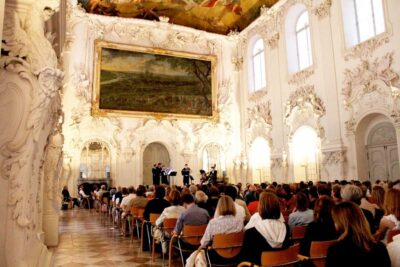

Bike Tours in Munich, compared.
Classic Mike’s Bike Tour daily @ 11.30 incl Beer Garden & Surfers
Read our review →
Neuschwanstein Castle by Bus Incl. Bike Ride or Hohenschwangau
Read our review →
Browse the lists this tour appears in