
Reviewed · WEIMAR TOURS & ACTIVITIES
Weimar: Old Town Tour of Classical Weimar
Classical Weimar is quick to grasp, and this tour helps you do it. In about 1.5 hours, you cover the old town’s big names and big places linked to Goethe, Schiller, Herder, and Wieland, mostly from the outside. I like how efficient it is, and I also like that you get a guided route that points you to where to look next.
Two things I especially appreciate: the Market Square stop, with its town hall and nearby landmarks like the Cranach House and Hotel Elephant, and the way the walk strings together major stops around the Duchess Anna Amalia Library and Fürstenhaus area. The tour finishes on Theaterplatz, so you end right where Weimar’s literature meets its dramatic, public square energy.
One drawback to consider: it is a short, exterior-focused tour. If you want to go inside buildings for views and exhibits, you will need to plan extra time on your own, and the tour is not suitable for people with mobility impairments.
In This Review
- Key points before you go
- Neptun Brunnen to Market Square, where Weimar’s story starts
- Herderplatz and St. Peter und Paul, a square built for perspective
- Platz der Demokratie, Anna Amalia Library, and Fürstenhaus
- Goethe’s House, Schiller’s House, and the Park an der Ilm connection
- Theaterplatz and the Goethe and Schiller monument, a strong finish
- The German live guide, and how the delivery can affect your experience
- What this 1.5-hour format does well, and where it falls short
- Price and value, why 14 dollars can be a smart spend
- Who should book this Weimar classical tour?
- Practical tips to make it better on the ground
- Should you book the Old Town Tour of Classical Weimar?
- FAQ
- Where do I meet for the tour?
- How long is the tour?
- What language is the guide speaking?
- What will I see during the tour?
- Is the tour only in the old town?
- Where does the tour end?
- How much does it cost?
- Is free cancellation available?
- Can I reserve without paying immediately?
- Is this tour suitable for people with mobility impairments?
Key points before you go
- Neptun Brunnen is the clean, easy meeting point for your start in the old town
- Market Square gives you the orientation jump, with the town hall and local classics like the Cranach House area
- Photo stops at key squares help you capture the story, not just the scenery
- Platz der Demokratie connects the thought-world to specific Weimar sites like the Anna Amalia Library and Fürstenhaus
- Goethe and Schiller houses are handled in a smart, outside-view way that still makes the names click
- Theaterplatz is a strong finish with the Goethe and Schiller monument
Neptun Brunnen to Market Square, where Weimar’s story starts
I love starting a walk-tour in a real town anchor, and Neptun Brunnen does that job. You meet at the Weimar Tourist Information at the Neptune Fountain, which is handy because it keeps your first steps stress-free. From there, the route slides you into the heart of Classical Weimar without wasting time.
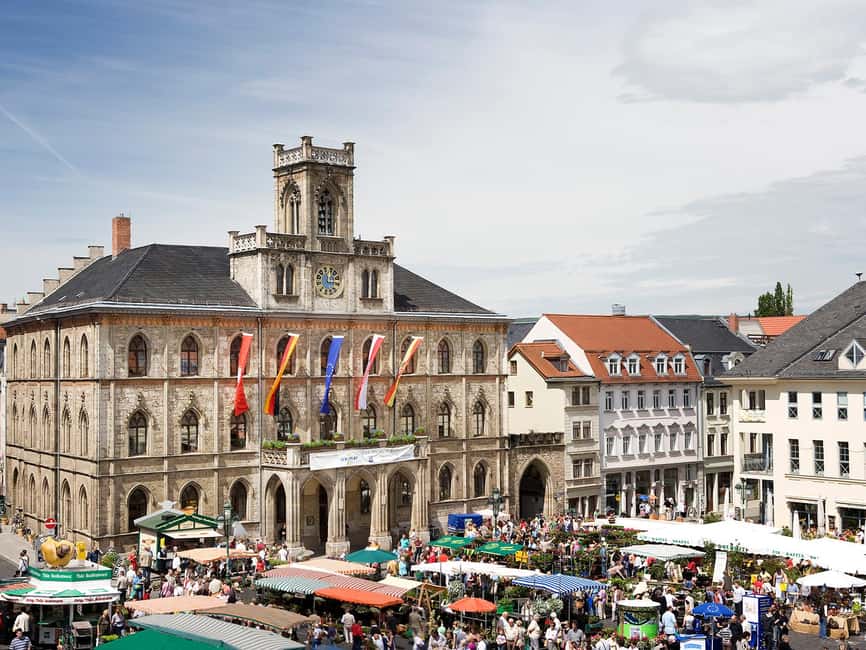
The first major stop is Market Square Weimar, where the vibe shifts from “getting oriented” to “this matters.” You get a guided look at the town hall and the surrounding historic cluster, and you also pass by well-known spots that give context to the city’s older layers. It is not just sightseeing, it is learning how the market square functioned as a public stage where culture and civic life could meet.
One practical tip for this part: take a quick moment at the square to decide what you want photographed. You will be getting photo stops later too, so it helps to use the market square for your best wide shot.
Also holding a platform in Weimar
- Weimar: Old Town Guided Walking Tour
★ 4.7 · 1,080 reviews - Weimar: Die Highlights auf eigene Faust entdecken
★ 4.3 · 125 reviews - Weimar: DunkelWeimar, true crime citytour and game
★ 4.0 · 64 reviews
Herderplatz and St. Peter und Paul, a square built for perspective
Next comes Herderplatz, and this stop is all about linking names to places. You get a guided segment plus a photo stop, and the square is positioned so you can grasp the area’s layout and why it feels like a deliberate “thinking” neighborhood.
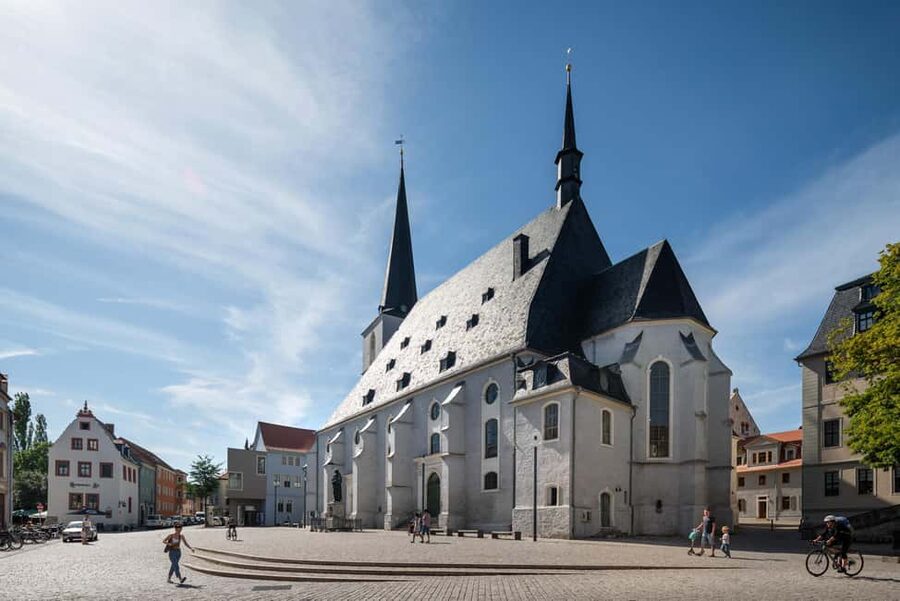
At Herderplatz you also see the exterior of St. Peter und Paul City Church. Even without entering, the church’s presence anchors the square visually, and it helps you picture what daily life and gatherings would have looked like in earlier centuries. Nearby, you are also shown the Wilhelm-Ernst-Gymnasium area, which is a good reminder that education and ideas did not stop after the famous writers.
If you are a detail person, watch how the guide connects “who” to “where.” Even when you are only seeing facades and street views, the explanation can turn a random-looking square into a mental map.
Platz der Demokratie, Anna Amalia Library, and Fürstenhaus
This is where the tour starts feeling more like a narrative. At Platz der Demokratie, you get another photo stop plus guided sightseeing, and the focus tightens on Weimar’s cultural institutions.
The big draw here is Duchess Anna Amalia Library. Since the tour views everything from the outside, you will not be touring the interior collections during this walk. Still, seeing the library’s place in the square is valuable, because it helps you understand how the duchess’s patronage supported serious intellectual work in Weimar.
You also pass by Fürstenhaus, which supports the same idea from a different angle. Even if you do not memorize architectural details, you will leave with a clearer sense of how power, culture, and learning were physically connected in the city’s planning.
One small consideration: if you prefer heavier, slower storytelling at each stop, this section may feel “fast,” because the tour is designed as a tight, old-town highlight sweep. It is great for first-timers, less perfect if you want deep reading time at every location.
Goethe’s House, Schiller’s House, and the Park an der Ilm connection
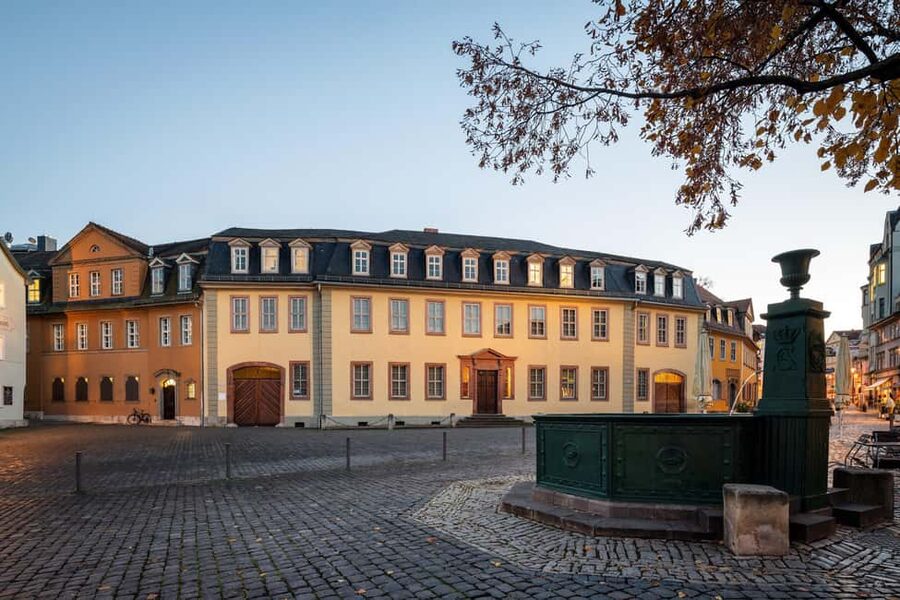
Your route then moves into the writer-focused part of the walk, and it is the reason many people book this Weimar old town tour in the first place. You get Goethe’s House as a photo stop with guided viewing, and later you also cover Schiller’s House in the same outside-focused format.
What I like about this approach is that it keeps the experience moving, while still giving you the mental hooks. Instead of getting lost in one building, you see how these figures fit into the city at street level. Standing near the exterior of Goethe’s and Schiller’s places helps you connect the writers to everyday Weimar, not just to book covers.
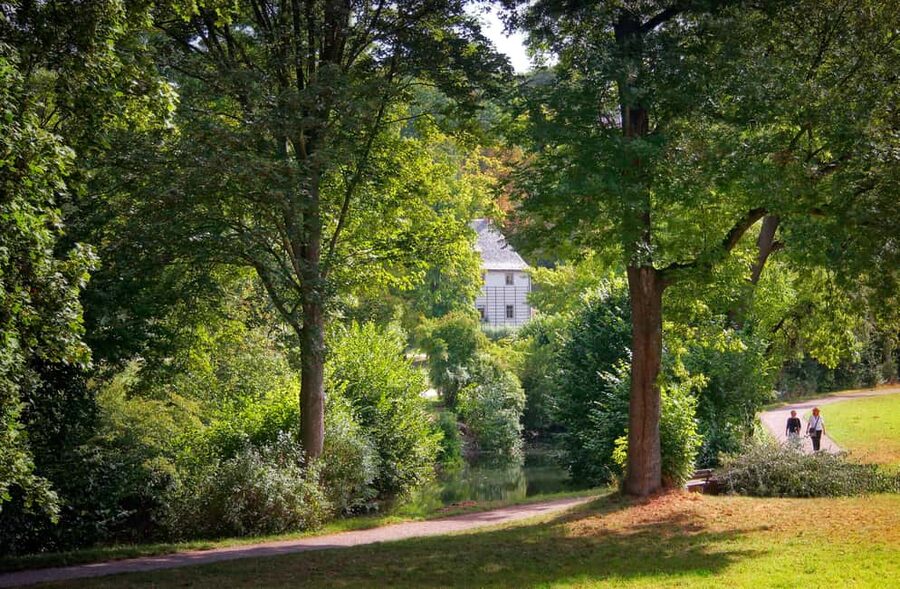
Between the houses, you also pass by the Park an der Ilm and Goethe’s garden house area. Even if you only catch views alongside the greenery, it matters. Literature in Weimar was not only made inside rooms. It was shaped by the city’s rhythms, its gardens, and the way people stepped from public life into reflective space.
Also, the tour includes theater-related context right around this zone. That matters because it sets you up for the final big square, where drama and monument meet.
If you love photos, do not treat these as random snapshots. Try to frame each stop with a clue: a doorway rhythm, a street angle, a nearby landmark that the guide points out. You will thank yourself later when you compare your photos and remember the explanation.
Theaterplatz and the Goethe and Schiller monument, a strong finish
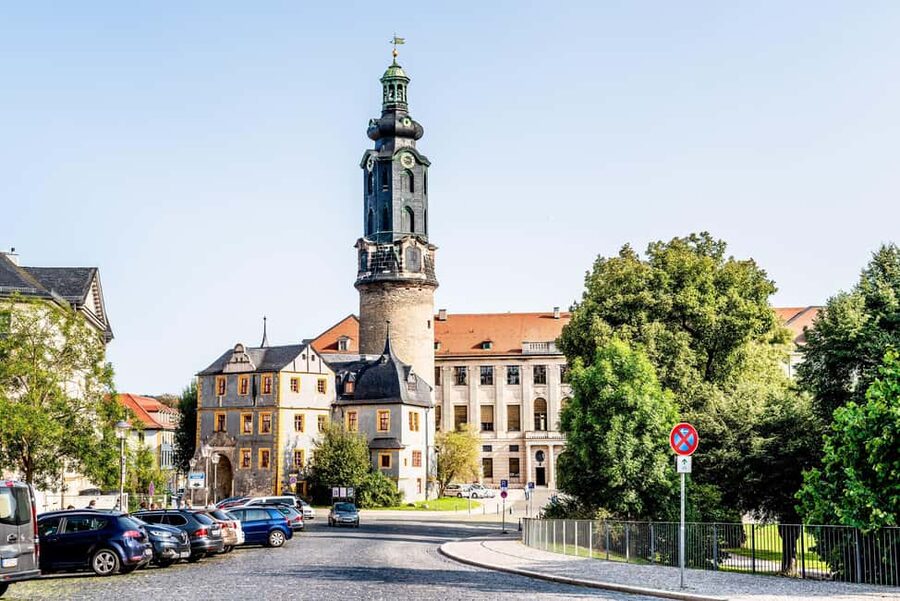
The tour ends at Theaterplatz, which is a smart closing move. You finish with the Goethe and Schiller monument area, and it is the kind of public landmark that turns learning into something you can actually feel.
This finale works even if your German is basic, because monuments are visual. Still, it helps to listen to the guide’s connections to Weimar’s theatrical and literary culture. The square gives you a clear “big picture” moment: these names were not only respected, they were publicly commemorated.
If you have time after the tour, I suggest lingering near Theaterplatz for a few minutes. The walk is short, and your brain will still be organizing facts. A little free time at the end helps those facts settle.
Onward connections from Weimar:
The German live guide, and how the delivery can affect your experience
This tour is led live in German. That is great if you speak the language or you enjoy following explanations closely. Some tour content may appear in its original language, so you will likely stay better engaged if you are comfortable reading a bit or listening patiently.
From real experience patterns, guide style makes a difference. One standout mentioned Sandra Sembdner, praised for telling Weimar’s story with charm and wit, and for keeping the tour interesting and full of information without losing momentum. Another note in the overall feedback is that the tour can sometimes feel more academic than energetic, which is worth thinking about if you prefer punchy storytelling.
My practical advice is simple: if you are booking specifically for narration, choose a session time that fits your energy level. And during the walk, ask your own question when you can, even if it is just clarifying a person’s connection to a building.
What this 1.5-hour format does well, and where it falls short
This is a short old-town highlights tour. That is not a flaw. It is the whole point. You cover a well-chosen loop that hits the biggest names and places linked to Classical Weimar, and you do it at a pace that works for tight schedules.
Also, all sights are viewed from the outside. That means you are not going to get indoor access to the library or the houses during the tour. The value is in orientation: you learn the story in the correct order, then you can decide later if you want to enter specific sites on your own.
This format is ideal if:
- you are short on time and want a fast map of the old town
- you want context for reading later, or for understanding what you see in Weimar
- you like guided structure, especially when names like Goethe and Schiller start to feel like labels
This format may not be ideal if:
- you want lots of time at one building
- you need accessible routes due to mobility limitations
- you prefer tours that include interiors rather than exterior orientation
Price and value, why 14 dollars can be a smart spend
At $14 per person for about 1.5 hours, this tour is priced like an affordable culture sampler. You are paying mainly for the guide’s connections and the route planning, not for museum tickets.
If you were to do the same thing solo, you could walk it yourself, but you would likely miss the “why” part. The guide helps connect each square and building to the specific intellectual world of Classical Weimar. That is where the value lives.
So, I think the best way to see this price is as paying for momentum. You get a guided storyline, photo stop structure, and a finish at a central square. For many visitors, that is exactly what makes a short trip feel complete.
Who should book this Weimar classical tour?
Book it if you want Classical Weimar orientation. This tour is especially good for first-time visitors who want to understand how Goethe, Schiller, Herder, and Wieland relate to specific places.
It also suits you if you like walking tours but do not want a long day. The old town route is limited to the core area, so your time stays focused. And if you enjoy photos with captions, the repeated photo stops help.
One more match: you should book this if you are comfortable with German at least at the listening level. Since the guide talks live in German, you will get the most out of the experience when you can follow the explanation without translating every sentence in your head.
If you need mobility accessibility support, skip this specific format. It is not suitable for people with mobility impairments based on the tour details.
Practical tips to make it better on the ground
Wear comfortable walking shoes. The tour is short, but you are still moving between squares and viewpoints, and old town streets can be uneven.
Bring your camera or phone, and be ready for photo stops rather than only spontaneous shots. If you want to remember the story later, you will photograph each stop as your anchor point.
When you hear a key name, try to connect it immediately to the place you are seeing, not the person you studied in school. For example, when the guide shifts to the Duchess Anna Amalia Library and Fürstenhaus area, listen for how that connects to patronage and learning.
Finally, keep your expectations realistic. This is an outside-view walk with guided explanation. It is not a deep museum session, but it is a great way to set yourself up for the sites you may want to visit more closely later.
Should you book the Old Town Tour of Classical Weimar?
If you want an efficient, story-led walk through Classical Weimar, I think this is an easy yes. The combination of Market Square, the thinkers’ squares like Herderplatz, and the institution cluster around Platz der Demokratie gives you a smart overview in a short time.
I would skip it only if you strongly prefer inside access, need accessibility support, or you know you struggle with German guided tours. If those are not your issues, $14 for 1.5 hours of guided orientation is a solid value, and the Theaterplatz finish is a satisfying payoff.
FAQ
Where do I meet for the tour?
You meet at the Weimar Tourist Information at the Neptune Fountain, Neptun Brunnen.
How long is the tour?
The tour lasts 1.5 hours.
What language is the guide speaking?
The live tour guide speaks German, and some content may appear in its original language.
What will I see during the tour?
You see the main stops of the Classical Weimar old town route, with all sights viewed from the outside, including Market Square, Democracy Square, the Duchess Anna Amalia Library area, Fürstenhaus, City Palace, St. Peter and Paul City Church, Goethe’s house, Schiller’s house, and Theater Square.
Is the tour only in the old town?
Yes, the tour is limited to the old town highlights.
Where does the tour end?
The tour finishes at Theaterplatz.
How much does it cost?
It costs $14 per person.
Is free cancellation available?
Yes, you can cancel up to 24 hours in advance for a full refund.
Can I reserve without paying immediately?
Yes, the tour offers reserve now and pay later.
Is this tour suitable for people with mobility impairments?
No, it is not suitable for people with mobility impairments.
Fresh on the arrivals board for Weimar
Weimar Tours & Activities, compared.

weimar card – Abholung in der Tourist Information Weimar
Read our review →Browse the lists this tour appears in