
Reviewed · NEUSCHWANSTEIN CASTLE TRIPS
Sightseeing flight Zugspitze Neuschwanstein Castle Alps Munich Augsburg
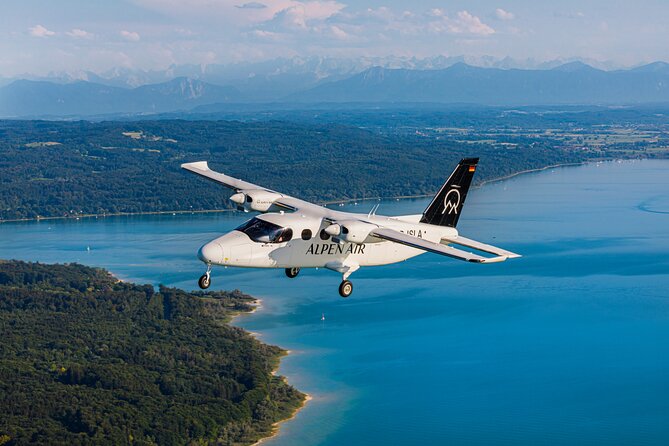
Flying Bavaria from 600 meters changes everything. In one tight circuit, you get Munich, the Alpine lake chain, and the fairytale look of Neuschwanstein, all from the window. I love the big-window views and the calm, local pilot narration (Moritz Reuter was highlighted by a pilot-guide style review), and I also appreciate that safety and comfort are taken seriously. The main consideration is weather, since poor conditions can mean postponements and you need to roll with that.
This is a small group flight from Augsburg, offered in English, with a duration around 1 hour 45 minutes to 1 hour 50 minutes. You fly over iconic places like Marienplatz and the Frauenkirche, then keep going across Bavaria’s lake regions and up toward Germany’s highest mountain area. The tradeoff is that you are not doing guided walking tours on the ground, it is pure aerial sightseeing.
You’ll also notice how the route is planned for comfort and pressure changes: shallow climbs and descents are used, and the flight altitude is managed. Over the Munich and Five Lakes Region part, the plane does not exceed 1,500 meters above sea level, while the Alps run around 2,000 meters on average and the Zugspitze area can briefly reach about 3,250 meters.
In This Review
- Key highlights I think you should care about
- Augsburg to Munich: a fast pass over Bavaria’s biggest hits
- Chiemsee and Herrenchiemsee: the Bavarian Sea from above
- Into the Alps: Kampenwand, Wilder Kaiser, and the northern lake chain
- Zugspitze, Eibsee, and Plansee: Germany’s top view, minus the lines
- Neuschwanstein and Lake Forggensee: the fairytale angle from the air
- Five Lakes Region finish: Starnberg, Andechs, and the water colors you cannot fake
- Price, duration, and value: when $767.81 makes sense
- Practical tips so you get the best photos and the best mood
- Who should book this flight, and who might want to skip it
- Should you book the Augsburg to Neuschwanstein and Alps sightseeing flight?
- FAQ
- How long is the sightseeing flight?
- Where does the flight start and end?
- What language is the experience offered in?
- What is the maximum group size?
- Is the flight affected by weather?
- What altitude can the flight reach?
Key highlights I think you should care about
- A route that stacks major sights fast, from Munich landmarks to Zugspitze views to Neuschwanstein and back
- Pilot-led commentary that feels human, with Moritz Reuter called out for calm, local insight
- Small group feel (max 4 travelers), which makes the experience less like a cattle call
- Altitude planning for comfort, including limits over Munich and the Five Lakes Region
- Aerial access to the Alpine lake chain, where colors shift dramatically from above
- A practical value story for short trips, since you cover a lot of ground that would take days by car
Augsburg to Munich: a fast pass over Bavaria’s biggest hits
You start at Flughafenstraße in Augsburg, and the whole idea is simple: you lift off and then Bavaria starts shrinking into a map you can actually see. One of the smartest parts of this flight is the way it begins with Munich. You get that moment where the city layout clicks, streets and landmarks become readable, and you understand why people talk about this region with such confidence.
From the air, the route takes you via Dachau, then into Munich at about 600 meters above sea level. As you approach the city center, you’ll spot the Allianz Arena, the home base for FC Bayern Munich. Looking down at a stadium from above is one of those things that feels basic, until you realize you’re also seeing the shape of the surrounding neighborhoods and roads. It is not just a photo op, it is spatial context.
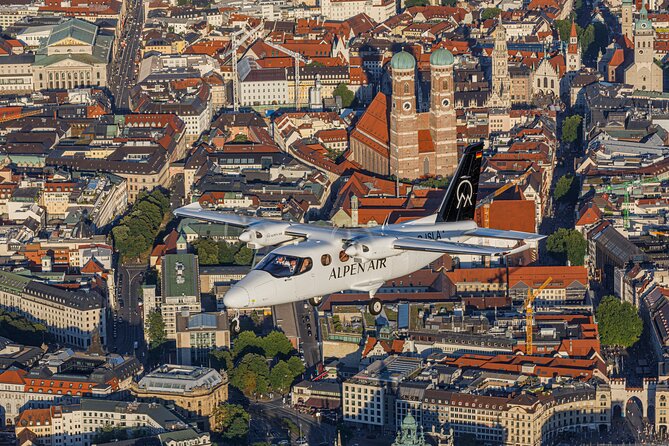
Then the flight glides over major Munich “anchors” that you can’t easily line up from ground level in one day. The English Garden and the German Museum appear as distinct shapes along the water, and Marienplatz plus the Frauenkirche give you the classic historic core view. From above, the Frauenkirche stands out because of its recognizable roof silhouette and the way it sits within a tight urban pattern.
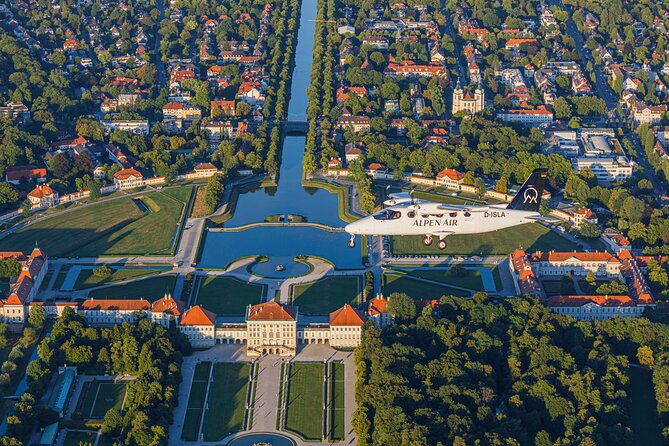
After that, you head toward Nymphenburg Castle, a wide, formal complex that reads instantly as a “royal seat” from the air. The flight also circles the BMW World at slow speed and includes the Olympic Park, with the Olympic Tower highlighted at 291 meters high. That slow circle matters. It turns what could be a quick glance into a real chance to track angles, design details, and the layout of the park.
Why this portion is valuable: if you have limited time in Bavaria, this gives you a Munich overview that makes the rest of your trip make sense. Even if you do not plan to stay in the city long, this is the kind of aerial first impression that helps you connect neighborhoods to landmarks.
What to consider: if you are sensitive to flights, the very start matters psychologically. You go from ground to air quickly. You still get comfort-focused planning (shallow climbs and descents), but it is still an airborne experience.
More runs out to the Ludwig castles:
- From Munich: Neuschwanstein & Linderhof Castle Full-Day Trip
★ 4.6 · 14,646 reviews - Neuschwanstein & Linderhof Castle-Fairytale Day Tour from Munich
★ 4.5 · 7,275 reviews - Neuschwanstein Castle Tour from Munich
★ 4.5 · 5,117 reviews
Chiemsee and Herrenchiemsee: the Bavarian Sea from above
Once Munich is behind you, the flight turns toward Chiemgau and the Chiemsee, often nicknamed the Bavarian Sea. This is where the colors and scale start doing the heavy lifting. From above, lakes stop looking like water features and start looking like their own world, with shorelines that curve like design elements.
The route includes a view of Simssee first, then opens up to the big one, Chiemsee. Then you get a clear view of Herrenchiemsee Castle and the island area of Fraueninsel. The castle on the island is one of those sights that becomes extra impressive from a window because you can see the distance and the surrounding water. It is not the same as seeing it from a boat or from a shoreline vantage point, but from the air you get a crisp sense of its position.
Why this portion is valuable: Chiemsee is one of those places where geography shapes mood. From above, you see why people talk about it like it is a separate vacation world. The islands and peninsulas become easy to map visually, so the whole region feels less random.
What to consider: this part depends on visibility. If you’re in flat light or hazy weather, water color can look muted. That said, clear conditions make it spectacular.
Into the Alps: Kampenwand, Wilder Kaiser, and the northern lake chain
Now you move into the mountain sequence, and the flight does something really satisfying: it links the alpine peaks with a string of lakes. First, you pass the Kampenwand and the Wilder Kaiser. These mountains are landmarks in themselves, but from the air they become shapes you can measure with your eyes. You’ll likely notice how the ridgelines look layered, not just high.
Then you fly almost 150 kilometers along the northern Alps. After the Inn Valley, you pass Wendelstein and continue through a lake chain: Thiersee, Schliersee, Spitzingsee, and Tegernsee. Then the route crosses the Isar and shows you Sylvensteinsee. You also see Brauneck and Benediktenwand, then Kochelsee and Walchensee. In total, you get a pattern of mountains, valleys, water, repeat.
This is where the aerial perspective pays off. Lakes from the air can look like gemstones, but the more practical point is that you see how each lake sits in relation to the slopes. You also see how water color changes with shoreline shape and depth. Even when it is not bright blue, the contrast between forested slopes and water is what makes this section feel “alive.”
Later, the flight again crosses the Isar and returns to Sylvensteinsee, followed by repeated view angles of the Brauneck and Benediktenwand pair, and the Kochelsee and Walchensee combo. That repetition is not accidental. It gives you time to really track the peaks and understand where one lake ends and another begins in the same visual rhythm.
Altitude note you should know: in the Alps, the altitude averages around 2,000 meters, and around the Zugspitze area it can briefly reach about 3,250 meters above sea level. The operator also uses shallow climbs and descents to keep pressure changes as low as possible. If you have concerns related to comfort or health, it is worth contacting the team before booking.
What to consider: mountain sections are the most visually demanding, but they can also be the coldest and most changeable in feel. Dress for quick temperature swings.
Zugspitze, Eibsee, and Plansee: Germany’s top view, minus the lines
The big moment arrives when you see Zugspitze. You will fly past it, and Germany’s highest mountain rises majestically in front of you. Zugspitze is listed at 2,962 meters high in the route description, and the view from above is the kind you remember later because it is hard to match from the ground.
Just after that, the deep blue Eibsee appears from the valley. Eibsee is one of those lakes that looks different depending on light and angle. From the air, it reads as an intense color block against rocky slopes, and you can really see how the coastline folds.
Then the mountain tour ends with the Ammergau Alpine countryside views and a look at Plansee surrounded by mountains. Plansee matters here because it shifts you from “one famous peak” mode into “region mode.” You’re not just chasing a single postcard. You’re seeing how water and mountains interact across a bigger area.
Why this portion is valuable: Zugspitze is a bucket-list destination in Germany, but reaching it and making it fit into a short trip can be tricky. This flight gives you the aerial version of that feeling: big altitude, big scale, and no logistics day lost to transfers.
What to consider: because it is a flight, you are not stopping for viewpoints. You get the view, then you move on.
Neuschwanstein and Lake Forggensee: the fairytale angle from the air
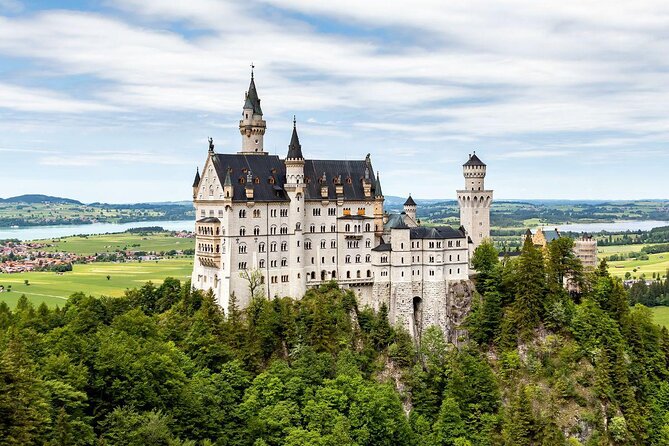
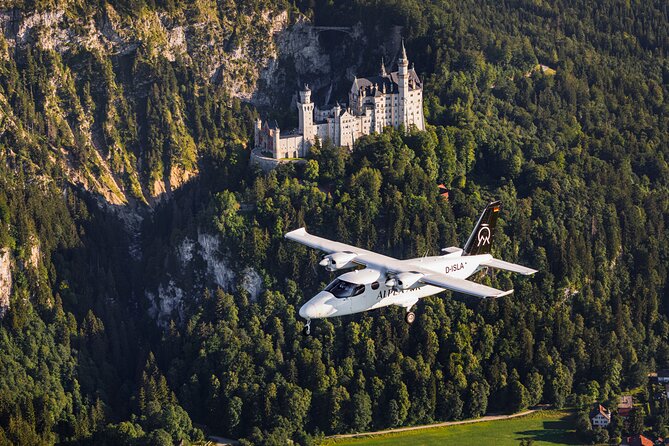
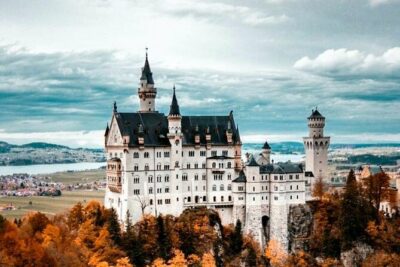
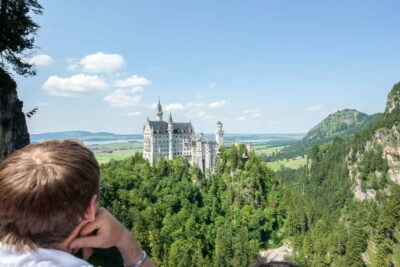
After the Alps, you move into the Neuschwanstein highlight. The castle rises at the foot of the mountains, and the route includes a view of Lake Forggensee. From above, Neuschwanstein can look like it’s staged, because it sits on a dramatic location and the surrounding terrain reads like a scene built to frame it.
What works especially well from the air is the relationship between castle, forested slopes, and the water. Ground views often make it feel like you are looking at architecture. Aerial views make it feel like the castle is part of the landscape system, even though you are not physically walking there.
You also get the benefit of timing. If you have only a day to spend in this region, this flight gives you the “aha” moment without adding a full day of transportation and waiting.
What to consider: if you want to tour inside, this flight is not a substitute. It is the view you get, plus the context of where it sits.
More metres up the Zugspitze:
Five Lakes Region finish: Starnberg, Andechs, and the water colors you cannot fake
Once you leave the mountain zone behind, the flight turns into a lake loop that feels designed for photography. You’ll pass Murnauer Moos, then Lake Staffelsee, and the Riegsee. Next come the Easter lakes, followed by the Five Lakes Region.
This is where you’ll notice water colors shift fast. First you pass Lake Starnberg, and then the flight gives you a strong look at the Rose Island area for its water colors. You also spot Andechs Monastery on the Holy Mountain, with Lake Ammersee in the background. Even if you do not know these places well, you can tell when a town sits higher on a ridge because it reads as a sharper shape, and Andechs helps anchor the view.
The final wave includes Pilsensee and Wörthsee. When you are flying over multiple lakes like this, the most valuable thing is that you see how the region is layered. You’re not just watching one pretty lake, you’re watching a whole system of connected basins.
Why this portion is valuable: after the dramatic Alps, the lakes region feels calmer but no less photogenic. It makes a great “second act” so the flight does not end on one peak and fade out.
Practical comfort detail: on the Munich and Five Lakes Region portion, the route does not exceed 1,500 meters above sea level. That can make the ride feel more manageable compared with the higher mountain segment.
Price, duration, and value: when $767.81 makes sense
The price is listed at $767.81 per person, and the flight time is about 1 hour 45 minutes to 1 hour 50 minutes. It is not a bargain, but it is easier to justify once you think about what you are getting: you are cramming Munich, Chiemsee, large stretches of northern Alps, Zugspitze area, Neuschwanstein, and multiple lakes into one single aerial route.
This is where you should be honest with yourself. If your travel style is about walking ruins, museums, and time on the ground, you might feel like this is too “quick.” But if your travel style is about seeing big geography fast, this kind of flight can be very good value. A car trip can cover parts of this circuit, but it cannot replicate the aerial relationships between peaks, islands, and shorelines.
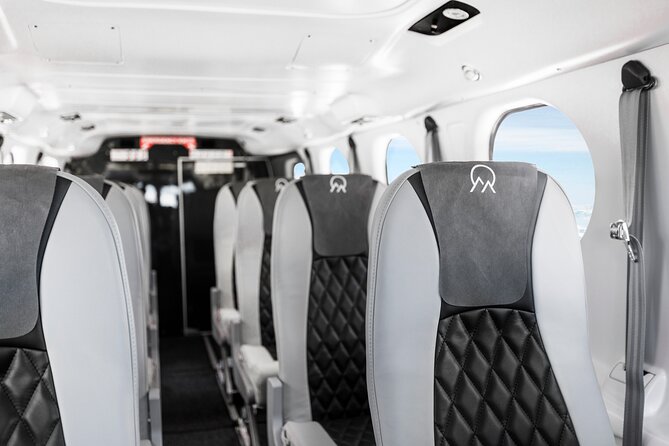
A small group size also changes the vibe. The max is 4 travelers, which typically means you get a less rushed feel and more attention from the pilot-guide style narration. Several details point to a careful approach to safety and professionalism, and you can feel that when someone pilots calmly and also explains what you are seeing.
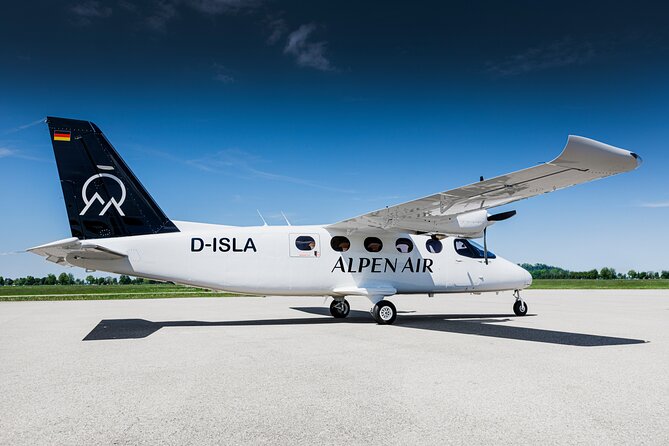
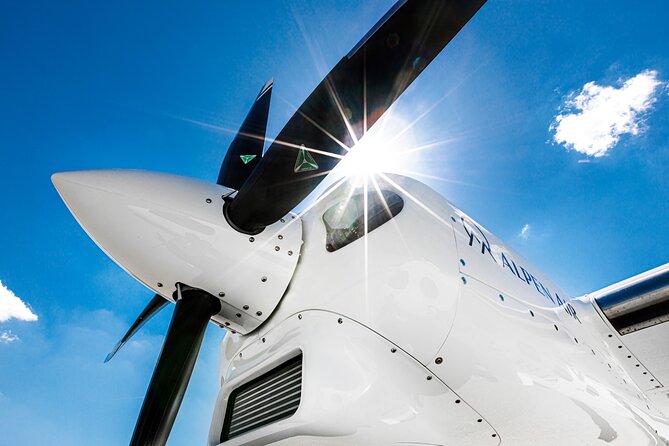
One review also mentions that the Tecnam P2012 is used, and that CO2 compensation is included in the ticket price. Fuel burn and sustainability claims may not matter to everyone, but it is at least a sign the operator thinks about the full picture.
Also consider timing. This flight is commonly booked well ahead, with an average booking window around 73 days in advance. If your dates are fixed, early booking is smart, especially because weather can cause postponements.
Practical tips so you get the best photos and the best mood
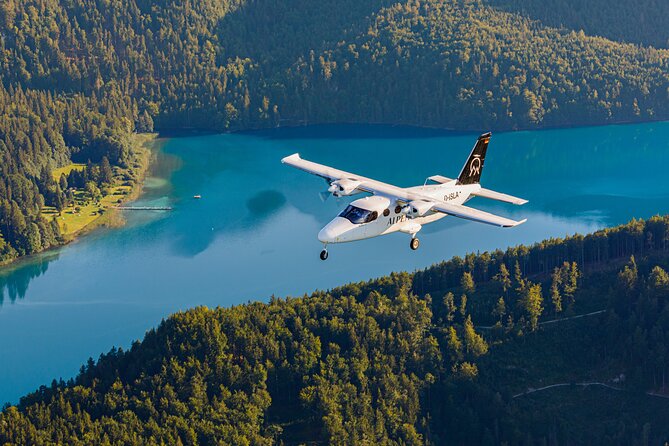
You do not need to overthink it, but a few choices help:
- Treat this like a photo session: plan for extra battery and storage, and wipe the window area if it looks smudged when you board.
- Bring layers. Even if the weather is nice on the ground, the Alps can feel different quickly.
- If you get motion sensitive, tell the team ahead of time. The operator notes that shallow climbs and descents are used to keep pressure changes as low as possible, but personal comfort still varies.
The best tip is to go with curiosity, not checklists. The pilot explanations are part of the experience, and the route is packed. If you listen for what is coming next, landmarks pop into focus.
Who should book this flight, and who might want to skip it
This flight is a great match if:
- you have limited time in Bavaria and want a big-picture overview
- you love mountains and water, and want to see them from the air where shapes and colors make sense
- you are comfortable flying in a small-group setting and want pilot-guided storytelling
It might not be the right match if:
- you want to physically tour castles and walk the grounds, because this is air-only sightseeing
- you have health limitations related to flying comfort, since altitude and pressure can be relevant. The operator asks pregnant travelers or people with physical or mental limitations to contact them before booking, and the pilot makes the final call.
Should you book the Augsburg to Neuschwanstein and Alps sightseeing flight?
If you can swing the price and you are flexible with weather, I think it is an easy yes for the right traveler. This is one of those experiences that turns geography into something you remember with your whole brain, not just as a set of photos. Munich becomes readable, Chiemsee becomes mythic, the Alps feel close up, and Neuschwanstein looks like it belongs in a story.
Before you book, ask yourself one question: do you want views more than checklists? If yes, this flight is a strong choice. If your priority is ground time, museum hours, and walking tours, you may want to pair Bavaria sightseeing on the ground with something else, and keep this flight for when you want to see the region as one interconnected picture.
FAQ
How long is the sightseeing flight?
It runs about 1 hour 45 minutes to 1 hour 50 minutes.
Where does the flight start and end?
It starts at Flughafenstraße, 86169 Augsburg, Germany. It ends back at the same meeting point.
What language is the experience offered in?
The sightseeing flight is offered in English.
What is the maximum group size?
The tour/activity has a maximum of 4 travelers.
Is the flight affected by weather?
Yes. The experience requires good weather. If it is canceled due to poor weather, you will be offered a different date or a full refund.
What altitude can the flight reach?
Over the Munich and Five Lakes Region portion, the flight altitude will not exceed 1,500 meters above sea level. In the Alps it averages around 2,000 meters, and in the Zugspitze area it can briefly reach about 3,250 meters above sea level.
Turrets Against the Hills
- From Munich: Neuschwanstein Castle Full-Day Trip
★ 4.7 · 3,977 reviews - Premium Neuschwanstein Castle and Linderhof VIP Tour from Munich
★ 5.0 · 2,480 reviews - Neuschwanstein Castle and Linderhof Palace Day Trip from Munich
★ 4.5 · 1,756 reviews - From Munich: Premium Neuschwanstein Castle & Linderhof Tour
★ 4.8 · 1,433 reviews
Fresh on the arrivals board for Neuschwanstein
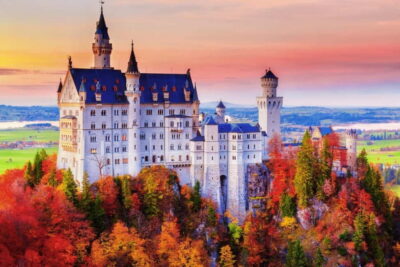
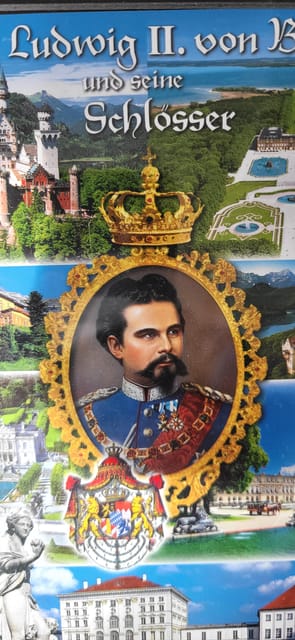
Neuschwanstein Castle Trips, compared.
Neuschwanstein & Linderhof Castle Full-Day Trip
Read our review →
Neuschwanstein & Linderhof Castle-Fairytale Day Tour from Munich
Read our review →
Premium Neuschwanstein Castle and Linderhof VIP Tour from Munich
Read our review →
Neuschwanstein Castle and Linderhof Palace Day Trip from Munich
Read our review →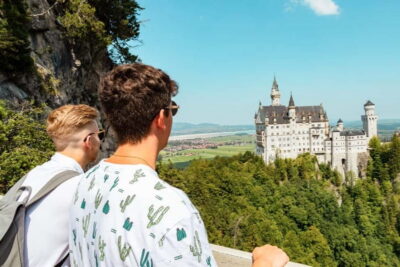
Premium Neuschwanstein Castle & Linderhof Tour
Read our review →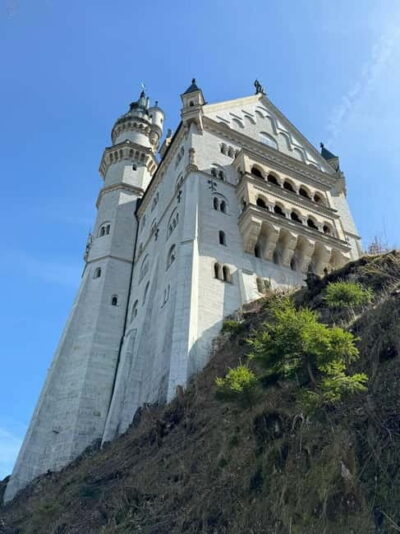
Neuschwanstein Castle Skip-the-Line Ticket with Audio Guide
Read our review →Browse the lists this tour appears in