
Reviewed · SCAVENGER HUNTS & URBAN GAMES
Freiburg im Breisgau: Scavenger Hunt Self-Guided Tour
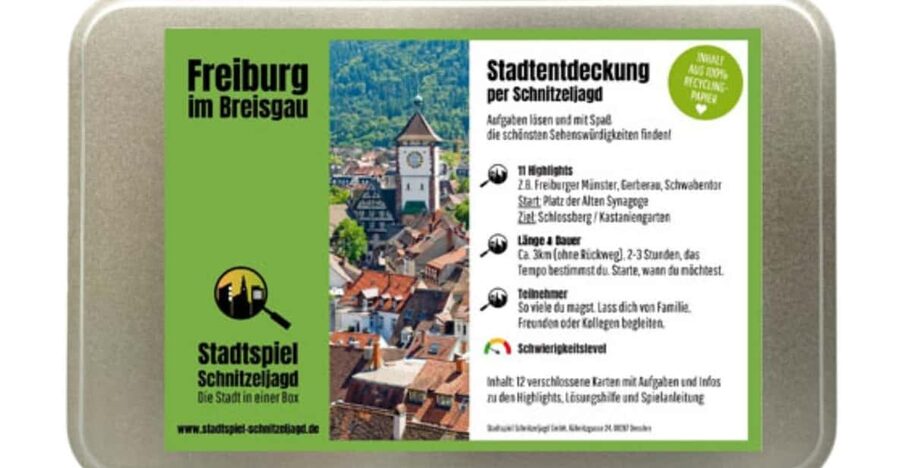
Freiburg turns into a puzzle in your hands. This self-guided scavenger hunt is a smart way to see the big sights of Baden-Württemberg’s cozy university city, without lining up for anything or relying on a live guide. I like that the format is simple, no screen time, and you can move at your own speed.
The best part is how the game nudges you into places you might otherwise zip past. You’ll work through 11 sealed, numbered cards with riddles and short directions, and the route threads together major stops like the Freiburger Münster and the Augustinerplatz area. I also like that it is built for real strolling, not a checklist, with photo breaks and snack stops you can drop into whenever you want.
One thing to consider: this hunt is only available in German, so if you are not comfortable reading German, some tasks may feel harder than they should. It’s still doable if you take your time, but you will want to be realistic about your comfort level with the language.
In This Review
- Key points at a glance
- Why Freiburg Works So Well for a Card-Based Hunt
- Price and Timing That Actually Fit Real Travel Days
- Getting Your Scavenger Hunt Box and Starting at Platz der Alten Synagoge
- How the 11 Sealed Cards Shape Your Walk (No Guide, No Rush)
- Freiburg’s Big Sights You’ll Work Into the Route
- Freiburger Münster: Use the Clues to Look Up
- Augustinerplatz and Schlossplatz: Where the Walk Feels Like City Living
- Schwabentor and the Approach to Schlossberg
- Colombischlössle: A Sight That Feels Quirky in the Best Way
- Historisches Kaufhaus: Make Shopping Streets Feel Like Story Streets
- Photo Breaks and Your Tempo, Not the Clock
- Family-Friendly Fun Without Needing to Be an Expert
- Language Consideration: German-Only Means You Plan Your Comfort Level
- Group Size and What $47 Per Group Really Buys You
- What I’d Do Differently to Make the Hunt Even Better
- Should You Book This Freiburg Scavenger Hunt?
- FAQ
- How long is the Freiburg scavenger hunt?
- What does the price include?
- When will I receive the box?
- Where do I start the hunt?
- Do I need a guide?
- Is the tour available in languages other than German?
- What should I bring?
Key points at a glance
- 11 sealed cards, numbered and ready to open, so you always know what comes next
- Major Freiburg sights in one walk, including Freiburger Münster, Schwabentor, and Schlossberg
- Flexible pacing for families and couples, with photo and café breaks built into the rhythm
- No guide required, so you can pause, wander, and resume on your own schedule
- Emergency card with all solutions, helpful when a clue goes sideways
Why Freiburg Works So Well for a Card-Based Hunt
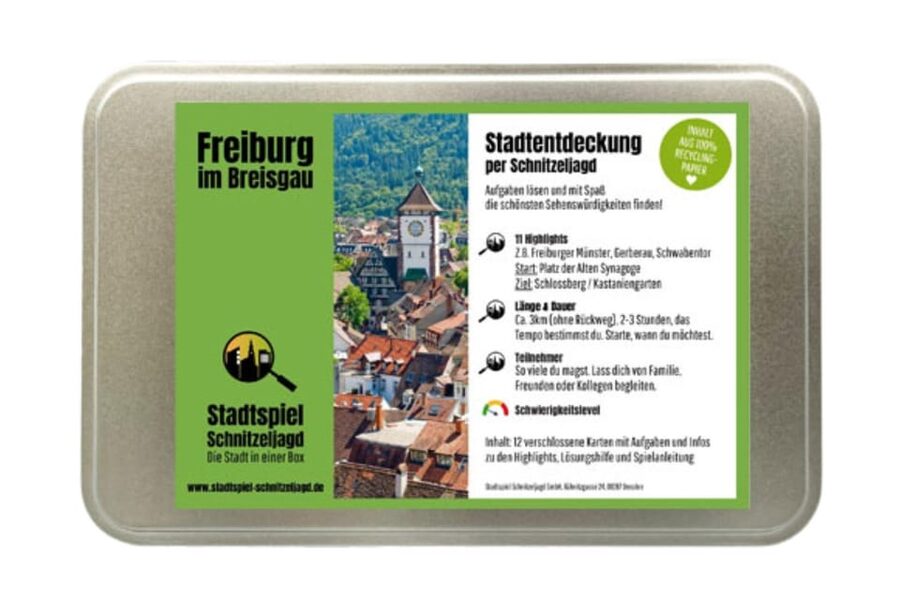
Freiburg im Breisgau has that perfect old-town feel where walking makes sense. Streets stay close together, landmarks are visually strong, and it’s easy to pivot from a tower view to a café without wasting time.
This scavenger hunt leans into that. Instead of forcing you to follow a tight group path, the cards give you direction and mini-missions that keep you paying attention as you go. I love tours like this because you end up learning the city’s layout the way locals do, by moving through it on foot.
Also, the fact that it is self-paced matters in Freiburg. You can linger at a viewpoint, detour for a photo, or stop for coffee when the mood hits. That makes the walk feel like time spent exploring, not time spent completing.
Price and Timing That Actually Fit Real Travel Days
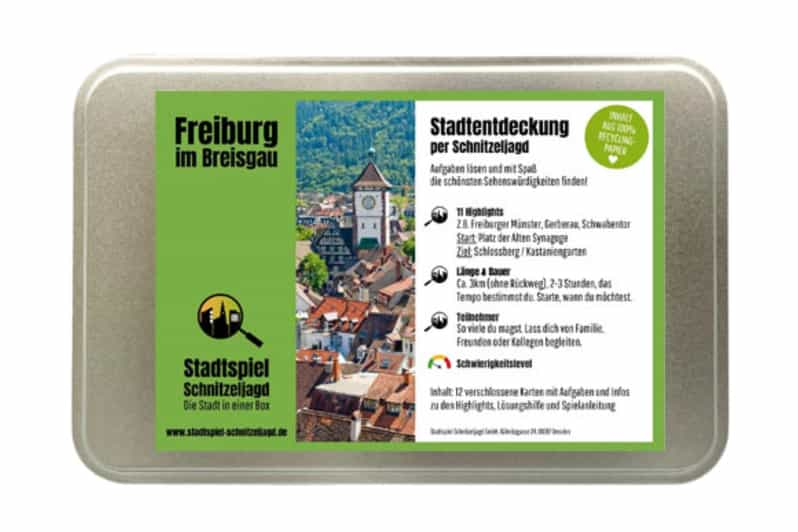
At $47 per group up to 10 and about 3 hours, this is priced like a budget-friendly activity with value for the whole group. Since it’s per group, not per person, it can work well if you are traveling with friends or family and want something everyone can do together.
The time window is also useful. Three hours is long enough to cover meaningful parts of the center, but short enough that you are not tied up for an entire day. If you are the type who likes an active morning and a relaxed afternoon, this fits nicely.
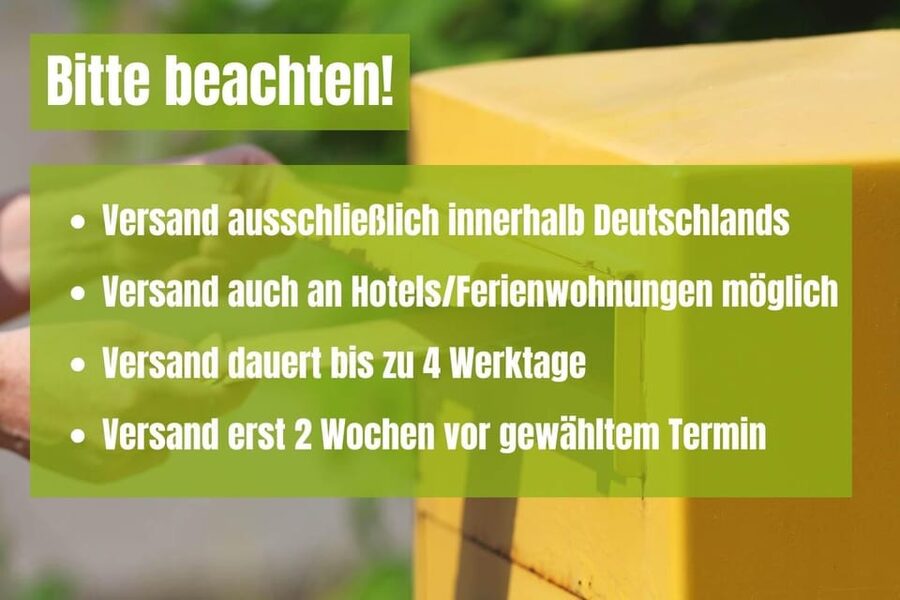
Keep one timing note in mind: the game box arrives by mail, and shipping within Germany can take up to four working days. The provider ships it at the earliest two weeks before your selected date, so plan backwards and don’t wait until the last minute.
Getting Your Scavenger Hunt Box and Starting at Platz der Alten Synagoge
You start the experience once the mailed box arrives at your front door. Then you head out on foot and begin at Platz der Alten Synagoge, opening your first sealed card there.
That start point is clever. It sets the tone for a walk that is not only about pretty buildings, but also about place and memory. Even if you are just using the hunt as a fun structure, you get anchored in the city early, and the rest of the clues can guide you outward through the old center.
Important practical point: you cannot pick up the box in Freiburg, so your plan has to include receiving it at home or where you are staying before you travel. Also, the hunt is only in German, so make sure you are comfortable reading German instructions at a relaxed pace.
What to bring is straightforward: comfortable shoes and the game box. Since it is a walk-based hunt, footwear matters more than anything fancy.
How the 11 Sealed Cards Shape Your Walk (No Guide, No Rush)
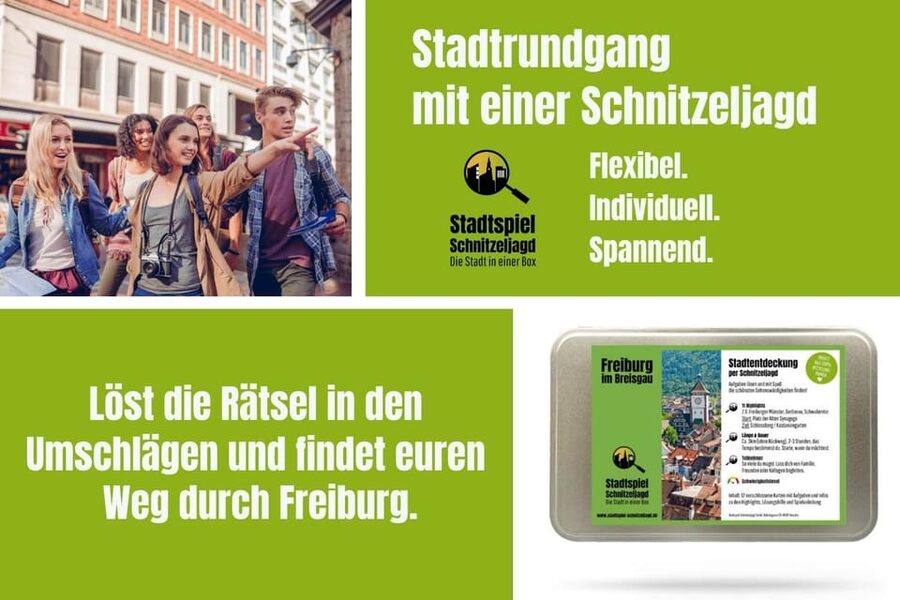
The scavenger hunt uses 11 sealed and numbered cards, each with riddles, directions, information, and small interesting facts. The cards act like a guided walk without a live person, which is a big deal if you hate waiting for check-ins or losing time because a group is moving slowly.
Here is how this format usually feels on the ground:
- You open a card, follow the direction to a sight or area, and complete the mini-task.
- Then you move on to the next location by using the clues in the current card.
- You repeat that rhythm 11 times, with built-in reasons to look up, look close, and notice details.
Because each card is sealed, you are not tempted to jump ahead and ruin the puzzle. And because it is self-guided, you can pause for photos or a drink without feeling like you are holding anyone back.
There is also an emergency card with all solutions. That’s not something you hope to use, but it is a safety net when a clue feels ambiguous or you miss a detail. It makes the hunt feel forgiving, not frustrating.
And yes, it is no screen time. You get that old-school feel of exploring while reading simple prompts, rather than staring at a phone the whole walk.
Freiburg’s Big Sights You’ll Work Into the Route
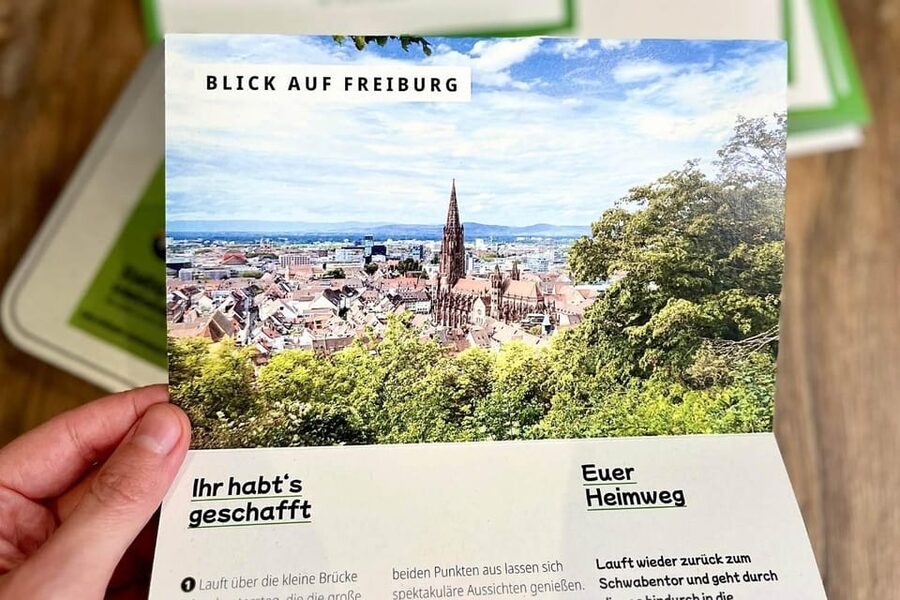
The hunt weaves through classic Freiburg sights, including the Freiburger Münster, Augustinerplatz, Schlossplatz, Schwabentor, Schlossberg, Colombischlössle, and the Historisches Kaufhaus. You will see these as part of the clue path, not as isolated photo stops.
That matters, because the hunt turns landmarks into checkpoints with reasons to slow down. You are not just arriving, snapping a shot, and moving on. Instead, you have a task that makes you notice architectural cues and city geometry.
Below, I’ll break down what each of these places adds to your walk, and what you should pay attention to.
Freiburger Münster: Use the Clues to Look Up
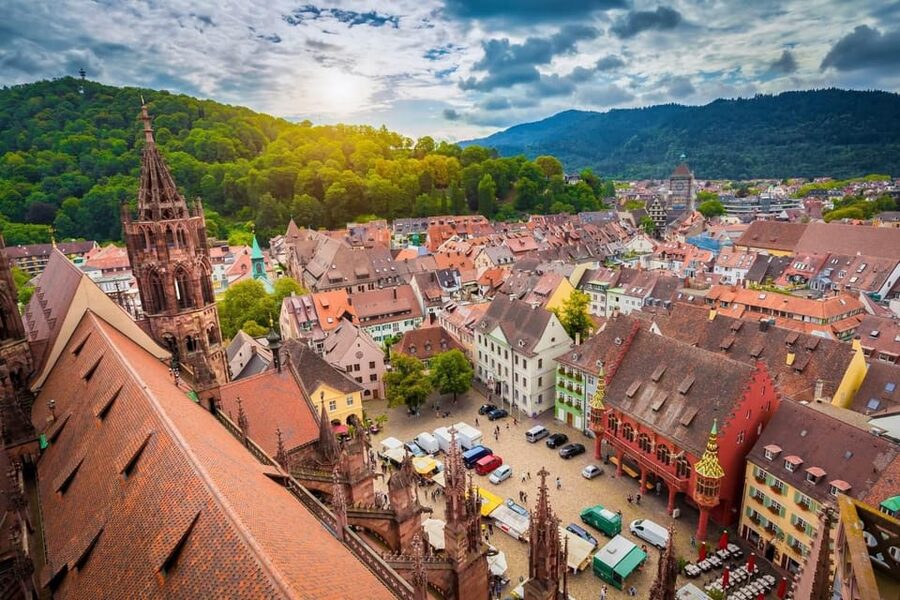
The Freiburger Münster is the kind of landmark that dominates the skyline, and it deserves more than a quick glance. When it shows up in your card sequence, think of it as your main “orientation moment,” where you get your bearings for the rest of the old town.
Since the cards include small information and facts, you are likely to get prompts that push you to notice details people often miss. Even if you are not fluent in German, the visual cues around the Münster give you enough to connect what you read with what you see.
A practical tip: budget a few minutes to just stand and study the front and surroundings. Freiburg’s charm comes from how quickly you can go from open views to narrow streets, and the Münster area is where that becomes obvious.
Potential drawback: because this is a major sight, you may be sharing space with other visitors. That is not a problem, but it is one reason the self-paced format helps. You can wait out a crowd, then return to the task calmly.
Augustinerplatz and Schlossplatz: Where the Walk Feels Like City Living
The Augustinerplatz and Schlossplatz areas are the heart-beat of the walk. These are places where Freiburg feels lived in, not staged. In a traditional tour, you might rush through to “get the highlights.” In a hunt, you slow down naturally because you are completing tasks between sights.
This part of the route is also where café breaks make sense. The hunt structure gives you reasons to stop, and you don’t have to time it around a guide. If you want a coffee, pastry, or a simple rest, this is the region where you can do it without turning the day into a logistics puzzle.
What to watch for here: subtle city details. Look at how streets funnel toward the squares, notice how people use the space, and pay attention to the transition from grand landmark zones to more human-scaled corners.
If you are traveling with kids, this is often the sweet spot. The tasks keep energy up, while the open squares give everyone room to breathe and reset.
Schwabentor and the Approach to Schlossberg
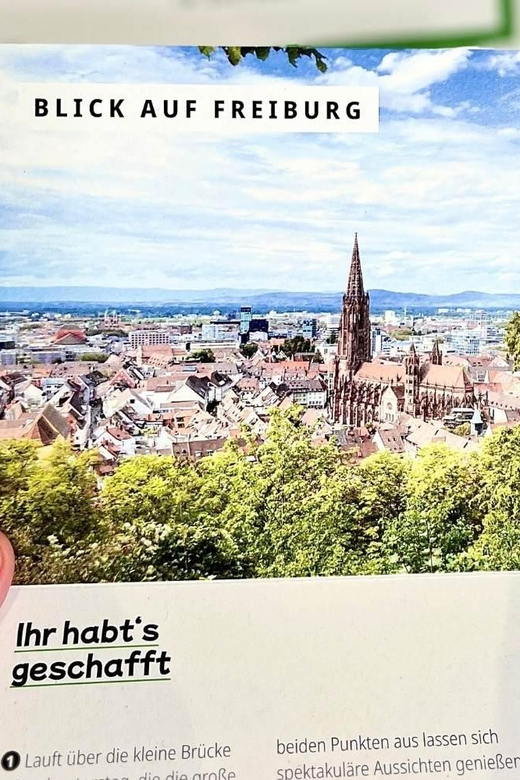
You’ll also come across Schwabentor. This is a gate and tower type landmark that helps you understand the city’s older boundaries and defensive past. When a clue points you toward a place like this, it’s a good moment to ask, what role did this spot play in shaping how the city grew?
Then you get the Schlossberg connection. Schlossberg is the name you want to remember, because it signals higher ground and wide viewpoints. Even if your card tasks focus on specific details, Schlossberg gives you the chance to look out over Freiburg and make sense of the geometry of the center.
Practical advice for the Schlossberg stretch: wear shoes with decent grip. The city center is walkable, but any climb or uneven ground can add up over a 3-hour outing.
If the weather turns less cooperative, this section can still work because the hunt is modular. You can move more carefully, take a bit longer at a viewpoint you can access, and still finish the final cards without turning your walk into an endurance event.
Colombischlössle: A Sight That Feels Quirky in the Best Way
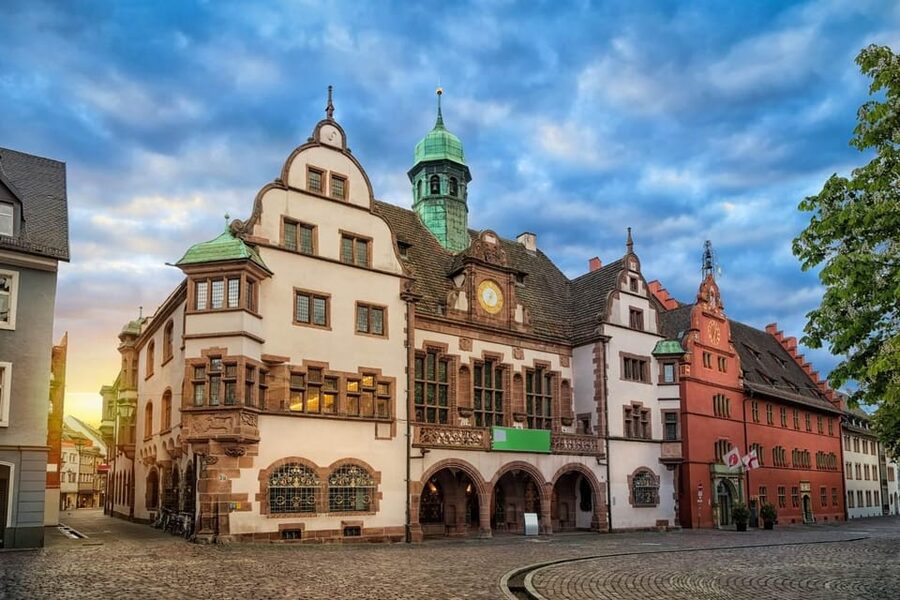
The Colombischlössle shows up as part of the clue path, which is great because it’s the sort of spot that can be overlooked if you are only chasing the most obvious landmarks. In a hunt, you tend to get there because a card tells you to, not because you saw it on a map first.
When you encounter something like this, treat it as a “detail stop.” Pause long enough to notice what makes it distinct in its setting. Even if the task is short, the view and setting are what make it memorable.
One more point I like about including places like Colombischlössle: it breaks up the walk between bigger, more crowded anchor landmarks. You get variety, and that keeps the mood fresh halfway through.
Historisches Kaufhaus: Make Shopping Streets Feel Like Story Streets
The Historisches Kaufhaus is a strong reminder that old towns are not just museums. It’s tied to commerce and everyday life, and that makes it more than a backdrop.
Because this hunt includes information and interesting facts inside the cards, the stop can help you connect what you see with why it matters. Even if you are in German-language mode, the setting itself does a lot of the teaching, because you can match what you read to the building’s presence in the street.
Practical tip: if you see entrances, courtyards, or spots where the building opens up visually, take a moment. The clue-based format usually expects you to look, not just pass by.
Photo Breaks and Your Tempo, Not the Clock
A key benefit of this hunt is the way it supports breaks. The format is designed for you to stop for photos and sightseeing and then resume when you want. That means you can build in a short reset without feeling like you are derailing a schedule.
I’d treat the hunt like a slow-motion city walk. If you rush, you might miss the fun. If you go at a comfortable pace, you end up with a route that feels personal.
This is also why it works for mixed groups. One person might want to linger by the Münster, while another can speed through the clue and then catch up later at a square or café.
Family-Friendly Fun Without Needing to Be an Expert
The feedback around the hunt highlights how well it can land for a family mix. One of the clearest points is that it works for children while still holding adults’ interest. That’s hard to do, but the card structure helps, because it keeps tasks short and visible, like mini quests instead of lectures.
If you are visiting with an 11-year-old or similar age, plan on reading parts of the cards aloud or taking turns. The language requirement is the main factor here, so set yourselves up for success by approaching the German text at a pace that matches your group.
The upside is that you are not handing kids a screen. You are handing them a mission and letting Freiburg do the entertaining.
Language Consideration: German-Only Means You Plan Your Comfort Level
This activity is only in German. That is not a small detail, because the scavenger hunt cards include riddles and directions, plus information and facts.
My practical advice is simple: if German is comfortable for you, this will feel smooth. If it is not, make sure you are okay with a slower pace. Use the sights themselves as your guide, and rely on the emergency card if you hit a snag.
Because you can go at your own pace, language doesn’t have to shut you down. It just affects how quickly you can move from card to card.
Group Size and What $47 Per Group Really Buys You
The price is $47 per group up to 10. For a self-guided activity, that can be a great value because you are essentially paying for the hunt design plus the shipped box.
There’s also a group rule that helps you avoid surprise issues: choose one scavenger box per ten people in your group. If you have more than 10 people, plan to select multiple boxes so everyone can work through the clues comfortably.
Think of it like this: you are paying for an experience that gives you structure. You still get the freedom to walk and explore, but you also get an easy way to turn a random stroll into a satisfying route.
If you compare this with guided tours that cost per person, the per-group pricing can be the difference between doing something fun one evening and skipping it to save money.
What I’d Do Differently to Make the Hunt Even Better
Because this is self-guided, your choices shape the experience. A few small tweaks can make it smoother:
- Start with comfortable shoes, because 3 hours on foot is real time.
- Bring a plan for the language barrier, either by assigning a reader or taking longer at each card.
- Build in a café stop during the central squares portion, where the route naturally supports it.
And remember: the emergency card is there. If you get stuck, use it without guilt. The point is to enjoy Freiburg, not to turn the hunt into a battle of wills.
Should You Book This Freiburg Scavenger Hunt?
Book it if you want a lightly structured, fun way to see Freiburg’s major sights, especially if you like walking and you prefer independent travel. It’s a strong option for couples, small groups, and families who want an experience that doesn’t require keeping up with a guide.
I would skip it or rethink it if German is a real challenge for your group. Since the whole hunt is in German, you may spend more time translating than exploring, unless you are comfortable reading at least basic directions and riddles.
If you are looking for a 3-hour activity that turns sightseeing into something interactive, this is a smart value play. You get a clear route, memorable landmarks like the Freiburger Münster, and the freedom to stop and enjoy the city on your own terms.
FAQ
How long is the Freiburg scavenger hunt?
The experience lasts about 3 hours, and starting times depend on availability.
What does the price include?
Your purchase includes the scavenger hunt box shipped to you, plus 11 sealed numbered cards with riddles, directions, information, and interesting facts, and an emergency card with all solutions.
When will I receive the box?
Shipping within Germany can take up to four working days. The box is shipped at the earliest two weeks before your selected date.
Where do I start the hunt?
You begin at Platz der Alten Synagoge and open the first card there.
Do I need a guide?
No. This is a self-guided activity, and there is no guide included.
Is the tour available in languages other than German?
No, this scavenger hunt is only available in German.
What should I bring?
Bring comfortable shoes and the game box.
More Self-Guided Tours in Marburg
- Dortmund: BVB Self-Guided Stadium Walk
★ 4.5 · 3,195 reviews - Neuschwanstein Castle Skip-the-Line Ticket with Audio Guide
★ 4.4 · 1,388 reviews - Berlin: Solar Powered Sunset Catamaran Cruise & Audio Guide
★ 4.6 · 1,043 reviews - Füssen: Neuschwanstein Castle Express Ticket and Audio Guide
★ 3.9 · 788 reviews
City Puzzles on Foot
- Hamburg: Treasure Hunt Game through HafenCity
★ 4.7 · 364 reviews - Hamburg: Scavenger Hunt Self-Guided Tour for Children
★ 4.5 · 319 reviews - Treasure Hunt through Hamburg’s Hafencity
★ 5.0 · 234 reviews - Escape Room Adventure in Berlin Solve the Mystery
★ 5.0 · 222 reviews
Scavenger Hunts & Urban Games, compared.

Escape Room Adventure in Berlin Solve the Mystery
Read our review →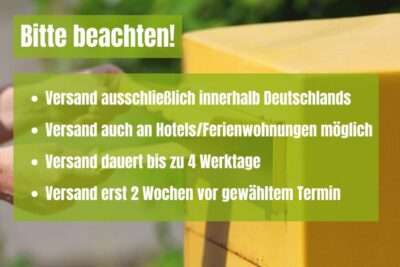
Self-Guided Family and School Class Scavenger Hunt
Read our review →
Escaping and spying on the Berlin Wall Scavenger hunt
Read our review →Browse the lists this tour appears in